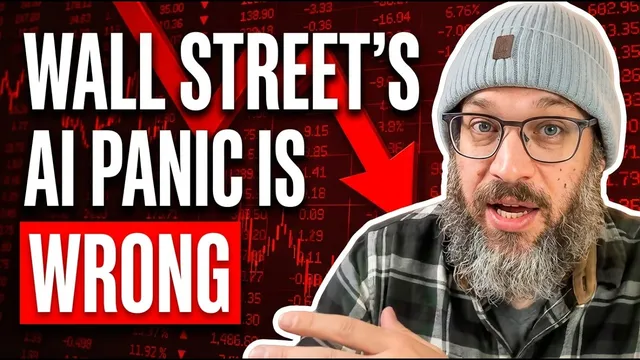
Why the Biggest AI Career Opportunity Just Appeared—and Almost Nobody Sees It.
Based on AI News & Strategy Daily | Nate B Jones's video on YouTube. If you like this content, support the original creators by watching, liking and subscribing to their content.
AI-related press releases are triggering rapid, cross-sector selloffs that the transcript frames as a “sell first, analyze later” reflex rather than precise technological repricing.
Briefing
A $6 million karaoke-to-logistics company triggered a broad stock-market selloff after an AI-related press release—yet the bigger story isn’t the absurd trigger. The repeated pattern across eight sectors shows Wall Street is treating AI headlines like immediate, sector-wide proof of disruption, selling first and analyzing later. That reflex is now reshaping corporate decisions—hiring, roadmaps, and budgets—often before real AI capability arrives, creating damage that can outlast any market rebound.
The sequence begins with Palantir’s earnings on February 2, where strong growth and guidance tied to compressing SAP enterprise migrations into “as little as 2 weeks” helped push the stock higher. Within days, Anthropic released new AI “co-work” plugins for legal work—contract review, compliance workflows, and legal summaries. In the following 48 hours, roughly $285 billion in market value vanished from legal-tech, data-analytics, and SAS-related stocks, a drop dubbed the “SAS apocalypse.” The contagion then spread beyond software: private credit and alternative asset managers fell on fears that AI could analyze deals and manage portfolios; insurance brokers dropped after Insurify launched an AI rate-comparison tool; wealth management slid after Altruist rolled out an AI tax-planning product; commercial real estate services fell after CBRE and Jones Lang LaSalle were hit by AI headwinds; office REITs bled on the idea that AI reduces headcount and office demand; and logistics was hit when Algorithm Holdings—formerly the Singing Machine Company—claimed its logistics platform could scale freight volumes by 3 to 400% without adding headcount.
The transcript argues this isn’t efficient repricing of genuine technological change. Instead, it’s a “reflexivity” loop: stock drops driven by AI fear force companies into defensive postures—cost cuts, hiring freezes, and “performative” AI partnerships—because investors demand visible action. Even if the underlying technology is years away from replacing core operations, the market reaction can still create real organizational consequences. The result is a self-fulfilling prophecy: companies become more vulnerable to actual disruption because they redirect resources toward optics rather than domain-specific implementation.
To explain why the market is getting it wrong, the transcript divides AI exposure into three categories. First are sectors where AI is displacing labor today—especially software development—where AI coding tools like Cursor and claims about token-based developer workflows challenge per-seat, human-dependent business models. Second are sectors where AI matters on a 3–5 year horizon but panic overstates near-term risk, such as wealth management and insurance brokerage, where relationship, trust, negotiation, and claims handling remain central. Third are areas where the market has “lost the plot,” where AI headlines don’t invalidate entrenched advantages like logistics networks, proprietary data, and cross-border operational complexity.
The practical takeaway is that the scare trade is simultaneously creating mispricing and opportunity. Public SAS valuations are falling while private AI valuations keep rising, fueled by investor FOMO and the tendency to reward “AI” branding. For workers, the transcript frames job risk as tied to organizational responses rather than immediate AI capability: roles that look like cost centers or process automation are more exposed, while people who can translate domain expertise into real AI workflow testing gain leverage. The central claim: the market’s panic is speeding up AI transformation—sometimes by years—yet the winners will be those investing in genuine, domain-specific capability rather than chasing headlines.
Cornell Notes
The transcript describes an “AI scare trade” in which AI-related press releases trigger rapid selloffs across multiple industries, even when the underlying technology is not yet capable of immediate replacement. The pattern is portrayed as a reflexive loop: falling stock prices push companies into defensive actions—hiring freezes, roadmap pivots, and AI partnerships aimed at investor optics—creating real organizational harm that can outlast the market’s mood. It argues that markets are mispricing AI exposure because they treat very different risk categories as identical. The speaker divides exposure into (1) labor-displacing AI today (notably some software models), (2) longer-horizon change where panic overstates near-term disruption (wealth management, insurance), and (3) cases where the market’s chosen “disruptor” is implausible (e.g., logistics and commercial real estate). The implication: investors and workers should focus on domain-specific AI capability rather than headline-driven narratives.
Why does a small company’s AI press release lead to large, sector-wide stock declines?
What is the “reflexivity” mechanism, and how does it turn market fear into real corporate decisions?
How does the transcript distinguish between different kinds of AI exposure?
Why does the transcript argue per-seat SAS models face special pressure?
What does the transcript say about career risk and career opportunity during the scare trade?
What practical question should employees ask about their company’s AI transformation spending?
Review Questions
- How does the transcript connect stock-market reactions to downstream changes in hiring, roadmaps, and budgets?
- Which of the three AI exposure categories does wealth management fall into, and why does the transcript argue near-term panic is overstated?
- What specific capabilities does the transcript say are most valuable for career growth during the scare trade?
Key Points
- 1
AI-related press releases are triggering rapid, cross-sector selloffs that the transcript frames as a “sell first, analyze later” reflex rather than precise technological repricing.
- 2
Stock drops can force immediate defensive corporate actions—hiring freezes, roadmap pivots, and cost cuts—creating real organizational consequences even when AI disruption is not imminent.
- 3
The transcript argues markets misprice AI risk by treating different exposure types identically; it separates labor-displacing AI today, longer-horizon change, and implausible disruption narratives.
- 4
Per-seat SAS models face particular pressure when AI reduces the human bottleneck in software development, though the transcript says software won’t vanish overnight.
- 5
Wealth management and insurance brokerage are presented as examples where relationship and negotiation limit near-term automation, making panic overstate disruption timing.
- 6
For workers, job risk is tied to how leadership reallocates resources under investor pressure; roles that look like automatable process work are more exposed.
- 7
Career upside goes to domain experts who can test and implement AI in real workflows with measurable outcomes, bridging vendor claims and business reality.