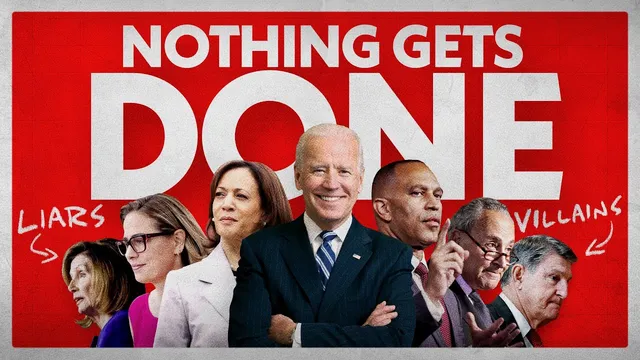
Why The Democrats Never Get Anything Done
Based on Second Thought's video on YouTube. If you like this content, support the original creators by watching, liking and subscribing to their content.
The transcript argues that unmet Democratic promises persist because obstructionism is incentivized and structurally useful, not because of one-off bad luck or simple Senate arithmetic.
Briefing
Democrats repeatedly fail to deliver on major promises not because of simple vote-count math, but because party power is structured to block majority rule and protect corporate-aligned interests—making “obstructionists” inside the party a functional feature, not an accident. In election-year terms, that means voters hear familiar pledges from the Biden campaign (“this time will be different”), while the underlying incentives that dilute or kill progressive legislation remain in place.
For roughly two years after Democrats won the presidency and both chambers in 2021, the expectation was that progressive priorities would move quickly. Instead came watered-down proposals, delayed outcomes, and policy reversals that left many campaign promises unmet—whether on a $15 minimum wage, federal abortion protections, or student debt cancellation. When bills stalled, the standard explanation was institutional: a narrow House margin and a Senate tie with a few members who supposedly align more with Republicans. That framing, however, doesn’t account for why the same pattern keeps recurring—progressive proposals die, then reappear under new names with major concessions.
The transcript traces the recurring “rotating villain” dynamic to two overlapping mechanisms. First is lobbying and campaign finance. Examples include Joe Lieberman’s pivotal role in removing a public option from the Affordable Care Act after Democrats had the votes, and later efforts to block or weaken measures that would have curtailed corporate influence. The same pattern is tied to other centrist or conservative Democrats, such as Joe Manchin—described as consistently pro-fossil-fuel and repeatedly obstructing bills that would reduce reliance on oil and gas. The argument extends to more subtle incentives: the revolving door, where lawmakers can cash out after leaving office by taking lucrative lobbying or corporate-linked roles. It also points to “No Labels,” a nonprofit framed as a centrist spoiler operation, with reported funding from prominent Republican-aligned donors.
Second, the transcript argues that lobbying alone doesn’t fully explain why Democrats would preserve obstructionism. The deeper driver is the American political-economic system and the way gridlock reshapes power. Drawing on Sheldon Wolin’s concept of “managed democracy,” it claims that near-paralysis in Congress doesn’t merely stop government—it prevents majority rule and keeps political influence concentrated among a small number of seats that can be purchased and leveraged by money. Under this view, Democrats must maintain legitimacy with progressive rhetoric while ensuring they can govern only in ways that don’t seriously threaten corporate backers.
That produces a predictable political strategy: let a few party members take the heat for blocking popular policies, while party leadership and aligned super PACs invest in centrist candidates who are likely to vote against the party’s agenda. The transcript cites internal Democratic efforts against progressive incumbents and describes leadership spending that supports centrist groups working to undermine parts of the Biden agenda, including drug pricing and financial regulation. It also highlights high-profile primary contests—like New York’s Jamal Bowman vs. George Latimer—where major outside spending and endorsements favor a centrist track.
The bottom line is blunt: the Democrats, as an institution, are portrayed as structurally unable—or unwilling—to deliver radical change. Real change, the transcript concludes, depends on organized mass politics rather than a party apparatus designed to keep popular majorities from translating votes into transformative power.
Cornell Notes
The transcript argues that Democrats’ repeated failure to deliver on progressive promises stems less from narrow majorities and more from a system that limits majority rule and protects corporate-aligned interests. “Rotating villains” inside the party—centrists or conservative Democrats who flip key votes—are presented as a recurring mechanism that dilutes policies while preserving party legitimacy. Lobbying, campaign donations, and the revolving door are cited as direct incentives, but the deeper explanation is “managed democracy,” where gridlock and institutional design concentrate power in the hands of a small number of seats and moneyed actors. Party leadership is portrayed as investing in centrist candidates and sidelining progressives so that elections can be won with progressive rhetoric while governance stays constrained. The result is a cycle of mobilization before elections and demobilization afterward.
Why does the transcript say “vote math” doesn’t fully explain stalled Democratic priorities?
How are lobbying and the revolving door used to explain obstructionism by Democrats?
What role does “No Labels” play in the argument?
What is the transcript’s deeper explanation beyond money and constituency?
How does the transcript connect party leadership to the “rotating villain” strategy?
What does the transcript conclude about where radical change comes from?
Review Questions
- Which mechanisms does the transcript treat as primary drivers of obstructionism: institutional vote counts, campaign finance, revolving-door incentives, or gridlock’s effect on majority rule?
- How does the transcript use Lieberman’s role in the ACA public option debate to support its broader claim about “rotating villains”?
- According to the “managed democracy” framing, why might gridlock be politically useful rather than merely dysfunctional?
Key Points
- 1
The transcript argues that unmet Democratic promises persist because obstructionism is incentivized and structurally useful, not because of one-off bad luck or simple Senate arithmetic.
- 2
Lobbying and campaign finance are presented as direct influences on key votes, with Lieberman’s public-option reversal during the ACA process used as a central example.
- 3
The revolving door is framed as an additional incentive: lawmakers may face electoral risk from party dissent but can still benefit financially by moving into lobbying or corporate-linked roles after leaving office.
- 4
The transcript’s core theory is that gridlock and institutional design prevent majority rule, concentrating power in a small number of seats that money can influence.
- 5
“Rotating villain” dynamics are portrayed as a strategy that lets party leadership preserve legitimacy while a few members absorb blame for blocking progressive legislation.
- 6
Party leadership and super PAC activity are described as backing centrist candidates and undermining progressive challengers, including in high-spending primaries like New York’s Bowman vs. Latimer.
- 7
The transcript concludes that radical change requires organized mass politics rather than expecting transformative outcomes from the Democratic Party apparatus.