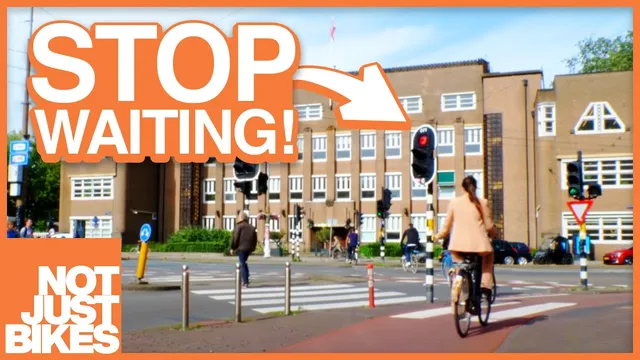
Why the Dutch Wait Less at Traffic Lights
Based on Not Just Bikes's video on YouTube. If you like this content, support the original creators by watching, liking and subscribing to their content.
Dutch intersections often use traffic-dependent detectors that sense approaching users, not just vehicles stopped at the stop line.
Briefing
Dutch traffic lights cut waiting time by treating intersections as systems for moving people—not just cars—and by using real-time detection to coordinate movements while minimizing conflict. Instead of giving every direction a fixed, one-size-fits-all phase, many Dutch signals adapt based on what’s approaching and what’s already cleared, allowing certain users to go when it’s safe and efficient.
A key difference is priority. Dutch traffic engineering sets two goals at intersections: first, reduce conflicts so road users don’t cross paths unexpectedly; second, optimize throughput for as many people as possible, not merely maximize the number of vehicles. That philosophy shows up in how signals are triggered. Dutch intersections often use traffic-dependent detectors—loops and sensors that detect stopped vehicles and also approaching cyclists and cars—so controllers can shorten or extend phases based on actual demand. One example described daily by the narrator: bicycle detection occurs not only at the light but several meters upstream. When cyclists are approaching and the intersection can clear, the system turns cars red and speeds up the bicycle countdown so riders can pass without stopping.
The Dutch approach also allows signals to operate more independently when movements won’t interfere. Rather than forcing everyone to wait for a single direction’s full cycle, the system can grant green time to one group while another direction remains restricted. In the cited intersection, bicycle signals can be green in both directions when no cars are detected going straight, enabling a left-turning cyclist to proceed without stopping. On larger intersections, pedestrians may receive partial crossing phases—green for part of the route—so they begin walking earlier instead of waiting for the entire intersection to clear.
Safety design is woven into these timing choices. The transcript highlights leading pedestrian signals, where pedestrians get a head start before cars and bikes move. It also points to the absence of “right turns on red” for cars in the Netherlands, contrasting it with U.S. findings that allowing right turns on red increases pedestrian and cyclist crashes by 69%. Dutch rules tightly control when right turns occur, keeping turning paths clear and enabling more complex signal combinations.
Transit priority is another major lever. Dutch systems frequently give trams and buses priority so they don’t get trapped at red lights, reflecting the idea that transit vehicles carry many passengers and deserve consistent movement. By contrast, the transcript criticizes North American transit signal priority as rare and often blocked by concerns about disrupting other streets—an engineering rationale framed as protecting car flow over everyone else.
The overall takeaway is that the technology for adaptive, conflict-minimizing, multi-modal control exists elsewhere, including in places like Toronto. What differs is how cities choose to use it: Dutch intersections are programmed to serve pedestrians, cyclists, and transit as legitimate traffic participants. The result is fewer unnecessary waits, shorter crossing times, and fewer conflict points—making intersections feel more responsive and safer for people outside cars.
Cornell Notes
Dutch traffic lights reduce waiting by coordinating movements for multiple road users using real-time detection and conflict-minimizing signal design. Instead of fixed phases that treat all directions the same, many Dutch intersections use sensors to detect approaching cyclists and cars and then adjust signal timing—sometimes speeding up countdowns or granting greens only when safe. The system also prioritizes pedestrians and cyclists with features like leading pedestrian signals and controlled turning rules (including no right turns on red). Transit vehicles like trams and buses often receive priority as well, helping keep public transport moving. The practical impact is more efficient intersection throughput for people, not just cars, alongside fewer crossing conflicts and safer behavior for those walking and cycling.
How do Dutch traffic lights decide when to change signals instead of relying on fixed timing?
What does “minimize conflict” mean in signal timing, and how does it affect who gets to move when?
Why does the Netherlands avoid “right turns on red,” and what evidence is cited?
How do leading pedestrian signals change crossing safety and timing?
What role does transit signal priority play, and why does the transcript say it’s handled differently in the Netherlands?
What’s the core complaint about some North American pedestrian button systems compared with Dutch behavior?
Review Questions
- What specific detection features (location and purpose) allow Dutch signals to shorten waits for cyclists?
- How do leading pedestrian signals and the absence of right turns on red work together to reduce conflict at intersections?
- Why does transit signal priority matter for intersection efficiency, and what limitation is described for using it in North America?
Key Points
- 1
Dutch intersections often use traffic-dependent detectors that sense approaching users, not just vehicles stopped at the stop line.
- 2
Signal timing in the Netherlands prioritizes minimizing conflict between road users before optimizing throughput.
- 3
Many Dutch lights allow independent or overlapping green phases when movements won’t interfere, reducing unnecessary full-cycle waits.
- 4
Safety rules like no right turns on red reduce unexpected turning conflicts with pedestrians and cyclists.
- 5
Leading pedestrian signals give pedestrians a head start, improving safety and reducing collisions.
- 6
Transit vehicles frequently receive priority in the Netherlands, helping public transport move reliably through intersections.
- 7
Adaptive control technology exists in other countries too, but it’s often used primarily to keep car traffic flowing rather than to optimize for all modes.