Why The First Computers Were Made Out Of Light Bulbs
Based on Veritasium's video on YouTube. If you like this content, support the original creators by watching, liking and subscribing to their content.
Edison’s observation of one-sided bulb discoloration revealed that hot filaments emit electrons and that DC voltage directs where they land.
Briefing
The first digital computers didn’t start with silicon—they started with light bulbs, because the physics of hot filaments quietly delivered the two ingredients computing needed: controllable electron flow and fast switching. Early bulbs used a carbon filament inside a vacuum. When voltage heated the filament above 2000 Kelvin, it glowed and emitted electrons through thermionic emission. Thomas Edison noticed a practical clue: the glass discolored only on one side over a bulb’s lifetime. That asymmetry traced back to DC power—electrons were pulled toward the positive side, accelerated across the gap, and gradually bombarded the glass there.
That one-sided “Edison effect” became the basis for vacuum-tube electronics. In 1904, John Ambrose Fleming patented a diode-like device: a heated filament plus a second electrode. Making the plate positive relative to the filament let electrons cross and complete the circuit; making it slightly negative blocked current. Fleming’s thermionic diode acted like a one-way street for electricity and could rectify alternating current into a pulsier direct current. Engineers then improved the geometry by placing the filament at the center and surrounding it with a cylindrical anode, capturing more emitted electrons and enabling larger currents. By combining multiple diodes with capacitors, designers produced steadier DC—an early, practical vacuum-tube technology that set the pattern for the vacuum tubes dominating electronics for decades.
The next leap was amplification, crucial for long-distance radio and clearer telephone signals. Relay-based amplification worked for telegraphy but struggled with analog signals because relays output binary on/off behavior and rely on mechanical motion. In 1906, Lee de Forest added a third electrode to the diode: a wire-mesh grid between cathode (filament) and anode. In a triode, the grid voltage controls how many electrons reach the anode. A slightly negative grid repels electrons and shuts current off; a slightly positive grid attracts them through the grid’s holes. Small grid changes therefore produce large, rapid changes at the anode—high-frequency amplification without moving parts.
Once triodes could switch and amplify electronically, the path to digital logic opened. Claude Shannon’s 1937 work linked Boolean algebra to electrical circuits, making it possible to implement logic gates with real hardware. In the same year, George Stibitz built the first digital calculator, the Model K, using relays and light bulbs to represent binary inputs and outputs. Its half-adder circuit mapped directly onto XOR and AND behavior: one bulb lit for “either A or B but not both,” and another lit only when both inputs were on.
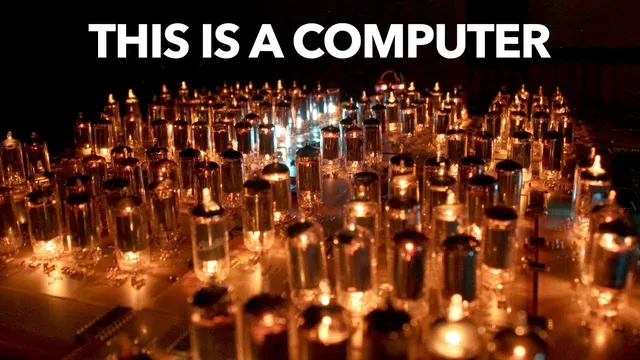
Relays powered early machines, including systems used by the US military and NACA (later NASA), but mechanical switching was slow, failure-prone, and loud. Vacuum tubes solved the switching problem by using electron motion in a vacuum instead of physical contacts. That shift culminated in ENIAC, the first electronic programmable computer, which came online December 10, 1945. ENIAC filled a room, weighed about 30 tons, consumed 175 kilowatts, and ran at roughly 500 operations per second—fast enough to support major wartime calculations, including hydrogen bomb development at Los Alamos. Yet vacuum tubes brought their own costs: constant filament heating, large size, and frequent breakdowns (ENIAC’s longest uninterrupted run was 116 hours). The “light bulb” era was bulky and unreliable, but it proved the core trick—electron control—until silicon later made the same logic practical at modern scale.
Cornell Notes
Hot filaments in vacuum bulbs emit electrons (thermionic emission), and DC voltage makes those electrons move preferentially toward the positive electrode—Edison’s one-sided glass discoloration. That effect enabled vacuum-tube diodes and then triodes, where a grid voltage controls electron flow between cathode and anode, enabling fast amplification and switching without moving parts. Boolean algebra then mapped logic operations (AND, XOR, etc.) onto electrical circuits, letting relay-based calculators perform binary arithmetic. Relays were too slow and unreliable for the future, so electronic switching with vacuum tubes powered early programmable computers like ENIAC. ENIAC’s speed and flexibility were transformative, even though vacuum tubes were power-hungry and prone to frequent failures.
Why did Edison’s bulbs discolor only on one side, and why did that matter for electronics?
How did Fleming’s diode turn AC into a usable form of DC?
What changed when de Forest built the triode, and how did the grid enable amplification?
How did Shannon’s work connect logic to circuits, and what did that enable in practice?
Why were relay computers eventually replaced by vacuum-tube switching?
What made ENIAC a milestone, and what were its major limitations?
Review Questions
- How does DC polarity in a vacuum bulb lead to one-sided glass discoloration, and how does that relate to diode behavior?
- Describe how a triode’s grid voltage can produce large changes in anode current. What sign of grid voltage blocks versus allows electron flow?
- Why did relay-based digital computers struggle as computing needs grew, and how did vacuum tubes address those specific problems?
Key Points
- 1
Edison’s observation of one-sided bulb discoloration revealed that hot filaments emit electrons and that DC voltage directs where they land.
- 2
Thermionic diodes used a heated filament plus a second electrode to create one-way electron flow, enabling rectification of AC into DC.
- 3
Triodes added a wire-mesh grid so small grid voltage changes could rapidly control electron flow, enabling amplification and electronic switching without moving parts.
- 4
Boolean algebra’s logic operations can be implemented with electrical circuits, turning binary arithmetic into gate-level hardware behavior (e.g., XOR and AND).
- 5
Relay computers were limited by mechanical speed, wear, noise, and reliability issues, which became unacceptable for future computing.
- 6
Vacuum-tube switching enabled early programmable electronic computers like ENIAC, delivering high speed and flexibility at the cost of power draw and frequent failures.