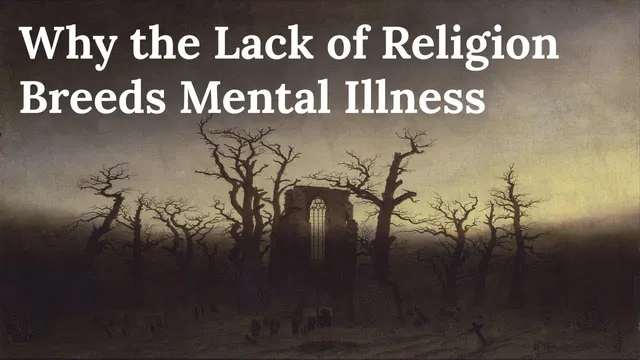
Why the Lack of Religion Breeds Mental Illness
Based on Academy of Ideas's video on YouTube. If you like this content, support the original creators by watching, liking and subscribing to their content.
Meaning is portrayed as narrative coherence across time; losing continuity or lacking a fulfilling life story is linked to psychological suffering.
Briefing
A widespread “crisis of meaning” is driving anxiety, depression, addiction, and other mental-health struggles—especially as religion declines and mythos is treated as mere fiction. The core claim is that people don’t just lack comfort or community; many lack a life narrative that makes events cohere across time. When that narrative breaks down or never forms, suffering intensifies, and the search for substitutes—money, status, pleasure, even ideology—often fails to deliver lasting psychological stability.
The argument traces the problem to modernity’s shift away from religious worldviews. Friedrich Nietzsche diagnosed rising nihilism as a “radical repudiation of meaning,” anticipating the “agony” of a godless world. The transcript then connects that prediction to Viktor Frankl’s observation that more people now have the means to live but not the meaning to live for. Ronald Stromberg is cited on the social consequences: hatred of society, apocalyptic “sense of an ending,” and the need for a worthy cause that can give life direction.
Meaning, in this account, is grounded in narrative. A person’s “life narrative” functions like a cognitive organizer—providing a plot or theme that sustains selfhood. When continuity collapses, life can become frightening and contextless; Louis Sass describes schizophrenic experience as losing the “continuity linking the events” of the past, leaving only disconnected fragments. Even when people don’t experience full disintegration, many still lack a satisfying, meaning-rich narrative that helps them cope with existential realities.
That deficit shows up in widespread mental distress. Carl Jung is quoted equating meaninglessness with illness, while McGilchrist is used to argue that happiness without meaning tracks biological patterns similar to chronic adversity such as loneliness, bereavement, or poverty. The transcript also criticizes common coping strategies: chasing wealth, status, knowledge, or pleasure. These may fill time or reduce discomfort, but they don’t supply the integrative thread that links past, present, and future.
So where does meaning come from? The proposed remedy is to recover mythos—the symbolic wisdom embedded in the great religions. Mythos is contrasted with logos (reason and science): science can identify mechanisms and correlations, but mythos teaches how to endure pain, cope with loss, and face death with purpose. Karen Armstrong is cited to frame logos as practical and controlling, while mythos supplies broader understanding of life’s meaning.
Religion’s value is presented as psychotherapeutic in function: Jung calls religion a system that heals “the suffering of the soul” and even the body caused by that suffering. As an example, the transcript uses Jung’s reinterpretation of the “imitation of Christ.” Rather than treating Christ as a literal model to copy, it’s framed symbolically as a call to realize one’s own deepest convictions with courage and self-sacrifice—an invitation to self-realization rather than mere imitation.
Finally, the transcript argues that rejecting religion doesn’t remove the need for meaning; it reroutes it into substitutes like the state, political parties, or science—options portrayed as inadequate or sometimes dangerous. Jung’s challenge to scientism closes the case: science cannot be certain that a “religious instinct” doesn’t exist. The takeaway is that people may need mythos, not necessarily institutional affiliation, to rebuild a coherent narrative that can withstand life’s losses and uncertainties.
Cornell Notes
The transcript links mental illness and social unrest to a “crisis of meaning” that grows as religion declines. Meaning is described as narrative coherence across time: when people lack a fulfilling life story, events lose context and suffering increases. Jung’s view is central—meaninglessness inhibits fullness of life and functions like illness—and McGilchrist’s claim is used to argue that happiness without meaning resembles the biological signature of chronic adversity. The proposed remedy is to engage mythos, the symbolic wisdom in religious traditions, because it teaches how to endure pain and cope with loss in ways that logos alone cannot. Accessing this wisdom doesn’t require joining an institution; reading, learning rituals, and applying the lessons are presented as the practical route.
How does the transcript define “meaning,” and why does it claim meaning affects mental health?
What role do Nietzsche, Frankl, and Stromberg play in the argument about modern decline?
Why does the transcript argue that money, status, knowledge, and pleasure don’t solve the problem?
What’s the logos-versus-mythos distinction, and how does it connect to coping with suffering?
How does Jung’s “imitation of Christ” example illustrate the symbolic use of religion?
What does the transcript suggest happens when people reject religion entirely?
Review Questions
- What mechanisms does the transcript use to connect narrative coherence (or its absence) to anxiety, depression, and other mental-health outcomes?
- How does the logos-versus-mythos framework explain why scientific knowledge alone may not satisfy existential needs?
- In the transcript’s symbolic interpretation of “imitation of Christ,” what changes about the goal of religious practice?
Key Points
- 1
Meaning is portrayed as narrative coherence across time; losing continuity or lacking a fulfilling life story is linked to psychological suffering.
- 2
Modern nihilism is traced from Nietzsche’s “radical repudiation of meaning” to Frankl’s claim that people have means but not meaning, with social fallout described by Stromberg.
- 3
Material pursuits and pleasure are treated as inadequate replacements because they don’t supply the integrative thread that links past, present, and future.
- 4
Logos (reason/science) is framed as powerful for control and explanation, but mythos (religious symbolism) is framed as necessary for enduring pain and coping with loss and death.
- 5
Religion is presented as psychotherapeutic at the level of the soul—helping people heal existential distress rather than merely providing doctrines.
- 6
The transcript argues that engaging mythos doesn’t require institutional affiliation; reading, learning rituals, and applying lessons are emphasized as the practical path.
- 7
Rejecting religion is said to reroute meaning-seeking into substitutes like the state or political ideology, which the transcript warns can be harmful.