Why the Muon g-2 Results Are So Exciting!
Based on PBS Space Time's video on YouTube. If you like this content, support the original creators by watching, liking and subscribing to their content.
Muon g−2 targets the tiny difference between a muon’s measured g factor and the baseline value of 2, testing quantum effects with extreme precision.
Briefing
Muon g−2 is generating excitement because the measured “anomalous” magnetic behavior of the muon still disagrees with the Standard Model’s ultra-precise prediction, now at 4.2 sigma—strong enough to keep the door open to new physics, but not yet strong enough to claim a discovery.
In particle physics, the Standard Model predicts how charged particles respond to magnetic fields. That response is encoded in a quantity called the g factor, with the muon’s “g−2” referring to the tiny difference between the measured g value and the baseline value of 2. For the electron, quantum electrodynamics (QED) has been tested to extraordinary precision: the electron’s g factor matches theory to about one part in a billion. The muon, a heavier cousin of the electron with the same electric charge and quantum spin, should follow the same framework—yet earlier measurements found a persistent mismatch between experiment and calculation. The discrepancy is not blamed on sloppy theory; it suggests that the calculations may be missing something beyond the Standard Model.
The reason the muon is such a sensitive probe comes down to mass. In quantum field theory, particles interact not only with real forces but also with a “seething” vacuum of virtual particles. Contributions from virtual particles depend strongly on mass: the chance that a particle is perturbed by a massive virtual state scales roughly with mass squared. Because the muon is about 200 times heavier than the electron, it is about 40,000 times more likely than the electron to be influenced by virtual heavy states—whether that means known particles like the Higgs boson or hadrons, or potentially unknown particles. Even after including all Standard Model effects, the muon’s predicted g factor remains slightly off, leaving room for an additional contribution from new physics.
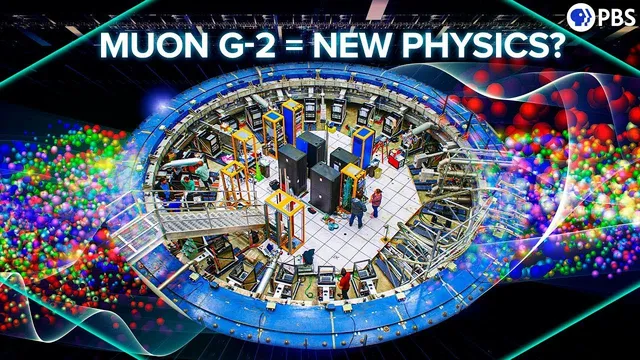
Fermilab’s Muon g−2 experiment is designed to measure the muon’s magnetic precession with extreme accuracy. Muons are accelerated to nearly the speed of light and injected into a 50-foot-diameter magnetic storage ring. Their magnetic dipole axes rotate—an effect called “muon precession.” The precession frequency depends on the g factor, and it also controls the energies of the decay products. By measuring the energies of decay positrons, researchers infer the precession rate and thus the g factor.
The latest result keeps the anomaly alive. Brookhaven’s earlier measurement (2001) showed a 3.7 sigma tension with theory, which corresponds to about a 1 in 10,000 chance of arising from random fluctuations. Fermilab’s improved sensitivity is now reporting a 4.2 sigma deviation. That still falls short of the 5 sigma threshold typically required for a discovery, but the probability of a random 4.2 sigma fluctuation is now down to a little over one in 100,000. The remaining question is whether the discrepancy is truly statistical—or whether an unrecognized systematic effect could be biasing the measurement. The only decisive path is independent confirmation by other experiments.
If the anomaly survives, it would represent one of the most promising “glitches” in the Standard Model—an opening that could point toward new particles or interactions, and potentially reshape the search for a deeper theory that unifies today’s successful frameworks.
Cornell Notes
The muon’s magnetic behavior—captured by the quantity g−2—still disagrees with Standard Model predictions. The anomaly is “anomalous” because the muon’s g factor differs slightly from the baseline value of 2, and that leftover difference is sensitive to subtle quantum effects. QED predicts the electron’s g−2 with extraordinary accuracy, but the muon’s heavier mass makes it far more susceptible to contributions from virtual heavy particles, including possible unknown ones. Fermilab’s Muon g−2 experiment measures the muon’s magnetic precession in a storage ring and infers the g factor from the energies of decay positrons. The latest reported deviation is 4.2 sigma—promising, but not yet at the 5 sigma level needed to claim discovery.
What does “muon g−2” actually measure, and why does it matter?
Why does the muon provide a stronger test of quantum physics than the electron?
How does Fermilab measure the muon’s g factor in practice?
What confidence level does the latest result reach, and how does that compare to earlier work?
What would it take to turn this from a hint into a confirmed discovery?
Review Questions
- What physical mechanism makes the muon g−2 measurement more sensitive to potential new particles than the electron’s g−2?
- Describe the chain from muon precession frequency to the extracted g factor in the Fermilab experiment.
- Why is 5 sigma treated as the discovery threshold, and what does a 4.2 sigma result imply statistically?
Key Points
- 1
Muon g−2 targets the tiny difference between a muon’s measured g factor and the baseline value of 2, testing quantum effects with extreme precision.
- 2
The Standard Model predicts the electron’s g−2 accurately, but the muon’s heavier mass makes it far more sensitive to virtual heavy states and potential new physics.
- 3
Virtual-particle contributions scale strongly with mass, so the muon is roughly 40,000 times more affected than the electron by heavy virtual effects.
- 4
Fermilab measures muon precession in a 50-foot magnetic storage ring and infers the g factor from the energies of decay positrons.
- 5
The latest reported deviation is 4.2 sigma, improving on Brookhaven’s earlier 3.7 sigma result but still below the 5 sigma discovery threshold.
- 6
Systematic errors remain the main alternative explanation, and independent experiments are needed to confirm the anomaly.