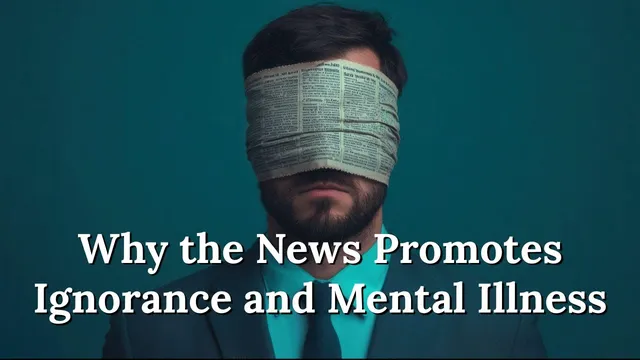
Why the News Promotes Ignorance and Mental Illness
Based on Academy of Ideas's video on YouTube. If you like this content, support the original creators by watching, liking and subscribing to their content.
News consumption is portrayed as a net disadvantage that increases stress, passivity, and intolerance rather than improving judgment.
Briefing
News consumption is framed as a net harm: it doesn’t make people better informed or more capable of civic judgment, but instead drives ignorance, intolerance, passivity, and chronic stress—damaging both mental health and social cohesion. Drawing on Ralph Dobelli’s Stop Reading the News: A Manifesto for a Happier, Calmer, and Wiser Life, the argument treats news as “mental poison” and “mental pollution,” likening its effects to a steady stream of distress that people can’t meaningfully escape.
A key mechanism is “learned helplessness,” described through 1960s experiments by psychologists Martin Seligman and Steven Meyer. In those studies, rats that could not stop electric shocks developed passivity, reduced motivation, and an inability to feel pleasure (anhidonia). The transcript claims news works similarly: constant exposure to fear, anxiety, and hopelessness—without turning that information into effective action—conditions people into a passive mindset. That passivity then spills into everyday life, affecting relationships and work where people actually have room to act.
The transcript also argues that news fosters ignorance by oversimplifying a complex world. Social, political, and environmental events are portrayed as nonlinear systems shaped by many interwoven factors, yet news is forced into short narratives, sound bites, and catchphrases. The result is an “illusion” of explanation: readers come away believing the world is simpler and more controllable than it is. On top of that simplification, the transcript claims news narratives are filtered through political agendas and shaped by interests tied to government and advertisers, with public relations influence outweighing reporting. It cites an admission that for every U.S. reporter there are more than four public relations specialists pushing preferred messaging.
Beyond misinformation and shallow understanding, the transcript links news to polarization and intolerance. With strong opinions amplified by media cycles and social platforms, public discourse becomes less deliberative and more hostile toward opposing views. Jodie Jackson’s media research is invoked to connect unresolved, seemingly unsolvable problems in news narratives to depression and diminished hope.
Attention and stress are treated as additional casualties. The transcript cites Pew Research Center data that the average person consumes about 60 news items a day (around 20,000 a year), arguing that modern 24-hour feeds create perpetual distraction. It further claims research from the University of Tokyo associates heavier news intake with fewer neurons in the anterior cingulate cortex, a brain region tied to attention and impulse control. Stress is tied to negativity bias: repeated coverage of wars, crimes, riots, economic instability, pandemics, and climate threats is said to raise anxiety levels, with Graham Davey’s Sussex University research used to support a correlation between news consumption and daily stress.
The proposed remedy is “radical abstinence”: cutting news out entirely, with a 30-day experiment to make emotional and psychological benefits visible. If someone relapses, the advice is to restart immediately with “zero tolerance.” Importantly, abstinence is not framed as ignorance; long-form alternatives—books, well-researched articles, podcasts, documentaries, textbooks, online courses, and academic journals—are presented as ways to stay informed with depth and nuance.
Finally, the transcript challenges the idea that news is necessary for accountability and social change. It points to major historical revolutions—American, French, 1848, and the fall of the Soviet Union—arguing they relied on pamphlets, speeches, debates, and meaningful conversation rather than continuous news feeds. The closing message leans on Stoic philosophy: most events are outside individual control, so energy should go toward what can be influenced—health, relationships, work, and constructive action—while treating news as a harmful distraction that can be detoxified away.
Cornell Notes
The transcript argues that consuming news produces a cascade of harms rather than civic benefits. It claims news triggers learned helplessness—conditioning people into passivity and reduced motivation—because distressing information is rarely paired with effective action. It also argues news increases ignorance by forcing complex events into oversimplified, often agenda-shaped narratives, which can distort how readers understand causality. On top of that, heavy news intake is linked to chronic stress, reduced attention, and greater polarization and intolerance. The proposed fix is a 30-day abstinence experiment, replacing short, biased headlines with long-form sources like books and academic work, so people can stay informed without sacrificing mental health or judgment.
How does “learned helplessness” explain the emotional impact of news consumption?
Why does the transcript say news makes people less informed?
What is the link between news consumption and polarization?
How do attention and brain effects enter the argument?
What does “news abstinence” look like, and what alternatives are offered?
Does the transcript claim news is necessary for accountability and social change?
Review Questions
- What psychological process is used to connect repeated news exposure to passivity, and how is it supported by the rat experiments?
- How does the transcript connect the need for short news formats to claims of ignorance and distorted causality?
- What replacement strategy does the transcript propose for staying informed without consuming daily headlines?
Key Points
- 1
News consumption is portrayed as a net disadvantage that increases stress, passivity, and intolerance rather than improving judgment.
- 2
Learned helplessness is used as a model for how repeated exposure to distressing information—without meaningful escape or action—can reduce motivation and pleasure.
- 3
Oversimplified, nonlinear realities are said to be compressed into sound bites, creating an illusion of explanation and weakening decision-making.
- 4
Media narratives are claimed to be shaped by political agendas and advertiser-linked incentives, with public relations influence described as outnumbering reporters.
- 5
Heavy news intake is linked to distraction and stress, with cited figures suggesting tens of thousands of news items per year for the average person.
- 6
The proposed remedy is a 30-day abstinence experiment, restarting immediately after relapse and replacing headlines with long-form, well-researched sources.
- 7
Historical examples are used to argue that accountability and social change can be driven through pamphlets, speeches, debates, and conversation rather than constant news feeds.