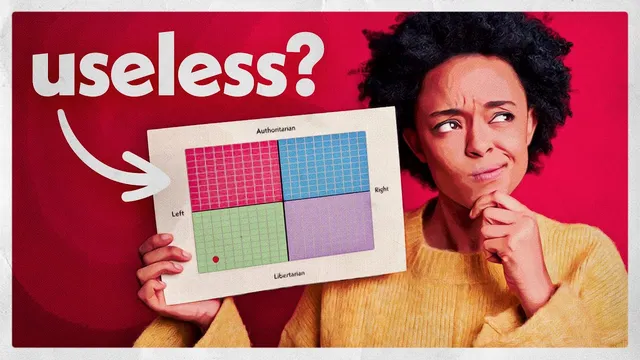
Why The Political Compass Sucks...And What's Better
Based on Second Thought's video on YouTube. If you like this content, support the original creators by watching, liking and subscribing to their content.
The political compass test is criticized for nudging results through question wording and for embedding a non-neutral separation of economics from government.
Briefing
The political compass test is popular for sparking interest, but it’s a poor tool for understanding someone’s politics in any meaningful, real-world sense. Its results are distorted by question wording, built-in assumptions, and a framing that separates economics from government—an approach that doesn’t fit many political traditions. Even when the test places people in a quadrant, it often can’t translate those numbers into what they actually do, because politics is less about what individuals claim to believe and more about how communities organize power and coordinate action.
A key problem is that the test’s design nudges outcomes. The quiz is presented as neutral, yet its structure tends to funnel many respondents toward the bottom-left quadrant. Some questions also pit concepts against each other in ways that can confuse people with different starting assumptions—for instance, treating transnational corporations and “humanity” as if they are naturally opposed, even though some respondents may see corporate behavior as aligned with human welfare. More fundamentally, the compass relies on a hard separation between economics (left-right) and authority/government (up-down). That split reflects a particular Western liberal tradition rather than a universal way to map political life.
For critics like the socialist perspective offered here, the separation itself creates blind spots. Businesses aren’t just economic actors; they operate with power, rules, and coercive effects that overlap with governance. From that view, government and business are intertwined parts of the same system of authority—so a model that treats government as an external force acting on an otherwise separate economy can’t capture how power actually works. The result is a map that may look tidy but doesn’t match how many ideologies interpret the world.
After the test, the numbers still don’t help much. The output is a self-administered snapshot of opinions, not a measure of behavior or engagement. The transcript argues that politics is ultimately about motivated people organizing communities—so the most important next step is learning what political terms mean and then building knowledge through practice and interaction.
On learning, the advice is pragmatic: political theory books can be accurate and detailed, but they’re often a bad first step for newcomers because they’re long, jargon-heavy, and easy to abandon. Videos are recommended as a more accessible entry point—so long as creators provide sources and use credible evidence beyond personal experience. YouTube viewers are urged to look for transparency, peer-reviewed or well-sourced material, and multiple openly biased perspectives rather than hunting for a single “unbiased” voice.
The transcript then broadens the learning menu: podcasts, Twitch live streams, and—most importantly—participation in organizations such as mutual aid groups, political parties, reading clubs, or local activist meetings. Joining groups is framed as both mentally stabilizing and practically effective, especially for people who feel isolated in places where their views are uncommon. The message closes with a caution about burnout: learning politics can make the world feel worse as problems become clearer, so mixing formats and staying hopeful is treated as part of the strategy. Labels are also treated as flexible—useful for organizing research and community, but not worth obsessing over as identities evolve with new evidence and relationships.
Cornell Notes
The political compass test can be a gateway into politics, but its quadrant results are unreliable for understanding real political commitments. Its question wording and underlying assumptions—especially the separation of economics from government—reflect a particular political tradition and can miss how power works in other frameworks. Even if the test places someone on a map, it doesn’t measure what people actually do, since politics is shaped by community organization and action, not just stated beliefs. For learning, the transcript recommends starting with accessible formats (especially sourced videos), using evidence and multiple perspectives, and then moving into practice through organizations, meetings, and discussion communities. Labels can motivate research, but they should remain flexible as knowledge and experience change.
Why does the transcript say the political compass test is “not super helpful” even when it seems to match someone’s beliefs?
What specific design assumptions make the compass less compatible with some political ideologies?
How does the transcript critique the compass’s question wording?
What learning strategy is recommended after taking a political test?
What should viewers look for in political YouTube content to avoid common traps?
Why does the transcript push joining political organizations instead of relying only on media?
Review Questions
- What assumptions about economics and government does the transcript claim the political compass test relies on, and why does that matter for interpreting results?
- How does the transcript distinguish between knowing what someone believes and understanding what someone will actually do politically?
- What criteria does the transcript suggest for evaluating political content online, and how do those criteria reduce the risk of misinformation or logic traps?
Key Points
- 1
The political compass test is criticized for nudging results through question wording and for embedding a non-neutral separation of economics from government.
- 2
A major limitation is that the compass output reflects opinions and self-perception, not real political behavior or community action.
- 3
Politics is framed as community organization and power coordination, so learning should move beyond labels and into participation.
- 4
For newcomers, sourced videos are recommended as a more accessible entry point than jargon-heavy political theory books.
- 5
Online political learning should prioritize transparency of sources and credible evidence, including peer-reviewed work when possible.
- 6
Because bias can’t be eliminated, the transcript recommends comparing multiple openly biased perspectives rather than hunting for a single “unbiased” voice.
- 7
Joining local organizations is presented as both mentally stabilizing and practically effective, turning beliefs into real-world impact.