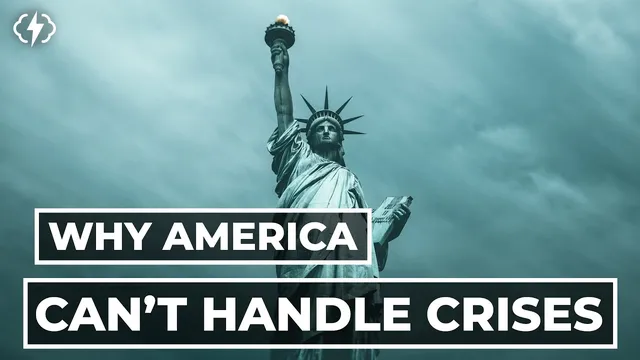
Why The United States Can't Handle Crises
Based on Second Thought's video on YouTube. If you like this content, support the original creators by watching, liking and subscribing to their content.
Obesity is presented as a major U.S. crisis, with 42.4% of adults obese in 2018 and severe obesity rising to 9.2%, alongside large medical costs and mortality links.
Briefing
The United States struggles with crises not because of a lack of talent or resources, but because a profit-driven system repeatedly creates the conditions that make emergencies worse—and then blocks the guardrails needed to respond. Across obesity, climate change, and COVID-19, the pattern is consistent: corporate incentives, political incentives, and weak social protections combine to turn preventable problems into large-scale harm.
Obesity is framed as a long-running public-health failure with roots deeper than personal choice. By 2018, 42.4% of U.S. adults were obese, and severe obesity nearly doubled from 4.7% to 9.2% between 2000 and 2018. Among children ages 2 to 19, nearly 1 in 5 were obese. The consequences are severe—higher risks of heart disease, stroke, type 2 diabetes, certain cancers, and shorter lifespans. A 2008 estimate put annual medical costs at $147 billion, and obesity is linked to nearly one in five deaths.
The transcript argues that sugar—rather than fat—was identified as a key driver as early as the 1950s, citing a scientific debate between John Yudkin and Ancel Keys. Yet the sugar industry allegedly responded by funding disinformation and lobbying for a low-fat diet initiative. The result, according to the account, was not less sugar but more sugar in “low-fat” foods, worsening the very problem the policy was meant to solve. Attempts like sugar taxes are described as too limited to dent a crisis that has continued to expand.
Climate change is treated as the next major example of preventable catastrophe met with denial and delay. The transcript points to melting sea ice, rising sea levels, ocean acidification harming coral reefs, more frequent extreme weather, species loss, and regions becoming unlivable. It claims the U.S. is among the few places where elected officials openly deny climate change. The explanation again centers on corporate power: Exxon is described as having conducted advanced climate research in the late 1980s and early 1990s, including models predicting that doubling CO2 would lengthen the Beaufort Sea open-water season by years to come. Instead of using that knowledge to mitigate harm, the account says oil and gas giants funded opposition, launched disinformation campaigns, and buried internal findings—then continued lobbying and supporting climate-denying politicians.
COVID-19 ties the argument together by showing how crisis response collapses when health protection conflicts with profit and political optics. The transcript cites more than 500,000 U.S. deaths and claims the U.S. had the worst outcomes despite vast resources. It describes early denial and politicization, resistance to lockdowns as “overreach,” and business models built on razor-thin margins that quickly translate lost revenue into layoffs. With health care tied to employment and no universal coverage, millions lose both income and access to treatment. Hospitals become overwhelmed, medical debt spreads, and the lack of social safety nets—paired with widespread refusal to wear masks—helps drive catastrophic outcomes.
The closing claim is that capitalism cannot solve crises it creates. When guardrails like universal healthcare, robust unemployment support, and strong regulation are removed, emergencies become more lethal and harder to manage. The transcript warns that future crises—economic and demographic—could compound this fragility, potentially undermining the consumer-driven engine of the U.S. economy and the broader empire it supports.
Cornell Notes
The transcript argues that the U.S. repeatedly fails at crisis management because its profit-first system both helps cause emergencies and blocks effective responses. Obesity is presented as a decades-long failure tied to sugar-driven disinformation and policy choices that increased sugar consumption. Climate change is framed as a case where oil companies allegedly suppressed internal research and funded denial, leaving the U.S. politically unable to act. COVID-19 is portrayed as the clearest example: denial and politicization met a labor market with thin margins, no universal healthcare, and weak safety nets, producing overwhelmed hospitals and massive death and debt. The core takeaway is that “crisis management isn’t profitable,” so guardrails are weakened until catastrophe becomes the default outcome.
What makes obesity a “crisis” in the transcript, and what numbers are used to justify that framing?
How does the transcript connect obesity to policy and industry influence rather than individual behavior alone?
What is the transcript’s explanation for why the U.S. struggles to respond to climate change?
Why does the transcript portray COVID-19 as a crisis-management failure rather than just a health problem?
What “system-level” claim ties obesity, climate change, and COVID-19 together?
Review Questions
- Which specific obesity statistics are cited, and how are they used to justify calling obesity a crisis?
- What evidence does the transcript claim Exxon gathered, and what does it say happened to that information afterward?
- How does the transcript connect business margins, employment-linked healthcare, and lack of safety nets to COVID-19 outcomes?
Key Points
- 1
Obesity is presented as a major U.S. crisis, with 42.4% of adults obese in 2018 and severe obesity rising to 9.2%, alongside large medical costs and mortality links.
- 2
The transcript attributes obesity’s worsening to alleged sugar-industry disinformation and lobbying that supported low-fat policies while increasing sugar in “low-fat” foods.
- 3
Climate change is described as already producing measurable impacts, while U.S. political denial is portrayed as a key barrier to mitigation.
- 4
Exxon is cited as an example of corporate climate research and modeling followed by alleged suppression and funding of opposition to delay action.
- 5
COVID-19 outcomes are linked to denial and politicization plus structural economic fragility: thin business margins, employment-linked healthcare, and weak unemployment and healthcare protections.
- 6
The overarching thesis is that profit incentives and deregulation remove “guardrails,” making crisis prevention and response systematically weaker.
- 7
Future instability is framed as likely to compound current failures, especially as younger generations face reduced purchasing power and demographic shifts.