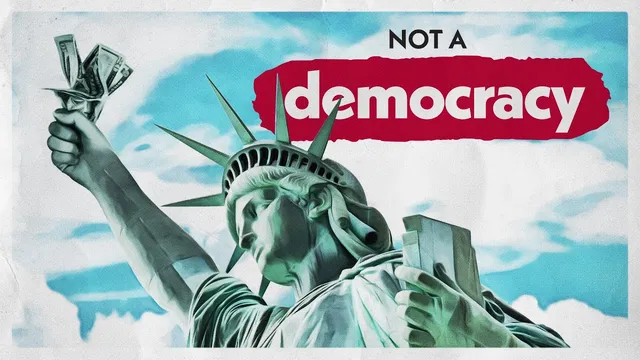
Why The US Is Not A Democracy
Based on Second Thought's video on YouTube. If you like this content, support the original creators by watching, liking and subscribing to their content.
A Princeton study is cited to argue that the bottom 90% of Americans’ policy preferences do not reliably affect whether Congress passes laws, while the top 10%’s preferences do.
Briefing
The United States is described as structurally incapable of becoming a true democracy because its constitutional design and capitalist economy concentrate political and economic power in the hands of a small, wealthy class. The central claim isn’t that campaign finance is the only problem, but that the country’s governing institutions and its economic system are built to limit popular sovereignty—so public preferences, especially those of most Americans, fail to reliably translate into law.
A key piece of evidence comes from a Princeton study on policy outcomes and voter preferences. Across nearly 2,000 policies over two decades, the relationship between public support and congressional action is reported as flat for the bottom 90%: when most people want a policy, Congress shows no consistent increase in passing it. By contrast, the top 10%’s preferences are said to closely track legislative outcomes. In this framing, votes mainly determine which slice of the wealthy gets to steer policy, rather than whether the majority’s interests prevail.
From there, the argument shifts to structure. Representative government—often treated as synonymous with democracy—is portrayed as historically favored by elites because it can filter and manage mass political demands. The transcript points to how electoral systems can be engineered to advantage those with resources: geographic districting, rules that restrict who can run or influence outcomes, and mechanisms that keep radical voices out. James Madison is cited from The Federalist Papers to underscore the idea that representation should “refine and enlarge” public views by routing them through a chosen body—an approach described as inherently anti-democratic because it bypasses direct popular control.
The Constitution’s checks and balances are then characterized as designed less to expand democracy than to protect property and the economic interests of the newly powerful bourgeoisie. Institutions such as the Senate, the Electoral College, the presidency, and the Supreme Court are presented as tempering the most democratic element: the House and the broader public. The transcript also argues that major expansions of political rights—women’s suffrage, Black enfranchisement, and labor gains like the eight-hour workday—required sustained pressure and struggle outside the system, implying the original design offered limited democratic outlets.
The economic system is treated as the deeper constraint. Liberal governments are described as separating politics from the economy, leaving workplaces and markets governed by profit incentives rather than collective needs. Workers, it says, do not elect decision-makers, cannot set conditions like safety or hours, and can be fired—creating leverage for owners and managers to prioritize their interests. Because capitalism is portrayed as hierarchical and profit-driven, the transcript claims it can’t help but undermine democratic goals: it concentrates power through mergers and acquisitions, and it influences politics through lobbying and think tanks while also keeping major life-determining decisions outside democratic control.
Finally, the transcript argues that democracy and capitalism are incompatible when “the freedom to exploit” is protected for those with property. It proposes alternatives aimed at bringing economic life under democratic influence—council or liquid democracy, worker-run workplaces, elected or lottery-based roles in institutions, and planning for essentials through referendums—so collective decisions reflect collective deliberation rather than market coercion. The closing message ties the political critique to a broader educational pitch: the channel promotes Nebula’s series The New F Word, focused on the origins and identification of fascism.
Cornell Notes
The transcript argues that the U.S. cannot function as a full democracy because both its constitutional structure and its capitalist economy limit popular sovereignty. Evidence cited from a Princeton study claims that policy outcomes track the preferences of the top 10% while the bottom 90% has little to no effect on whether Congress passes policies. The explanation centers on representative institutions designed to filter mass demands and protect property interests, with checks and balances described as tempering the most directly democratic parts of government. The economy is framed as a separate, non-democratic realm where workers lack control over key decisions and profit motives override collective needs. The proposed remedy is shifting toward more direct forms of democracy, including democratic control over workplaces and planning for essentials.
What does the Princeton study claim about how public opinion maps to congressional action?
Why does the transcript treat representative government as potentially anti-democratic?
How are the U.S. constitutional checks and balances characterized in this argument?
What role does capitalism play in the transcript’s claim that democracy is blocked?
What democratic reforms are proposed to increase popular control over everyday life?
Review Questions
- How does the transcript connect elite preference to policy outcomes, and what evidence is used to support that connection?
- Which constitutional features are named as tempering popular influence, and how is their purpose interpreted?
- Why does the transcript claim that separating politics from the economy prevents democracy from taking root?
Key Points
- 1
A Princeton study is cited to argue that the bottom 90% of Americans’ policy preferences do not reliably affect whether Congress passes laws, while the top 10%’s preferences do.
- 2
Representative government is portrayed as a system that can filter mass demands through rules and structures that favor those with resources.
- 3
James Madison’s “refine and enlarge” idea from The Federalist Papers is used to support the claim that representation bypasses direct popular control.
- 4
The Constitution’s checks and balances are framed as protecting property interests, with institutions like the Senate, Electoral College, presidency, and Supreme Court limiting the House and public influence.
- 5
Major expansions of rights and labor protections are described as requiring sustained pressure from outside the system, implying limited built-in democratic responsiveness.
- 6
The economy is argued to be governed by profit incentives rather than collective deliberation, leaving workers without democratic control over key workplace decisions.
- 7
Proposed alternatives include council or liquid democracy, worker control of workplaces, lottery or election-based representation, and democratic planning for essentials to reduce coercion through scarcity.