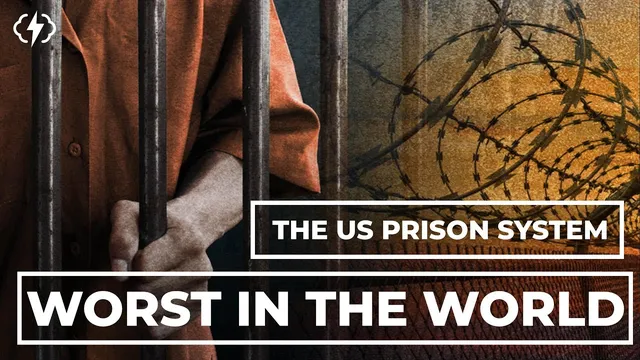
Why The US Prison System Is The Worst In The Developed World
Based on Second Thought's video on YouTube. If you like this content, support the original creators by watching, liking and subscribing to their content.
The U.S. incarcerates about 655 people per 100,000—far above other OECD countries cited, and it holds 22% of the world’s prison population despite having about 4% of the world’s population.
Briefing
The U.S. prison system is widely described as the worst in the developed world—not just because of how many people it locks up, but because the system is structurally built to profit from incarceration rather than reduce harm or prevent reoffending. As of June 2020, the United States held about 2,121,000 people in prison, with more than 10 million total when including those awaiting trial and those on parole. That scale is matched by an extreme per-capita rate: roughly 655 incarcerated people per 100,000, far above other OECD countries such as the UK (140), Canada (107), France (105), Germany (77), and even China (barely over 150). The U.S. holds about 4% of the world’s population but accounts for 22% of the world’s prison population.
That incarceration obsession is tied to a broader economic incentive structure often called the “prison industrial complex.” Prisons are not isolated from capitalism; they are embedded in it. Companies that sell food to incarcerated people profit from low-quality, low-nutrition products. Phone providers charge high per-minute rates because prisoners are desperate to contact family. Transportation firms profit from moving people to and from court. Most controversially, incarcerated labor is framed as modern slavery: in California, inmates fighting fires have been paid about $2 per hour, far below the U.S. minimum wage of $7.25 per hour, and some states reportedly pay nothing at all. Even when work is required, the pay can be as low as 12 cents per hour. In recent years, incarcerated people have been used for tasks including manufacturing hand sanitizer and PPE, washing hospital laundry, and digging mass graves related to COVID-19.
For-profit prisons intensify the incentives. As the “war on drugs” expanded in the 1980s and federal prisons became overcrowded, private companies were contracted to build and manage new facilities. The financial model pays companies a fixed amount per incarcerated person, creating a direct incentive to keep prisons full. Many private prison contracts include lock-up quotas—often guaranteeing occupancy around 90%, and in some cases 100%—so reform becomes financially risky. The money loop is described as political as well: private prison executives donate to politicians who support these contracts, while corporations profit from incarceration and from slave-labor supply chains.
The system’s outcomes are also portrayed as predictably grim. The U.S. emphasizes punishment over rehabilitation, and conditions are described as abusive enough that the United Nations and human rights groups have condemned practices such as solitary confinement as torture. After release, employment barriers and instability help drive high recidivism; the transcript cites a pattern where two out of three people return to prison. The broader social logic is criticized as a moral double standard: poverty is treated as criminality, while wealthy people can often avoid consequences through bail, less policing in their communities, or access to legal resources.
Systemic racism is presented as a major driver of unequal sentencing, with Black people receiving longer sentences than white people for similar crimes. White-collar crime is contrasted with harsh punishment for ordinary offenses, including the claim that major bankers involved in major financial misconduct face little or no comparable jail time.
As an alternative, the transcript points to Norway and Finland, where incarceration rates are far lower and prisons are designed around “normality”—comfortable living conditions, more freedom of movement, education and counseling, and staff trained to act as both support and supervision. Norway caps sentences at 21 years and reports low recidivism (about 20% arrested again within two years). Finland’s life-sentence model is described as less about confinement and more about structured access to education and work, with incarceration rates dropping dramatically over decades. The core message: the U.S. prison system is not merely harsh—it is incentivized to remain harsh, and meaningful change requires sustained public pressure rather than incremental reform inside the current profit-driven structure.
Cornell Notes
The U.S. incarcerates far more people than any other developed country, both in total numbers and per capita. The transcript links that scale to a “prison industrial complex” where corporations profit from every stage of incarceration, including low-paid or unpaid forced labor and private prison contracts that can guarantee high occupancy. It argues this incentive structure discourages reform and helps explain why punishment-focused policies produce high recidivism rather than rehabilitation. In contrast, Norway and Finland are presented as models that prioritize rehabilitation and “normality,” with lower incarceration rates and comparatively low reoffending. The implication is that fixing the U.S. system requires public mobilization to break the profit incentives sustaining it.
How extreme is the U.S. incarceration rate compared with other countries?
What role does profit play in the U.S. prison system, according to the transcript?
Why are private prisons portrayed as a barrier to reform?
What does the transcript say about fairness and unequal sentencing?
How do Norway and Finland differ from the U.S. prison approach?
Review Questions
- What specific per-capita and total incarceration figures does the transcript use to argue the U.S. is the worst among developed nations?
- How do lock-up quotas in private prison contracts create incentives that can undermine prison reform?
- What elements of Norway’s and Finland’s “normality” approach are presented as mechanisms for reducing recidivism?
Key Points
- 1
The U.S. incarcerates about 655 people per 100,000—far above other OECD countries cited, and it holds 22% of the world’s prison population despite having about 4% of the world’s population.
- 2
The prison industrial complex is portrayed as profit-driven across food, phone services, transportation, and forced labor, with pay sometimes far below the federal minimum wage or reportedly absent in some states.
- 3
Private prison contracts are described as creating reform-resistant incentives through per-inmate payments and lock-up quotas that can guarantee high occupancy (often around 90%, sometimes 100%).
- 4
The transcript links punishment-first policies to high recidivism, arguing that harsh conditions and post-release barriers make reoffending more likely.
- 5
Systemic racism is presented as a sentencing driver, with Black defendants described as receiving longer sentences than white defendants for similar crimes.
- 6
White-collar crime is contrasted with harsh punishment for ordinary offenses, with the transcript claiming major financial offenders often avoid significant incarceration.
- 7
Norway and Finland are offered as alternatives emphasizing rehabilitation and “normality,” including staff training, more humane living conditions, and access to education and counseling.