Why this puzzle is impossible
Based on 3Blue1Brown's video on YouTube. If you like this content, support the original creators by watching, liking and subscribing to their content.
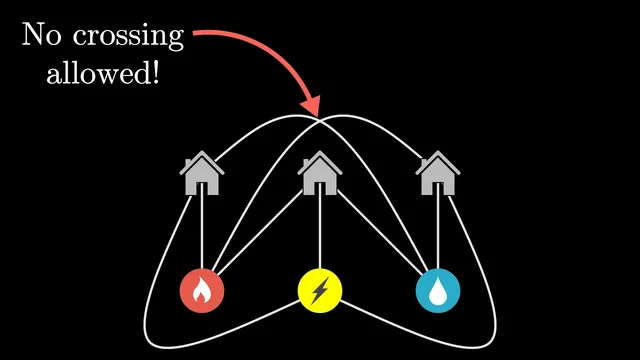
The utilities-and-houses puzzle is the complete bipartite graph K3,3 with nine required edges.
Briefing
The puzzle of connecting three utilities (gas, power, water) to three houses with nine non-crossing lines turns out to be impossible on a flat sheet—but becomes solvable once the drawing surface has a “hole,” like the handle of a mug. The key insight is that the usual planar-graph reasoning forces any non-crossing layout to create too many enclosed regions, and that region count demands more edges than the puzzle has.
On paper, the setup corresponds to the complete bipartite graph K3,3: every one of the three utilities must connect to each of the three houses, with no intersections allowed. The reasoning begins by tracking what happens when a new line is added. Each added edge either (1) reaches a new vertex, increasing the number of “lit up” vertices, or (2) closes off a new enclosed region, because the line completes a loop in the drawing. Starting from a single vertex and the unbroken plane, nine required edges would force exactly five enclosed regions in any hypothetical planar solution.
That’s where the contradiction appears. In K3,3, any cycle must have length at least four edges: you can’t return to the starting house in fewer steps because connections alternate between houses and utilities. As a result, each enclosed region in a non-crossing drawing would have a boundary made of at least four edges. If there are five regions and each touches at least four edges, counting boundaries gives at least 20 “region-edge incidences.” But every edge borders exactly two regions in such a planar embedding, so the total number of edges would have to be 10—yet the puzzle only allows nine lines. The mismatch proves the task cannot be done on a plane without intersections.
The mug changes the rules without changing the graph. The handle turns the surface into something topologically different from a disk: it behaves like a torus-like surface with a hole. That extra “passage” lets a line effectively slip around what would be a barrier on paper, breaking the planar argument at the point where Euler’s characteristic (the invariant behind the region/edge/vertex counting) no longer applies in the same way. In practice, the successful attempts route one or more connections through the handle, using it as a bridge so lines that would otherwise be forced to cross can be separated by the surface’s topology.
After the mathematical proof, the narrative returns to the physical challenge: dry-erase markers make it easy to iterate, and the final solution uses the handle to reroute connections that would otherwise trap a house. The takeaway is not just that the mug makes the puzzle solvable, but that the impossibility proof is tightly linked to planarity; once the drawing surface has a hole, the same graph can be embedded without crossings. The closing message pushes viewers to ask where such proofs fail and to treat even toy puzzles as a gateway to deeper math thinking.
Cornell Notes
Connecting three utilities to three houses with nine non-crossing lines is impossible on a flat plane because it corresponds to the graph K3,3, which cannot be embedded without crossings. A region-counting argument shows any planar drawing would need five enclosed regions, and each region would require a boundary of at least four edges (since cycles have length ≥ 4). That forces at least 10 total edges, but only nine connections exist, creating a contradiction. A mug’s handle changes the surface topology, allowing the same connections to be routed without crossings by effectively “passing through” the hole. The proof breaks because the planar invariants used in the argument no longer hold on a surface with a hole.
Why does the utilities-to-houses puzzle map to the graph K3,3?
What is the core planar-graph contradiction on paper?
Why can’t K3,3 have a cycle with fewer than four edges?
Where does the planar proof break on a mug?
How does using the mug handle make a non-crossing drawing possible in practice?
Review Questions
- In the planar argument, why does each added edge either increase the number of lit vertices or increase the number of enclosed regions?
- Recreate the edge-count contradiction: how do five regions and the minimum cycle length combine to demand at least 10 edges?
- What topological feature of a mug’s handle changes the applicability of planar invariants like Euler’s characteristic?
Key Points
- 1
The utilities-and-houses puzzle is the complete bipartite graph K3,3 with nine required edges.
- 2
On a plane, a non-crossing drawing would force exactly five enclosed regions based on how edges create new regions or new vertices.
- 3
In K3,3, every cycle has length at least four because connections must alternate between houses and utilities.
- 4
Five regions with boundaries of at least four edges would require at least 10 total edges, contradicting the puzzle’s nine connections.
- 5
The mug’s handle changes the surface topology, so planar embedding constraints and region-counting logic no longer apply the same way.
- 6
Routing one or more connections through the handle provides a non-crossing embedding that is impossible on a flat sheet.