Why Time Flows Differently Between Galaxies
Based on PBS Space Time's video on YouTube. If you like this content, support the original creators by watching, liking and subscribing to their content.
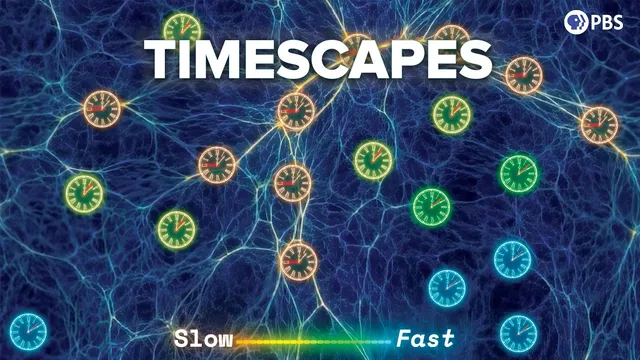
A timescape model links differential gravitational time flow (slower in dense regions, faster in voids) to differential expansion that can mimic the redshift pattern usually attributed to dark energy.
Briefing
A December paper by Antonia Seifert and collaborators at the University of Canterbury argues that the universe’s apparent acceleration might be an artifact of how cosmological models treat time. In their “timescape” framework, time runs at different rates in different environments: regions of strong gravity (dense galaxy clusters and filaments) tick more slowly, while vast low-density voids tick faster. Because the universe’s large-scale structure keeps changing—voids occupy a growing fraction of space—photons traveling through the cosmos would accumulate extra redshift over time. That extra redshift could mimic what observers currently attribute to dark energy, potentially removing the need for a cosmological constant in the simplest interpretation.
The claim matters because the dominant cosmological model, Lambda-CDM, is built on a key simplifying assumption: matter is treated as smooth and evenly distributed on large scales. Under that approximation, the Friedmann equations describe expansion driven by smoothly distributed matter plus a constant dark energy term. Observations of Type Ia supernovae—standardizable explosions of white dwarfs—then map out an expansion history. In the late 1990s, those supernova surveys revealed that expansion was accelerating, which pushed cosmologists to add a cosmological constant (Λ) to general relativity. Since then, Lambda-CDM has become the best overall fit to a wide range of measurements, even though cosmic acceleration has not been “directly” measured so much as inferred from how well models match the data.
Seifert’s team leans on a known feature of general relativity—gravitational time dilation—but adds a second, more consequential effect: differential time flow should alter the effective expansion rate from place to place. In their picture, faster-ticking voids expand more than slower-ticking dense regions. Photons crossing those environments would be stretched (redshifted) differently depending on how much time they spend in voids versus denser structures. As the universe becomes more clumpy and voids take up more volume, the void contribution grows, producing a late-time redshift boost that can resemble acceleration without invoking global acceleration.
The recent attention comes from an updated comparison against the Pantheon+ supernova dataset. Using a Bayes factor approach, the analysis finds timescape preferred over Lambda-CDM, especially when nearby supernovae are included—precisely where local inhomogeneities should matter most because photons traverse fewer structures and the “averaging out” assumption is weakest. When only more distant supernovae are used, the two models converge, though timescape still edges ahead in the reported results.
Still, the case is far from settled. Lambda-CDM retains strong support from independent probes such as baryon acoustic oscillations, which provide an expansion measure less sensitive to void-induced photon effects, plus the observed evolution of large-scale structure and the universe’s near-flat geometry. The timescape model also faces a quantitative challenge: it requires very large age differences between voids and dense regions—on the order of billions of years—where some estimates suggest the expected differential time flow should be closer to hundreds or thousands of years. The timescape team also acknowledges that supernova distance calibration is complex and needs further refinement.
Bottom line: dark energy hasn’t been cleanly disproved. Lambda-CDM still offers the most consistent overall framework, but the timescape results are a meaningful stress test—especially for how precisely cosmologists model the “temporal landscape” created by cosmic structure. Any crack in Lambda-CDM’s armor, such as the ongoing Hubble tension and hints of possible time variation in the cosmological constant, keeps alternative models like timescape on the table.
Cornell Notes
A new “timescape” analysis argues that apparent cosmic acceleration could come from how time flows differently across the universe’s structure, not from dark energy. In this model, dense regions tick more slowly and voids tick faster due to gravitational time dilation, and the growing void fraction later boosts the redshift of photons. When compared to the Pantheon+ Type Ia supernova dataset, timescape reportedly fits better than Lambda-CDM, particularly when nearby supernovae are included. However, independent evidence for acceleration from baryon acoustic oscillations, large-scale structure, and near-flat geometry still favors Lambda-CDM overall. The timescape scenario also appears to require unusually large void–cluster age differences, and supernova calibration uncertainties remain a key limitation.
What does the timescape model change compared with Lambda-CDM’s standard assumptions?
How can different rates of time flow mimic the redshift signature of acceleration?
Why do nearby supernovae matter more for this test?
What independent observations still support dark energy and Lambda-CDM despite the supernova fit?
What are the main criticisms or open issues for timescape?
Review Questions
- How does timescape connect gravitational time dilation to changes in the effective expansion rate and photon redshift?
- Which observational probes besides Type Ia supernovae are cited as strong support for Lambda-CDM, and why are they less sensitive to void-induced redshift effects?
- What magnitude of void–cluster age difference does timescape require, and why does that requirement conflict with some estimates?
Key Points
- 1
A timescape model links differential gravitational time flow (slower in dense regions, faster in voids) to differential expansion that can mimic the redshift pattern usually attributed to dark energy.
- 2
The model predicts that as voids occupy a growing fraction of the universe, later photons accumulate extra redshift without requiring global acceleration.
- 3
A Pantheon+ supernova comparison reports timescape fits better than Lambda-CDM, with the strongest preference when nearby supernovae are included.
- 4
Lambda-CDM still has strong support from BAO, large-scale structure growth, and near-flat geometry, which collectively point toward accelerating expansion and a substantial dark-energy component.
- 5
Timescape faces a quantitative challenge because it appears to require very large void–dense-region age differences that some estimates consider too big.
- 6
Supernova distance calibration remains a major uncertainty, and the timescape team acknowledges the need for further work before drawing firm conclusions.