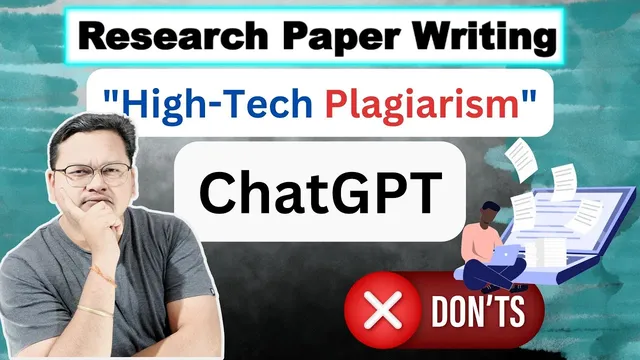
Why to Avoid ChatGPT for Paper Writing? || Research Publications || Dr. Akash Bhoi
Based on eSupport for Research's video on YouTube. If you like this content, support the original creators by watching, liking and subscribing to their content.
Copy-pasting ChatGPT-generated paragraphs into research writing is portrayed as a form of cheating that violates academic integrity.
Briefing
Generative AI—especially ChatGPT—has made it technically easy to draft academic text, but that convenience is colliding with journal authorship rules, plagiarism standards, and growing detection efforts. The central takeaway is that using AI output as-is for research writing (copying and pasting generated paragraphs into a paper) is widely treated as unethical because it undermines academic integrity and can trigger serious consequences like rejection, corrections, or retraction.
A key example comes from a January 2023 discussion in higher education that used ChatGPT to generate paragraphs in response to prompts about ethics and cheating. When asked to write about misuse, the model produced language emphasizing that AI chatbots aren’t inherently good or bad, yet they deserve attention for potential misuse in education—suggesting strict policies, regulation, and user education. When asked directly about cheating, the generated response described a straightforward workflow: students could feed prompts to ChatGPT, then copy and paste the responses into essay assignments. That “copy-paste” approach is framed as highly unethical and linked to academic integrity and plagiarism policies.
The transcript then points to multiple news and publication debates reinforcing that stance. Hindustan Times (January 21) reported an academic controversy over a ChatGPT co-authored research paper, arguing that attributing authorship to an AI tool isn’t acceptable because an AI system can’t take responsibility for content accuracy and scientific integrity. Nature also highlighted that scientists disapprove of listing ChatGPT as an author, with at least four articles crediting the AI tool as co-author—an approach that publishers and editors increasingly scrutinize.
Medical and publishing outlets add another layer: generative AI’s ethical impact in scholarly and medical contexts is described as uncertain, but the risk is real. The transcript warns that AI-generated content can later be flagged by editors, reviewers, or boards, potentially leading to retraction even after publication. That risk is paired with institutional countermeasures, including Stanford’s introduction of “DetectGPT” to help educators and publishers identify ChatGPT-generated text.
Finally, the transcript cites guidance from Springer Nature to editorial teams: ChatGPT (a large language model launched in November 2022) does not currently meet authorship criteria for Springer Nature, and the same principle may apply across publishers. The practical message is less about banning tools outright and more about how they’re used—if AI output is treated as a shortcut that replaces original work, it conflicts with authorship and integrity expectations. The safer path described is to keep traditional research practices, use AI only in ways that don’t misrepresent authorship or originality, and stay alert to evolving policies and detection capabilities.
Cornell Notes
ChatGPT can generate publishable-looking academic text, but using it as a substitute for original writing—especially copy-pasting responses into papers—raises plagiarism and integrity concerns. Multiple outlets and publishers have questioned whether an AI system can qualify for authorship because it cannot take responsibility for content accuracy or scientific integrity. Reported cases and debates (including Nature and Hindustan Times coverage) show growing resistance to listing ChatGPT as a co-author. Editors and institutions are also moving toward detection tools like Stanford’s DetectGPT, and AI-generated work may face later scrutiny, including possible retraction. Springer Nature guidance cited in the transcript says ChatGPT does not currently satisfy authorship criteria, reinforcing that ethical use depends on transparency and responsibility, not just convenience.
Why is copy-pasting ChatGPT-generated text into research writing treated as unethical in the transcript?
What authorship problem arises when ChatGPT is listed as a co-author?
How do detection and post-publication scrutiny change the risk calculus for AI-generated content?
What does Springer Nature’s guidance imply about using ChatGPT in scholarly publishing?
Does the transcript advocate banning AI tools entirely?
Review Questions
- What specific behaviors does the transcript label as unethical when using ChatGPT for paper writing?
- Why does the transcript say AI cannot meet authorship criteria, and how is that reflected in publisher debates?
- How do detection tools and retraction risk influence the transcript’s advice about AI-assisted writing?
Key Points
- 1
Copy-pasting ChatGPT-generated paragraphs into research writing is portrayed as a form of cheating that violates academic integrity.
- 2
Listing ChatGPT as a co-author is challenged because an AI system cannot take responsibility for content accuracy and scientific integrity.
- 3
Multiple reported debates (including Nature and Hindustan Times coverage) reflect growing publisher and scientific community resistance to AI authorship credit.
- 4
Editors and institutions are adopting detection approaches such as Stanford’s DetectGPT, increasing the chance that AI-generated text is flagged later.
- 5
AI-generated scholarly or medical content may face post-publication scrutiny, including potential retraction.
- 6
Springer Nature guidance cited in the transcript says ChatGPT does not currently meet authorship criteria, reinforcing that ethical use must follow publisher rules.