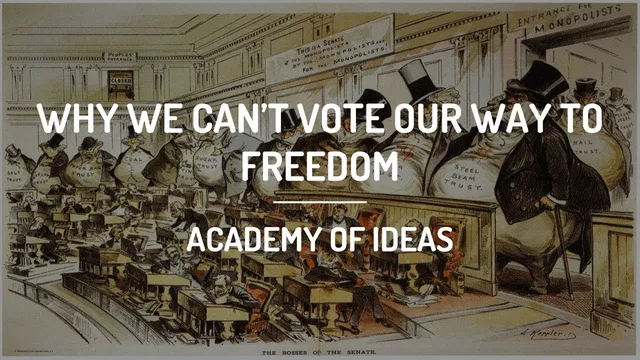
Why We Can’t Vote Our Way to Freedom
Based on Academy of Ideas's video on YouTube. If you like this content, support the original creators by watching, liking and subscribing to their content.
The transcript argues that elections rarely reduce the state’s coercive power because the underlying power imbalance between citizens and government keeps growing.
Briefing
Freedom in Western life has repeatedly lost ground as the modern state expands its reach into everyday existence—so much so that voting, even in democracies, may not deliver the liberty people expect. The central claim is that elections rarely change the underlying power imbalance between citizens and government. Instead, the political system tends to reproduce the same outcomes: war, high taxes, surveillance, heavy regulation, corporate welfare, the war on drugs, and censorship—regardless of which candidate wins.
The argument begins with a historical reversal: early 20th-century optimism about liberty after the abolition of slavery gave way to a government that increasingly “dictates,” “records,” and coerces. Even when power is formally “with the people,” the practical choice offered in major elections often looks like a contest between evils, with little real difference on the growth of state authority. Supporters of the system respond by urging voters to select the “right people” who will end abuses. That faith, the transcript contends, overlooks how powerful incentives and selection pressures shape who rises to the top.
Politics is portrayed as an institution built on coercion or the threat of coercion. Over time, the West shifted from limited government and free markets toward a world where the state limits what individuals can do. That expansion attracts the “power-hungry,” who see political office as the best vehicle for satisfying their desire to control. The transcript adds a psychological and moral dimension: modern politics draws people with an excessively narcissistic temperament—those who believe they should use state power to remake society according to their own vision.
A key theoretical point follows: transferring decisions from the individuals and organizations directly involved to distant politicians and bureaucrats is unlikely to produce better outcomes. The social world is described as an emergent order—coordinated through spontaneous processes like markets—while political planning replaces those decentralized mechanisms with a single plan enforced through violence or its threat. The transcript links this “fatal conceit” to 20th-century socialist experiments, arguing that attempts to centrally reorder complex society have led to impoverishment, suffering, and death.
Even sincere anti-state reformers face structural barriers. Western democracies are dominated by a handful of parties that have no incentive to shrink the state, and those parties can manipulate voting processes. Meanwhile, candidates who cheat, lie, and promise the impossible gain an advantage because truth and integrity do not play well in mass elections. Emotional appeals—especially hatred toward opponents—are highlighted as particularly effective tools for demagogues, echoing Vladimir Lenin’s view that negativity can be used not to persuade but to destroy.
Finally, the transcript argues that even a rare “good” winner would be pressured by bureaucrats and crony networks that benefit from state power. The proposed remedy shifts away from electoral hope toward reducing the concentration of power itself. If disparities of power drive oppression, then freedom requires technologies and social or economic institutions that are less dependent on the state—and, crucially, a diminished ability for a small group to control government. The closing note invokes H. L. Mencken’s bleak view: modern democracies tend to offer voters a choice between a demagogue and a “demo slave,” leaving most candidates either knowingly deceptive or willing to pretend they believe what mass audiences want to hear.
Cornell Notes
The transcript argues that voting cannot reliably produce freedom because elections do not fix the underlying power imbalance created by an expanding state. Modern politics is described as coercive by nature, and the incentives of political competition select for power-hungry, conceited personalities who favor state expansion and centralized planning. Centralized political control is framed as a “fatal conceit” because it replaces decentralized, emergent social coordination (like markets) with top-down plans enforced through threats or violence. Structural barriers—party dominance, manipulation of voting, and the electoral advantage of lying and hatred—make it hard for honest reformers to win or to resist corruption once in office. The proposed path to freedom is reducing concentrated state power and building institutions and technologies that operate independently of government control.
Why does the transcript claim elections often fail to deliver liberty, even when voters choose leaders?
What does the transcript say about what kinds of people politics attracts?
How does the transcript connect centralized planning to historical outcomes?
What electoral dynamics make honesty and truth less competitive than deception?
Why does the transcript doubt that a well-intentioned winner could resist corruption?
What alternative does the transcript propose for restoring freedom?
Review Questions
- What mechanisms in the transcript connect state expansion to a persistent power imbalance that elections cannot fix?
- How does the transcript’s view of “emergent order” challenge the case for centralized political planning?
- Which incentives in mass elections does the transcript identify as favoring demagogues over honest reformers?
Key Points
- 1
The transcript argues that elections rarely reduce the state’s coercive power because the underlying power imbalance between citizens and government keeps growing.
- 2
Political office is portrayed as coercive by nature, and the incentives of office selection favor power-seeking candidates who campaign for expanded state control.
- 3
Centralized political planning is framed as a “fatal conceit” because it replaces decentralized coordination with top-down decisions enforced through threats or violence.
- 4
Structural barriers—dominant parties, manipulation of voting processes, and the electoral advantage of dishonesty—make honest reformers less likely to win.
- 5
Mass elections are described as rewarding emotional hatred and grand promises, which helps demagogues mobilize support.
- 6
Even a well-intentioned winner is said to face institutional pressure from bureaucrats and crony networks that profit from state power.
- 7
The proposed remedy is to reduce concentrated state power and build independent social and economic institutions—supported by technologies—that do not depend on government coercion.