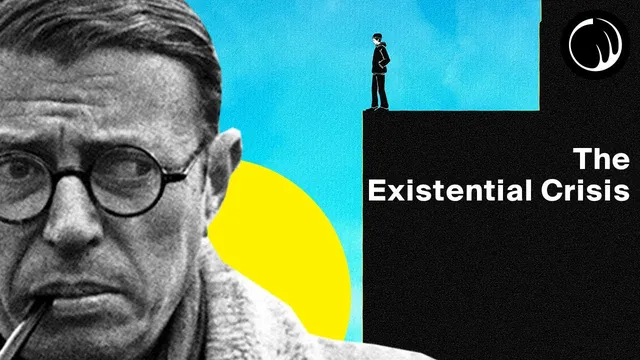
Why We Experience An Existential Crisis - The Philosophy of Jean-Paul Sartre
Based on Pursuit of Wonder's video on YouTube. If you like this content, support the original creators by watching, liking and subscribing to their content.
Sartre’s “existence precedes essence” rejects the idea that humans are born with a fixed purpose; meaning is created through living.
Briefing
Existential crisis, in Jean-Paul Sartre’s framework, isn’t a sign that life has collapsed—it’s the moment people confront the fact that nothing in advance guarantees meaning. Born without choosing one’s circumstances, body, or place in time, a person eventually faces the problem of deciding what to do with what has been done to them. Sartre’s central claim—“existence precedes essence”—captures the idea that humans are not manufactured with a built-in purpose. Unlike a paper knife, made for a specific function before it exists, people must create their own purpose through living.
That absence of predetermined meaning produces a second, sharper problem: anguish over choice. If there is no external authority designing a life plan, then every decision—what to believe, who to be, which path to take—becomes both necessary and uncertain. Sartre treats this not as despair but as the price of freedom: people are condemned to be free, meaning they cannot escape responsibility for how they shape themselves. Even refusing to choose counts as a choice, because inaction still commits someone to a stance.
Sartre also identifies a common escape route: “bad faith,” a self-deception that shifts responsibility outward. People may cling to popular templates, blame circumstances, or pretend their identity is fixed by forces outside them. The psychological payoff is temporary relief from the anxiety of freedom, but the cost is losing one’s authentic self and the real structure of the world. In other words, bad faith dampens anguish by lying—while also narrowing the range of genuine self-making.
Sartre’s view of identity follows from this. A person is “nothing else but what he purposes,” and is “the sum of his actions.” Meaning, then, is not discovered like a hidden object; it is forged through choices and commitments. Life’s inherent meaninglessness becomes, paradoxically, the condition for freedom—freedom to decide what matters, to pursue chosen values, and to build a life that can be owned.
The transcript pushes the practical edge of this philosophy: most decisions cannot be fully validated in advance, and regret often follows either path—whether someone stays or leaves, agrees or disagrees, marries or divorces, takes a job or quits. The uncertainty of outcomes never disappears. What remains is not finding the one “correct” course, but practicing self-honesty and virtue—living in a way that can be revisited without selling oneself short.
Ultimately, the existential burden is framed as a gift with a cost. Facing the abyss of choice and responsibility is difficult, but it humbles and clarifies what it means to be human. Sartre’s ideas land as a reminder to take responsibility for one’s life so thoroughly that the harshest critic is not oneself—because the most important authenticity is the one people maintain internally, even when others judge, disagree, or become upset.
Cornell Notes
Sartre’s existentialism centers on the claim that “existence precedes essence,” meaning humans are not born with a predetermined purpose. Because no external designer supplies meaning, people create who they are through choices and actions. That freedom brings anguish: every decision matters, and even refusing to choose still commits someone to a stance. Sartre warns against “bad faith,” the self-deception that blames circumstances or adopts ready-made templates to avoid responsibility. The result is a life project: build meaning through intentional living, self-honesty, and virtue, even though outcomes remain uncertain and regret is possible.
What does “existence precedes essence” mean, and how does it change how people think about purpose?
Why does the absence of predetermined meaning produce “anguish” rather than simple freedom?
What is “bad faith,” and why is it tempting?
How does Sartre connect identity to action?
If outcomes are uncertain and regret is likely, what does Sartre-style living still require?
Why does the transcript treat facing choice as a “gift” despite its difficulty?
Review Questions
- How does the paper knife example support the claim that humans create purpose rather than inherit it?
- What distinguishes authentic choice from “bad faith,” and what are the consequences of each?
- Why can’t existential living be reduced to finding the single correct decision in advance?
Key Points
- 1
Sartre’s “existence precedes essence” rejects the idea that humans are born with a fixed purpose; meaning is created through living.
- 2
Freedom brings anguish because every decision carries responsibility in the absence of predetermined guidance.
- 3
Even refusing to choose counts as a choice, so responsibility cannot be fully avoided.
- 4
“Bad faith” is self-deception that shifts responsibility to circumstances or popular templates, offering short-term relief at the cost of authenticity.
- 5
Identity is shaped as “the sum of actions,” making purpose something people enact rather than discover.
- 6
Uncertainty and regret are built into life decisions; the practical aim is self-honesty and virtue, not guaranteed outcomes.
- 7
The most important authenticity is internal: taking responsibility so that one’s own self is not the betrayer through denial.