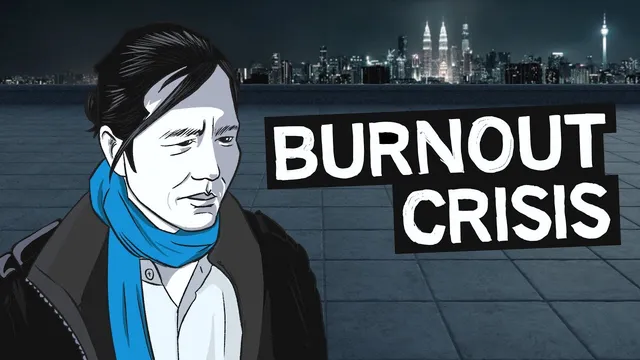
Why We’re All Burning Out | Byung-Chul Han’s Warning to the World
Based on Einzelgänger's video on YouTube. If you like this content, support the original creators by watching, liking and subscribing to their content.
Han argues that achievement culture internalizes control: people feel free while living under an “imperative to achieve.”
Briefing
Modern neoliberal capitalism sells “unlimited can”—the promise that anyone can become the best version of themselves—yet it quietly turns that freedom into a new kind of confinement. Byung-Chul Han’s warning, drawn from his book *The Burnout Society*, is that people aren’t primarily crushed by external rulers anymore. Instead, they internalize the demand to achieve, self-optimize, and excel, carrying a “work camp inside” that drives exhaustion, depression, and social fragmentation.
Han contrasts two social logics: the disciplinary “negativity of Should,” where rules and punishments force behavior, and the achievement “positivity of Can,” where individuals are urged to pursue possibilities. Disciplinary systems rely on domination and visible coercion, but they are costly and unstable—requiring constant enforcement and risking unrest. Achievement systems, Han argues, are more efficient because they shift control inward. The result is not fewer constraints, but constraints that look like self-chosen ambition. People feel free while living inside an “imperative to achieve,” a commandment that turns failure to perform into personal consequence.
That pressure fuels burnout. Han describes the achievement subject as an “animal laborans” who exploits itself voluntarily, becoming both predator and prey. The exploiter and exploited blur: the same person who pushes for success also punishes themselves when they fall short. As goals keep moving, expectations become unrealistic, and the self turns into a closed loop of overexcited self-reference—grinding itself down until it hollows out. Han links this trajectory to depression, portraying burnout as a precursor that emerges when the self can’t step outside itself or rely on anything beyond its own performance.
The exhaustion is amplified by hyperattention and digital life. Constant stimuli—notifications, feeds, messages—fragment focus and crowd out deep contemplation, the kind of sustained attention that produces genuine creativity and lasting work. Instead of profound idleness, people become multitaskers trained for speed, responsiveness, and superficial productivity. Even “breaks” can become another form of stimulation, like binge-watching while scrolling, which keeps the mind busy because it can’t tolerate boredom.
Han also connects achievement culture to broader social and psychological shifts: rising narcissism, transactional relationships, and weakened community bonds. Social networks, in his view, heighten ego by turning attention into a commodity. Even bullying is described as worsening, and society’s concern shifts from the good life toward mere survival.
The proposed counterweight isn’t a step-by-step escape plan. Han frames resistance as reclaiming “vita contemplativa”—a contemplative life that actively protects the mind from excess positivity. That means setting boundaries against constant achievement demands and intrusive stimuli, including learning to tolerate waiting and boredom. Underneath it all is a critique of capitalism’s fixation on survival and health as a substitute for meaning: when life loses narratives and values, “health” becomes a new goddess. Han’s final provocation is stark: people may be trying so hard to survive in an achievement society that they’re “too dead to live.”
Cornell Notes
Byung-Chul Han argues that modern capitalism replaces external discipline with internalized achievement. The “negativity of Should” (rules and punishments) gives way to the “positivity of Can” (endless possibilities), but the result is still confinement—just hidden inside the self. This internal pressure produces burnout and often depression because the achievement subject becomes both exploiter and exploited, constantly demanding more while never reaching an ideal. Digital technology intensifies the problem by fragmenting attention into hyperattention and multitasking, undermining deep contemplation. Han’s resistance is not a quick fix; it’s cultivating “vita contemplativa,” including real breaks that involve boundaries, waiting, and boredom rather than more stimulation.
How does Han distinguish disciplinary society from achievement society, and why does that matter for burnout?
What does “carrying a work camp inside” mean in Han’s framework?
Why does the imperative to achieve lead to depression, according to Han?
How does hyperattention and multitasking connect to creativity and exhaustion?
What social changes does Han associate with achievement culture?
What does Han recommend as resistance if *The Burnout Society* isn’t a self-help guide?
Review Questions
- What are the key differences between Han’s “negativity of Should” and “positivity of Can,” and how does each shape control over behavior?
- Explain the mechanism by which Han says exploitation can occur without domination in an achievement society.
- How does Han connect digital hyperattention to the loss of deep contemplation and to the conditions for burnout?
Key Points
- 1
Han argues that achievement culture internalizes control: people feel free while living under an “imperative to achieve.”
- 2
The shift from external discipline to internal motivation makes burnout more likely because individuals become both guard and prisoner.
- 3
Burnout, in Han’s account, grows from overexcited self-reference—high expectations, shifting goalposts, and self-punishment when ideals aren’t met.
- 4
Digital technology intensifies exhaustion by fragmenting attention into hyperattention and multitasking, reducing the capacity for deep contemplation.
- 5
Han links achievement society to narcissism and transactional relationships, where attention becomes a commodity and community bonds weaken.
- 6
Resistance is framed as cultivating “vita contemplativa,” using boundaries and real tolerance for waiting and boredom to counter excess positivity.
- 7
Han criticizes capitalism’s fixation on survival and health as a substitute for meaning, calling health a “new goddess.”