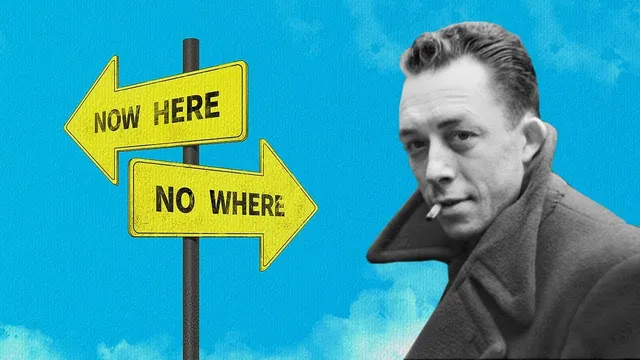
Why We're Fated To Feel Lost - The Philosophy Of Albert Camus
Based on Pursuit of Wonder's video on YouTube. If you like this content, support the original creators by watching, liking and subscribing to their content.
Camus links existential “feeling lost” to a mismatch between human demands for ultimate meaning and a universe that does not provide final answers.
Briefing
Albert Camus’ core claim is that human beings are “fated to feel lost” because the mind naturally demands meaning, reasons, and order—while the universe offers none in any ultimate, final form. That mismatch produces a recurring crisis: ordinary objects and routines suddenly feel strange, and questions about purpose and value become unavoidable. In modern life, where traditional religion has weakened and scientific thinking hasn’t eliminated existential confusion, the result is often a “meaning vacuum” filled with despair, alienation, and a sense that life lacks purpose.
Camus connects this feeling of disorientation to a deeper philosophical diagnosis: absurdity isn’t located in either humans or the universe alone, but in the relationship between them. Humans seek coherent explanations; the world appears indifferent. The absurd emerges when the two collide—when the desire for ultimate truth meets a reality that does not supply it. Camus rejects the nihilistic move that treats this as proof that nothing matters. Instead, he argues for a disciplined acceptance of the absurd as the starting point for living meaningfully.
A key tool for that acceptance comes from Camus’ reading of the myth of Sisyphus. Sisyphus is condemned to push a boulder up a hill only for it to roll back down, forcing endless repetition with no external payoff beyond the process itself. Camus uses this as a mirror for human existence: we keep searching for answers that never fully satisfy the hunger for final truth, and each “solution” can feel like the stone slipping back down the slope. Yet Camus insists on a surprising conclusion—Sisyphus must be imagined as happy. The point isn’t that the punishment becomes meaningful in some cosmic sense; it’s that value can be created and appreciated within the very conditions that seem pointless.
That means happiness and purpose come from how people respond to absurdity, not from discovering a final answer that ends the tension. Camus emphasizes that the everyday details of life—sunlight, trees, fresh air, friends, relationships, family, art, self-exploration—can become sources of richness precisely because there is no guaranteed ultimate justification. Even the act of asking “why?” becomes part of the human drama: the mind keeps reaching, failing, trying again, and learning to live without closure.
In this framework, the goal is not to eliminate the absurd or to reach a definitive metaphysical truth. Instead, people should recognize it, treat it honestly, and then search for and create personally meaningful experiences while sharing that stance with others. Camus also links this acceptance to moral and creative life: using absurdity as a route to ethical engagement, exploration, and art becomes, in his view, one of the highest achievements available to human beings. The guiding line is that the effort of pushing the boulder—rather than any final destination—can be enough to inspire.
Cornell Notes
Camus frames modern existential confusion as a predictable result of a mismatch: humans crave ultimate meaning and order, but the universe appears indifferent. That conflict produces “the absurd,” which lives in the relationship between human longing and a world that does not provide final answers. Rather than collapsing into nihilism, Camus urges acceptance of the absurd as the condition for living. His reading of Sisyphus turns endless repetition into a model for happiness: value is found in the process and in the vivid details of ordinary life. The practical takeaway is to stop chasing a final metaphysical resolution and instead create and appreciate personally meaningful experiences while engaging others honestly.
Why does Camus think people feel lost even when they have science, logic, and information?
What exactly is “absurdity” in Camus’ terms?
How does the Sisyphus myth function as a philosophical argument?
What does it mean to accept the absurd without becoming nihilistic?
Where does Camus say meaning and happiness come from if there is no final purpose?
How does Camus connect absurd acceptance to ethics, art, and relationships?
Review Questions
- How does Camus’ definition of absurdity differ from the idea that life is meaningless on its own?
- What changes in a person’s outlook when they stop seeking a final metaphysical answer and instead focus on the process of living?
- Why does Camus think Sisyphus’ happiness is rational rather than escapist?
Key Points
- 1
Camus links existential “feeling lost” to a mismatch between human demands for ultimate meaning and a universe that does not provide final answers.
- 2
Absurdity is the relationship between human longing for order and the world’s indifference, not a property of humans or the universe alone.
- 3
Modern life can intensify the crisis as traditional religious frameworks weaken while scientific and logical approaches still fail to settle ultimate purpose.
- 4
Camus rejects nihilism by urging acceptance of the absurd as the condition for creating value rather than waiting for cosmic resolution.
- 5
The myth of Sisyphus models endless searching: each attempt at meaning can feel like the boulder rolling back down, yet the process remains the site of value.
- 6
Happiness comes from appreciating ordinary life’s details and creating personal significance through attention, action, and creativity.
- 7
Ethical and artistic engagement become higher achievements when people treat absurdity as something to live through, not something to eliminate.