Why you can't finish what you start and how to fix it
Based on Ali Alqaraghuli, PhD's video on YouTube. If you like this content, support the original creators by watching, liking and subscribing to their content.
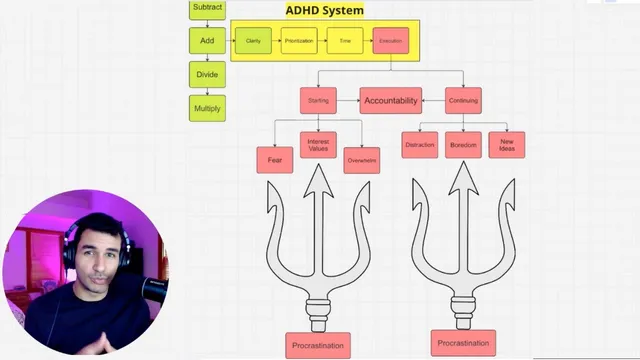
Finishing depends on “continuing,” which breaks down for three main reasons: external distraction, boredom, and internal distraction from new ideas.
Briefing
Finishing what someone starts often fails not because of a lack of willpower, but because execution breaks down after the initial push. The core distinction is between “starting” and “continuing.” Starting can be blocked by weak prioritization—unclear goals, misaligned values, or not feeling confident that a task belongs in the current life plan. Continuing, by contrast, is the ability to stay with a task once it has begun, and it tends to collapse for three predictable reasons: external distraction, boredom, and internal distraction from new ideas.
Distraction is the most obvious culprit. A phone notification, a quick search, or even opening YouTube “just to find a song” can derail attention and create a loop where the original task never gets resumed. The practical fix is environmental: declutter the desk and computer, remove or silence social media and notifications, and reduce opportunities for interruptions. Loved ones can also be managed—setting expectations that only true emergencies warrant breaking focus. For people higher on the ADHD spectrum, the stakes are higher because small interruptions can snowball into long detours.
Boredom is the second failure mode. Some tasks—taxes, paperwork, formal obligations—can be genuinely uninteresting, making it hard to sustain effort even after momentum begins. The suggested remedy is to make the work more tolerable by pairing it with something enjoyable. Music is presented as a “secret weapon”: assign specific playlists or albums to specific tasks so the brain links the pleasure of listening with the act of doing the work. When possible, boredom can also be softened by doing the task with other people, turning solitary drudgery into shared time.
The third issue is internal distraction: ideas that pop up mid-task. While working, the mind generates competing priorities—returning to a holography antenna design, rewriting code, or planning a new YouTube video—creating a rapid-fire stream of “maybe I should do this instead.” The proposed solution is not to suppress creativity, but to capture it. Building a “second brain” through a system for writing down and categorizing ideas lets the person acknowledge the thought, store it for later, and then return to the current task without losing the thread.
Before applying any fix, the transcript emphasizes diagnosis. The first step is awareness: notice why finishing is failing. With a strong clarity and prioritization system, the person can often detect the mismatch—starting something and then not finishing it—then test which of the three causes fits. Once the cause is identified, the cure becomes straightforward: delete distractions, add music/people for boredom, and use an idea-capture system for internal detours.
Accountability is offered as an additional “joker card.” Working alongside someone or having a deadline tied to someone else’s expectations can create urgency and trigger motivating brain chemistry (adrenaline, norepinephrine, dopamine). But even without external pressure, the three-part framework—distraction, boredom, internal ideas—provides a direct path to improving continuation and, ultimately, finishing.
Cornell Notes
Finishing tasks hinges on “continuing,” not just starting. Once a task begins, three common breakdowns appear: external distraction (phones, notifications, interruptions), boredom (work that feels miserable or uninteresting), and internal distraction (new ideas that hijack attention). The approach is to diagnose which problem is happening by building awareness—often supported by a robust clarity and prioritization system—then apply a targeted fix. Solutions include decluttering and removing digital distractions, pairing boring tasks with music (and sometimes people), and capturing new ideas in a “second brain” so they don’t derail the current work. Accountability can also provide urgency when available.
How does “continuing” differ from “starting,” and why does that distinction matter for finishing tasks?
What are the three root causes of not finishing after starting, and what does each look like in real life?
What environmental changes are recommended to reduce external distraction?
How does the transcript suggest handling boredom when a task is inherently unpleasant?
What’s the solution for internal distraction from new ideas during deep work?
How does accountability function as a workaround, and when might it be most useful?
Review Questions
- When you notice you started a task but didn’t finish, what diagnostic steps help determine whether the cause is distraction, boredom, or internal ideas?
- Which specific interventions match each root cause (external distraction, boredom, internal distraction), and how would you apply them to a real task like taxes or coding?
- How would building a “second brain” change your behavior when new ideas appear mid-task?
Key Points
- 1
Finishing depends on “continuing,” which breaks down for three main reasons: external distraction, boredom, and internal distraction from new ideas.
- 2
Weak prioritization and unclear goals can sabotage starting, but continuing failures usually require different fixes.
- 3
Reduce external distraction by decluttering the desk and devices, deleting or silencing social media and notifications, and setting interruption rules with loved ones.
- 4
Treat boredom by pairing unpleasant tasks with enjoyable inputs—especially music tied to specific tasks—and use people when possible.
- 5
Handle internal idea-drift by capturing and categorizing thoughts in a “second brain” so ideas don’t hijack the current task.
- 6
Use awareness to diagnose which root cause is active before choosing a solution; targeted cures work better than generic effort.
- 7
Accountability can create urgency and motivation through external deadlines and expectations, acting as a strong fallback when self-management isn’t enough.