Why You Can't Focus and How to Fix It
Based on Ali Alqaraghuli, PhD's video on YouTube. If you like this content, support the original creators by watching, liking and subscribing to their content.
Focus problems are framed as a brain wiring and communication issue, not a lack of discipline.
Briefing
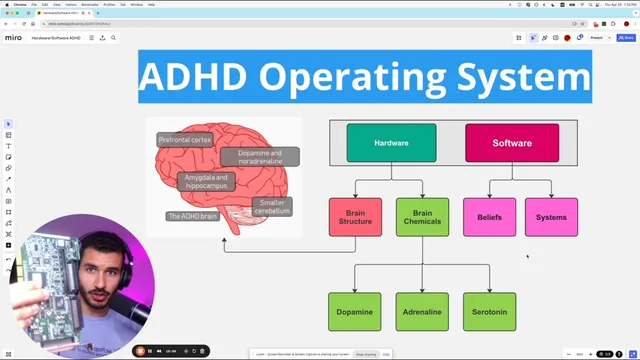
Difficulty focusing isn’t framed as a character flaw; it’s portrayed as a brain “hardware + software” mismatch. People higher on the ADHD spectrum often want discipline and productivity as much as anyone, but their executive-function circuitry—especially the prefrontal cortex—develops differently and communicates less efficiently with other brain regions. That structural lag can make impulsivity, boredom, anxiety, depression, and short- and long-term memory problems more likely, which then feeds a damaging self-image when others misread the behavior as laziness.
The explanation then shifts from structure to chemistry. Focus is linked to how quickly key neurochemicals are available: dopamine (associated with curiosity, reward, and incentives), adrenaline (associated with urgency, especially under deadlines), and serotonin (associated with mood and social connection). The core claim is not that these chemicals are absent, but that they’re reabsorbed quickly—so the brain struggles to stay engaged with tasks that don’t provide immediate novelty or pressure. That dynamic also helps explain why social isolation can worsen mood and why social media and phones can become especially compelling: each new scroll delivers a fresh dopamine-driven hit before attention can stabilize.
Medication is presented as a targeted way to slow reuptake so dopamine and adrenaline remain active longer, improving the ability to sustain attention. The discussion also warns that medication can carry side effects and frames it as a “Band-Aid” for many people, not the whole solution. Natural strategies are offered as ways to manage the same chemical drivers.
For serotonin, the practical lever is connection. The recommended approach is to avoid long isolation and maintain frequent contact with family and friends, including daily calls and regular in-person work with supportive people. For adrenaline, the lever is urgency created on purpose: realistic deadlines plus accountability to someone respected. A personal example describes struggling to progress on advertising for an online course, then partnering with a former paid-ads client who met regularly and imposed deadlines—turning vague goals into time-bound tasks.
Dopamine management is treated as the most complex. Sleep quality is emphasized as a foundation: less and poorer sleep is said to push the brain toward instant gratification, while better sleep strengthens prefrontal, rational control. Diet is also framed as a focus variable, with processed foods and high sugar likened to dopamine-disrupting cycles that feel good then crash. The suggested routine favors minimally processed foods, green tea, dark chocolate, fruits and vegetables, and an “old ingredients” filter.
Finally, a software layer is introduced: beliefs and systems. The key belief urged is that ADHD should not be treated as an identity that excuses inability; it’s acknowledged as a real disorder-like condition, but the recommended mindset is “nothing is wrong with you—your brain is wired differently.” That belief is paired with environmental and behavioral systems—habits, tracking, and setup of devices and workflows—to make focus easier to trigger. The overall message is that attention can be engineered by aligning deadlines, social input, physiology, and daily systems with how the ADHD brain actually runs.
Cornell Notes
People higher on the ADHD spectrum often struggle to focus not because of laziness, but because executive-function brain regions (especially the prefrontal cortex) develop differently and communicate less efficiently with other areas. The focus problem is tied to neurochemistry: dopamine supports curiosity/reward, adrenaline supports urgency under deadlines, and serotonin supports mood and social connection. Quick reuptake dynamics mean tasks without novelty or pressure can fail to hold attention. The practical fixes offered map to these mechanisms: build social connection for serotonin, create realistic deadlines and accountability for adrenaline, and stabilize dopamine through sleep, diet, and short exercise routines. The “software” layer—beliefs and life systems—aims to replace self-blame with a “wired differently, not broken” mindset and to design environments that make focus easier to sustain.
Why does the prefrontal cortex matter for focus in ADHD, and what does the transcript claim about its development?
How do dopamine, adrenaline, and serotonin map to attention and mood?
What does the transcript say about medication and why it can improve focus?
What non-medication strategies are suggested for serotonin, adrenaline, and dopamine?
How does the transcript connect exercise and cold exposure to dopamine and focus?
What does “software” mean here, and what belief is emphasized for ADHD?
Review Questions
- Which executive-function brain region is repeatedly tied to planning and adult self-control, and what developmental difference is claimed?
- How does the transcript explain the difference between tasks that hold attention and tasks that don’t—using dopamine vs adrenaline?
- What combination of “hardware” (sleep/diet/exercise) and “software” (beliefs/systems) is proposed to reduce focus problems?
Key Points
- 1
Focus problems are framed as a brain wiring and communication issue, not a lack of discipline.
- 2
Executive function is linked to the prefrontal cortex; slower development and weaker communication with other regions are presented as key drivers of ADHD-like behavior.
- 3
Dopamine, adrenaline, and serotonin are used as a practical map for motivation: novelty/reward, urgency, and mood/social connection respectively.
- 4
Medication is described as improving attention by slowing neurochemical reuptake (especially dopamine and adrenaline), but it’s treated as incomplete without lifestyle and systems.
- 5
Serotonin support is tied to social connection—frequent contact and avoiding prolonged isolation are presented as high-impact.
- 6
Adrenaline support comes from realistic deadlines and accountability to respected people, turning vague goals into urgent actions.
- 7
Dopamine support is presented as a stack: sleep quality, reduced processed/sugary foods, and short exercise (plus optional cold exposure) to create reliable focus windows.