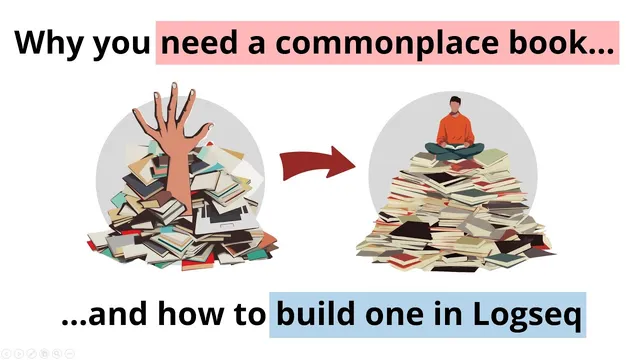
Why you need a commonplace book and how to build one in Logseq
Based on CombiningMinds's video on YouTube. If you like this content, support the original creators by watching, liking and subscribing to their content.
A commonplace book is a reusable repository for ideas and snippets, designed for later writing, speaking, and decision-making—not a promise to remember everything.
Briefing
A commonplace book—an organized storehouse for ideas, quotes, observations, and useful snippets—is positioned as the antidote to information overload, because it turns scattered inputs into reusable knowledge over time. Instead of chasing “remember everything” productivity hacks, the approach treats personal knowledge like a living resource: capture what matters, keep it searchable, and later recombine those pieces into writing, speaking, decisions, and projects. The concept traces back to figures such as Isaac Newton, Leonardo da Vinci, Marcus Aurelius, and others who maintained notebooks to preserve insights for future use.
In practice, the commonplace book is defined as a central repository for “gems” gathered during life and learning. It can include both structured and messy material: reference numbers from service calls, links, screenshots, code snippets, and random tidbits that don’t seem important yet. When ideas come from other sources, the method emphasizes capturing them as building blocks rather than forcing them into a rigid taxonomy immediately. Leonardo da Vinci’s “collection without order” becomes a guiding metaphor: analog note-taking is onerous and hard to retrieve, but a digital system can keep the mess while making it findable.
To build a digital commonplace book, the transcript focuses on Logseq and frames personal knowledge management through a “five PS” workflow: planning, plowing, planting, propagating, and probing. The segment concentrates on “planting,” meaning the capture and storage stage. Four categories of planting are offered: (1) reference materials (links, images, code, font guides), (2) source-based writing (notes and highlights pulled from articles and videos, organized with metadata so they can be triangulated later), (3) freeform thinking and writing (journal entries mixing reflections, emotions, and plans, organized with tags), and (4) project-based thinking and writing (meeting notes, decision tracking, drafts, and scripts managed with templates and queryable tags).
The core advantage of Logseq is retrieval—making it easy to resurface information when it’s needed. The transcript contrasts this with the “Apple Notes vs. overthinking systems” meme: if search and keyword structure are strong, information becomes usable without elaborate upfront design. Logseq’s outliner structure, backlinks, indentation, and filters provide “minimum structure” that supports later organization. Blocks can be dragged and dropped, moved with shortcuts, and rearranged without losing context. Queries add another retrieval layer, letting users pull up specific threads or topics by searching titles, text, or metadata.
Finally, the method argues against premature structuring. Categories should emerge from what the user actually searches for, not from a top-down plan. As the database grows, structure should evolve, and the system should allow ad hoc restructuring. With local-first storage in markdown plus optional syncing (including Sync and services like iCloud), the commonplace book is framed as a long-term project designed to survive app changes—growing into a personal knowledge wiki that can be mined for future work and ideas.
Cornell Notes
A commonplace book is presented as a reusable knowledge repository for ideas, quotes, observations, and useful snippets—built to prevent valuable information from getting lost in the noise. The transcript recommends using Logseq to create a digital version, emphasizing “planting” (capturing and storing material) in four forms: reference materials, source-based writing, freeform journal thinking, and project-based work. Logseq’s outliner, backlinks, indentation, filters, and queries are treated as the retrieval engine that makes messy notes usable later. The approach also warns against heavy upfront categorization; themes should emerge from what the person searches for over time. With local-first markdown storage and syncing options, the system is positioned as durable across devices and years.
What makes a commonplace book different from generic note-taking or “collecting highlights”?
How does “planting” in Logseq organize capture without forcing rigid categories?
Why is retrieval treated as the defining factor in digital note systems?
What role do blocks, metadata templates, and multimedia inputs play?
What’s the warning about organization, and what replaces it?
How does the system address long-term access and portability?
Review Questions
- What are the four “planting” categories, and what kinds of notes belong in each within Logseq?
- How do backlinks, indentation, filters, and queries work together to make retrieval easier than traditional paper notebooks?
- Why does the transcript argue against heavy upfront categorization, and how should categories emerge over time?
Key Points
- 1
A commonplace book is a reusable repository for ideas and snippets, designed for later writing, speaking, and decision-making—not a promise to remember everything.
- 2
Logseq’s “planting” stage can be organized into four capture types: reference materials, source-based writing, freeform journal thinking, and project-based work.
- 3
Outliner-based blocks plus backlinks and indentation provide minimum structure at capture time, while filters and queries handle later retrieval.
- 4
Metadata templates help consolidate source notes by making them triangulatable (e.g., by author/producer) instead of buried in a page-long document.
- 5
The system should avoid premature, rigid categorization; categories should emerge from what the user actually searches for.
- 6
Multimedia capture (screenshots, embedded videos, audio, PDFs) keeps context attached to ideas, improving future reuse.
- 7
Local-first markdown storage with optional syncing supports long-term access and reduces dependence on a single app ecosystem.