Why you should care about knowledge management
Based on Martin Adams's video on YouTube. If you like this content, support the original creators by watching, liking and subscribing to their content.
Knowledge management is about converting information into organized understanding that can be acted on, not just storing notes.
Briefing
Knowledge management is the practice of turning scattered information into organized, usable understanding—so decisions, conclusions, and action become easier. It’s not just “collecting notes.” The core idea is to take in new material, make sense of it, and structure it so it can be applied when it matters.
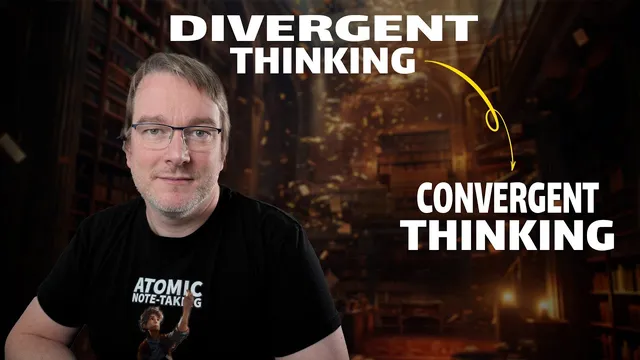
A useful way to frame it is as a loop between divergent and convergent thinking. Divergent thinking pushes outward: exploring new ideas, authors, subjects, and expanding the surface area of what someone knows. Knowledge management then pulls those inputs back inward through convergence thinking, reducing them into concrete takeaways—especially when evaluating something critically. In that sense, the “management” part is the set of techniques, but the purpose is practical: information should lead to action, not remain as clutter.
The urgency behind this approach is straightforward. The modern information environment is overloaded and uneven in quality—news, books, and the constant stream of YouTube content outpace any realistic ability to watch or verify everything. Not all information is accurate, and not all of it is helpful. By managing knowledge, people can filter what’s useful, discard what isn’t, and—crucially—choose which opinions and narratives to let influence their lives. Social media’s open-ended opinion culture often strips away context, making people prone to high-stakes decisions without a full picture. Knowledge management is presented as a remedy for that “chaos,” because it creates structure around what gets trusted and why.
There’s also a preparedness argument: people don’t know when they’ll need understanding most. When serious events occur—medical issues, major decisions, consequences that require interpretation—having tools to organize information can make comprehension faster and more accurate. The transcript highlights a common gap: even at the doctor, people rarely take notes, despite needing to understand medications, decisions, and downstream effects.
The discussion then connects knowledge management to career growth through a concept attributed to Cal Newport: knowledge workers often lack deliberate practice in how they learn and work. Musicians, athletes, and chess players train with intention; knowledge workers typically don’t get taught how to manage inputs like an inbox, communicate effectively, or build systems for better thinking. The payoff, according to Newport’s framing, is “career capital”—the reputation, status, and leverage earned by investing early through extra responsibility, studying, and skill-building. Knowledge management becomes a way to acquire those skills more effectively and to “vault past” peers by turning learning into repeatable performance.
Finally, the transcript lays out who benefits: undergraduates building longer-term knowledge beyond a degree; PhD students shaping research proposals; teachers organizing and delivering material; content creators using a bottom-up workflow (learn first, then create); entrepreneurs applying structured learning to business tasks; programmers turning tutorials into reusable patterns; and self-taught learners connecting books, articles, and quotes into teachable ideas. Curiosity is treated as the engine—knowledge management is the system that helps curiosity keep moving, until it can be shared back with the world.
Cornell Notes
Knowledge management turns incoming information into organized understanding that leads to action. It links divergent thinking (exploring many new ideas) with convergent thinking (reducing inputs into concrete conclusions), especially during critical assessment. The need is practical: information overload, unreliable sources, and social-media-driven decisions often lack context, while serious life moments require fast comprehension and organization. It also supports career growth by enabling deliberate practice for knowledge workers, building “career capital” through skills, responsibility, and reputation. The approach benefits students, researchers, teachers, creators, entrepreneurs, programmers, and self-taught learners by helping them connect ideas and apply what they learn.
How does knowledge management connect divergent and convergent thinking?
Why is knowledge management presented as a remedy for modern information overload?
What preparedness problem does knowledge management address?
How does deliberate practice relate to knowledge workers and career capital?
What does a bottom-up workflow look like for content creation?
How can programmers use knowledge management differently than students?
Review Questions
- What are the practical differences between divergent and convergent thinking in a knowledge management system?
- How does knowledge management change how someone filters information and influences from social media?
- In what ways does building “career capital” depend on turning learning into deliberate, organized practice?
Key Points
- 1
Knowledge management is about converting information into organized understanding that can be acted on, not just storing notes.
- 2
A useful mental model pairs divergent thinking (exploring many ideas) with convergent thinking (reducing inputs into concrete conclusions).
- 3
Information overload and unreliable sources make filtering and context-setting essential for better decisions.
- 4
Serious life moments—especially medical ones—raise the value of having organized notes to interpret decisions and consequences.
- 5
Knowledge workers often lack deliberate practice; knowledge management can supply the structure for improving how they learn and work.
- 6
Career capital grows when early investments in responsibility and skill-building compound into reputation and leverage later.
- 7
Different roles—students, researchers, teachers, creators, entrepreneurs, programmers, and self-taught learners—can use knowledge systems to connect ideas and apply them.