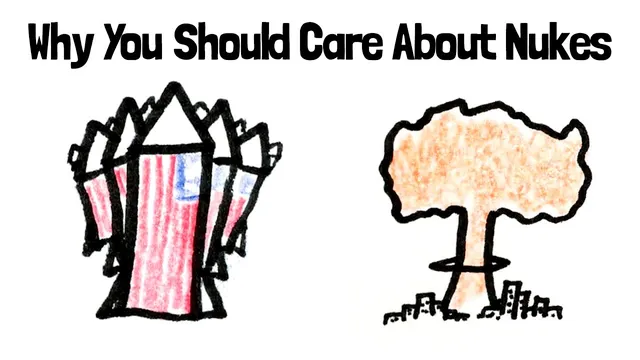
Why You Should Care About Nukes
Based on minutephysics's video on YouTube. If you like this content, support the original creators by watching, liking and subscribing to their content.
Nuclear-induced winter is presented as the most catastrophic nuclear outcome, with soot and smoke potentially causing year-round winter-like conditions.
Briefing
Nuclear weapons pose a risk far beyond immediate blast damage: even a limited exchange could trigger “global nuclear-induced winter,” collapsing food systems and driving mass unrest on a planetary scale. Max Tegmark argues the most dangerous nuclear outcome isn’t only millions killed by explosions or additional deaths from fallout, but the soot and smoke from fires sparked by as few as a thousand detonations. That material could darken the atmosphere enough to plunge Earth into year-round winter-like conditions—effectively a mini ice age—potentially threatening the survival of most of the roughly 7 billion people on Earth.
That threat persists even after Cold War reductions. The United States and Russia have slashed arsenals, but each still retains about 7,000 nuclear weapons. Tegmark’s point is that either side alone could generate a nuclear winter without the other retaliating, meaning the danger doesn’t require a full, mutual exchange.
The conversation then turns to why a catastrophic nuclear war could happen at all. Tegmark says the most likely trigger isn’t deliberate political choice but accident—failures and misinterpretations in early-warning and command systems. He cites near-misses where faulty computer chips in U.S. alarm systems falsely signaled incoming Soviet missiles, prompting preparations for retaliation; where Russian satellites misread a glint of sunlight off clouds as incoming American missiles, with an officer averting escalation by ignoring the alert; and where Russian radar systems mistook a Norwegian scientific rocket for an American nuclear missile, nearly launching retaliatory strikes. The recurring pattern, he argues, is that close calls keep happening and the probability of catastrophe rises as luck runs out.
Finally, Tegmark challenges the idea that nuclear risk is purely a national-security problem with no public leverage. He argues that deterrence requires only a small number of weapons, while maintaining large arsenals creates a danger not only for others but also for the countries that hoard them. In his framing, continuing to stockpile excessive nuclear forces is “stupid, dangerous, and irresponsible.”
On personal agency, he points to the arms race as being fueled not just by security logic but also by money and political incentives. Both the U.S. and Russia are described as planning costly upgrades even as they should be reducing risk. Tegmark adds that roughly 2% of S&P 500 companies are involved in nuclear weapons production; while individuals can’t stop taxes, they can influence the political economy by stigmatizing the industry—specifically by divesting from companies that produce nuclear weapons. The takeaway is that nuclear winter risk is real, accident-prone, and partially addressable through pressure on the financial and political incentives that sustain buildup.
Cornell Notes
The central claim is that nuclear weapons threaten humanity most through the possibility of “global nuclear-induced winter.” Even a relatively small exchange—fires and smoke from as few as a thousand nukes—could darken the atmosphere enough to cause year-round winter-like conditions, collapsing the global food system and triggering apocalyptic unrest. Tegmark argues this risk remains despite Cold War reductions because the U.S. and Russia still each have about 7,000 nukes, enough for one side to induce winter without retaliation. He also emphasizes that nuclear war is more likely to start accidentally than intentionally, citing multiple historical near-misses involving faulty alarms, satellite misreadings, and radar confusion. The practical implication is that deterrence doesn’t require massive arsenals, and public action like divestment can help reduce the political and financial incentives for buildup.
Why does the discussion treat “nuclear winter” as the biggest nuclear threat rather than explosions or fallout?
How can nuclear winter happen even if only one country launches nukes?
What makes accidental nuclear war plausible in this account?
Why does the argument say having more nukes than needed for deterrence is dangerous for everyone—including the country that owns them?
What practical action is offered to individuals who feel they can’t influence nuclear policy?
Review Questions
- What atmospheric mechanism links a limited nuclear exchange to year-round winter-like conditions?
- Which specific types of failures (computer, satellite, radar) are cited as near-miss causes of accidental escalation?
- Why does the argument claim deterrence does not require large arsenals, and how does that connect to divestment as a form of pressure?
Key Points
- 1
Nuclear-induced winter is presented as the most catastrophic nuclear outcome, with soot and smoke potentially causing year-round winter-like conditions.
- 2
A limited exchange—fires and smoke from as few as a thousand nukes—is described as sufficient to darken the atmosphere and disrupt global climate.
- 3
Cold War reductions did not eliminate risk because the U.S. and Russia still each retain about 7,000 nuclear weapons, enabling winter even without retaliation.
- 4
Accidental escalation is emphasized as a major pathway to nuclear war, with examples involving faulty alarms, satellite misreadings, and radar confusion.
- 5
Deterrence is argued to require only a small number of nuclear weapons; maintaining excess arsenals increases danger through accident risk.
- 6
The arms race is portrayed as influenced by money and politics, including costly upgrades by the U.S. and Russia.
- 7
Divestment is offered as a practical public action: about 2% of S&P 500 companies are involved in nuclear weapons production, and stigmatizing them can apply pressure.