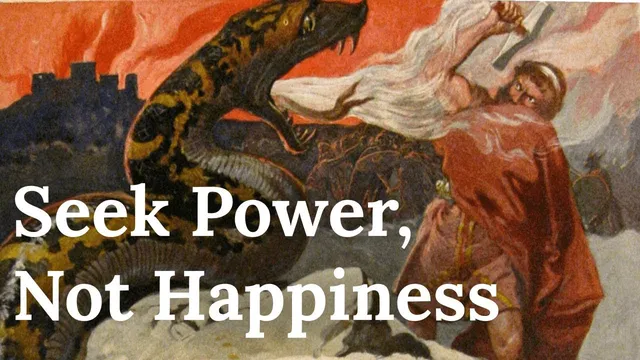
Why You Should Seek Power, Not Happiness - Nietzsche's Guide to Greatness
Based on Academy of Ideas's video on YouTube. If you like this content, support the original creators by watching, liking and subscribing to their content.
Nietzschean flourishing prioritizes enhancement of power over chasing happiness as an end in itself.
Briefing
Nietzschean self-improvement hinges on one priority: enhancement of power, not the pursuit of happiness. The core claim is that people inevitably organize their lives around an ultimate value—wealth, status, pleasure, knowledge, comfort—and that choosing “power” as the highest value is the most reliable route to health, fulfillment, and a life that keeps getting stronger.
In this framework, “power” does not mean domination over others. Nietzsche treats the urge to control as often rooted in weakness—an attempt by the insecure to manufacture superiority through manipulation. The more authentic target is power embodied within the self: growth, expansion, and the strengthening of capacities through disciplined practice. Examples range from an athlete building strength to a writer improving craft, an orator sharpening speech, or a teacher increasing the ability to educate. John Richardson’s interpretation sharpens the point: the purest power is “more life” raised to a higher level of capacity and control—an ascent that requires “self-overcoming,” not just expanding what already exists.
That ascent begins with goal-setting. A worthwhile goal must be meaningful and challenging, support health and well-being (including the well-being of others), foster personal excellence, and be self-chosen—an expression of individuality rather than borrowed ambition. Once the goal is set, daily, consistent work matters more than mood. Progress brings resistance: self-doubt, fear, anxiety, laziness, scarcity, criticism, and even health or relationship problems. Nietzsche reframes these obstacles as fuel. Resistance is valuable because it forces the mind and body to stretch; it functions like a worthy opponent for a warrior, turning friction into skill. The “game of resistance and victory” becomes a repeating pattern—overcome one hindrance, meet the next—until the original aim is reached.
But reaching a goal is not the finish line. Nietzsche’s cycle demands that achievements be left behind and replaced with fresh, greater challenges. What matters is not accumulating accomplishments but continuing to achieve—turning each attained state into the next platform for growth. Happiness, in this view, is not a target pursued for its own sake; it is a byproduct of increasing power. The feeling of happiness tracks the sense that a resistance has been overcome.
This ethics of power also offers a response to suffering. Many systems try to justify pain by pointing to a “true world” beyond the present—religious heavens or utopian futures where suffering is minimized. Nietzsche criticizes that move as devaluing earthly life and requiring faith in something outside experience. Instead, suffering is treated as inseparable from resistance: pain and distress arise when something hinders the will to power. If power is the highest value, then resistance—and the suffering that comes with it—becomes meaningful rather than nihilistic. The result is a life structured around continual self-overcoming, grounded in present action rather than salvation fantasies, and oriented toward “great health” and “great happiness” as the spontaneous outcomes of growth.
Cornell Notes
Nietzschean greatness is organized around enhancement of power rather than the pursuit of happiness. “Power” here means growth and expansion of one’s capacities—an inner strengthening that comes through self-overcoming—rather than controlling other people. The path starts with choosing high, noble goals that are meaningful, challenging, health-promoting, excellence-building, and self-chosen. Daily commitment brings resistance (fear, doubt, laziness, criticism, setbacks), and overcoming those resistances increases power. The cycle repeats: once a goal is reached, it is left behind and replaced with a greater challenge, with happiness understood as a symptom of power increasing—especially when resistance is overcome.
How does Nietzsche distinguish “power” from the common idea of dominating others?
What makes a goal the right kind of starting point for building power?
Why are obstacles and resistances treated as opportunities rather than setbacks?
What does it mean to “overcome” achievements instead of resting on them?
How does this view connect power to happiness?
How does Nietzsche’s ethics of power address the problem of suffering?
Review Questions
- What four criteria must a goal meet to function as a starting point for Nietzschean power-building?
- How does the “game of resistance and victory” structure growth over time?
- Why does Nietzsche treat happiness as a byproduct rather than a direct objective?
Key Points
- 1
Nietzschean flourishing prioritizes enhancement of power over chasing happiness as an end in itself.
- 2
“Power” means inner growth and increased capacity, not domination of other people.
- 3
High goals must be meaningful, challenging, health-promoting, excellence-building, and self-chosen.
- 4
Consistent daily effort turns resistance—fear, doubt, criticism, setbacks—into the raw material for strengthening.
- 5
Achieving a goal is only a checkpoint; greatness requires leaving achievements behind and seeking higher challenges.
- 6
Suffering is reinterpreted as the pain of resistance, making it meaningful within a life aimed at power rather than salvation fantasies.