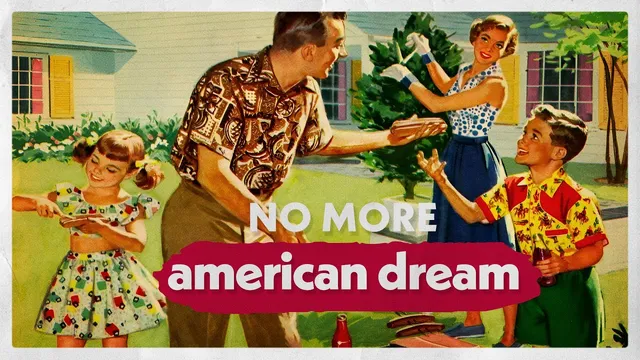
Why You'll Never Achieve The American Dream
Based on Second Thought's video on YouTube. If you like this content, support the original creators by watching, liking and subscribing to their content.
A cited study claims no U.S. state allows a married couple earning $100,000 to afford a baseline American Dream package that includes children, a pet, homeownership, and savings.
Briefing
The “American Dream” has effectively collapsed for most Americans because the economic system that once made middle-class stability plausible has shifted toward profit extraction, wage stagnation, privatization, and precarious work—leaving even $100,000 household incomes short of what’s required to live the dream. A recent cross-state analysis cited in the discussion finds no U.S. state where a married couple earning $100,000 can afford a baseline version of the American Dream: a home, children, a pet, and money left over for savings. The gap widens sharply in high-cost places like Massachusetts, where the threshold rises above $240,000, while even the “least expensive” state, Mississippi, still requires roughly $119,000.
That affordability crisis is framed as a downstream result of policy and structural changes, not a temporary downturn or personal failure. The narrative traces how the dream became a national promise: early colonial settlement sold the continent as a land of opportunity; later industrial expansion and the Gilded Age crystallized upward mobility as something achievable through hard work; the Great Depression turned the dream into a “national prayer,” and Franklin D. Roosevelt’s New Deal revived it by reducing poverty and expanding opportunity. After World War II, the dream became culturally entrenched through a booming economy, a growing middle class, and mass suburbanization—conditions that made stability feel attainable.
Between the 1950s and today, the discussion argues, the promise unraveled as government functions were increasingly sold to corporate interests. Reagan-era policy is singled out as a turning point: privatization accelerated, social safety nets were stripped back, and government agencies were pushed to operate like profit centers. The “trickle-down” idea is dismissed as a scam, with the claim that inequality and related indicators visibly worsened during that period. The result is a modern cost-of-living squeeze where wages don’t keep up, and where essential life milestones—homeownership, education, and stable employment—have become harder to reach.
Housing is only the start. College costs are described as having surged dramatically—tuition and fees rising 1,200% since 1980—helping drive student loan debt to $1.74 trillion. The discussion links this to a labor market increasingly dominated by gig work: as of 2023, nearly all new jobs are said to be part of the gig economy, with 59 million Americans performing gig work. These jobs are portrayed as lacking benefits and labor protections, shifting risks onto workers while companies keep profits.
All of these pressures—income inequality, stagnant wages, student debt, inflationary living costs, and gig precarity—are presented as symptoms of capitalism’s core contradiction: an owner class seeking maximum profit versus a working class seeking higher pay. When profits slip, the narrative warns, the ruling class tightens control, using political and sometimes violent repression to preserve the status quo. The “American Dream” myth is treated as inseparable from broader U.S. exceptionalism and imperial power; as that external dominance weakens, the discussion claims fascistic tendencies intensify inward.
The closing message shifts from diagnosis to action: build community-based alternatives—food programs, education, and defense initiatives—citing the Black Panthers as an inspiration. The “dream” that replaces the American Dream is framed as a collective project prioritizing dignity, stability, and solidarity for working people rather than endless growth for a small elite.
Cornell Notes
The discussion argues that the American Dream is no longer affordable for most households because wages and benefits have failed to keep pace with rising costs and because policy has increasingly favored corporate profit over social stability. A cited study claims there is no U.S. state where a married couple earning $100,000 can afford a baseline version of the dream, with thresholds rising to over $240,000 in places like Massachusetts. The narrative traces the dream’s rise through colonial opportunity, industrial-era mobility promises, New Deal reforms, and post–World War II prosperity, then points to Reagan-era privatization and safety-net cuts as a turning point. It connects today’s housing, education, and employment crises—student debt and gig work—to capitalism’s profit-driven structure and its tendency to concentrate power. The proposed response is to build community institutions that governments and markets fail to provide.
What does the cited affordability analysis define as “the American Dream,” and what does it conclude about $100,000 household incomes?
How does the discussion explain the American Dream’s historical rise and later collapse?
Why does the narrative blame Reagan-era changes rather than treating today’s problems as purely cyclical?
What role do education costs and student debt play in the affordability crisis?
How does the discussion connect gig work to the broader claim that the American Dream is unattainable?
What is the proposed “replacement” for the American Dream, and what actions are suggested?
Review Questions
- What specific household threshold does the discussion use to test whether the American Dream is affordable, and how do results vary across states?
- Which historical periods are credited with making the American Dream seem achievable, and what later changes are blamed for reversing that trend?
- How does the discussion link student debt and gig work to the claim that capitalism’s profit motive prevents broad middle-class stability?
Key Points
- 1
A cited study claims no U.S. state allows a married couple earning $100,000 to afford a baseline American Dream package that includes children, a pet, homeownership, and savings.
- 2
The American Dream is traced from colonial “opportunity” mythology through industrial-era mobility promises, New Deal reforms, and post–World War II prosperity before being described as unraveling in later decades.
- 3
Reagan-era policy is portrayed as a turning point that accelerated privatization, reduced social safety nets, and increased corporate influence over government decisions.
- 4
Rising costs—especially housing, education, and everyday expenses—are presented as outpacing stagnant wages, making middle-class stability harder to reach.
- 5
College affordability is framed as a central driver of instability, with tuition and fees described as rising 1,200% since 1980 and student loan debt reaching $1.74 trillion.
- 6
The labor market shift toward gig work is described as removing benefits and labor protections, with 59 million Americans doing gig work and nearly all new jobs categorized as gig-related as of 2023.
- 7
The proposed response is to build community institutions (education, food programs, and defense) to replace functions the discussion says markets and governments fail to provide.