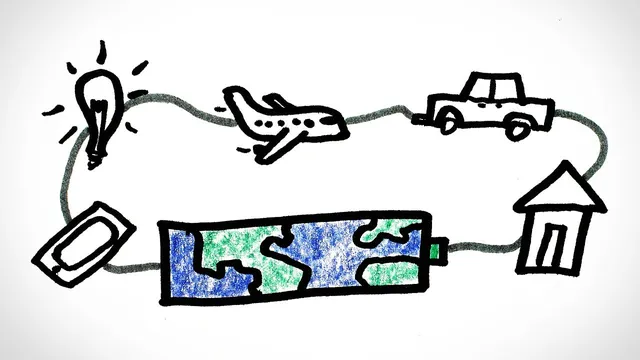
Will Batteries Power The World? | The Limits Of Lithium-ion
Based on minutephysics's video on YouTube. If you like this content, support the original creators by watching, liking and subscribing to their content.
Battery weight efficiency is limited by both the mass of the reacting materials and the energy delivered per electron transferred.
Briefing
Batteries are getting dramatically better at storing energy per kilogram, but chemistry and engineering impose hard ceilings on how light rechargeable batteries can become—ceilings that likely mean a fully battery-powered planet won’t arrive through lithium-ion alone. Over the past two decades, modern rechargeable batteries have more than doubled their energy density compared with the 1990s, cutting weight in half for the same stored energy and enabling smartphones, drones, and electric vehicles. The key question now is whether that trend can continue indefinitely, or whether fundamental limits in materials and reaction energy will flatten progress.
At the core, a rechargeable battery works by trading electrons between two materials: one side tends to give up electrons (atoms that dissolve more), while the other side tends to accept electrons (atoms that deposit back onto a solid). The intrinsic “lightweight” limit comes from two factors: the mass of the materials involved and how much energy each electron transfer can deliver. In principle, the most promising chemistry would pair very light atoms that strongly want to lose electrons with very light atoms that strongly want to gain them—elements on opposite sides of the periodic table. Lithium, sodium, and beryllium sit on the electron-losing side, while fluorine, oxygen, and sulfur sit on the electron-accepting side; atoms near the top of the periodic table are also lighter.
Reality blocks the simplest dream. Lithium and fluorine, for example, are so reactive that practical lithium-fluorine batteries are essentially off the table; the only well-documented uses of lithium–fluorine chemistry are tied to extremely powerful and dangerous rocket fuel. More broadly, battery electrochemistry must be controllable at normal temperatures and pressures, and it has to work with real-world constraints: oxygen is a gas, sulfur is a poor conductor, and sodium often requires molten conditions. Those practical requirements force designers away from idealized electron-pairing and toward workable combinations.
Today’s mainstream lightweight, rechargeable, commercially safe batteries use lithium and graphite on one side, with other materials—often cobalt oxide—on the other. Even when lithium is the active species that moves in and out during charge and discharge, much of the rest of the battery becomes “dead weight” that adds mass without delivering proportional energy per electron. Theoretical estimates suggest lithium-ion batteries could eventually reach a minimum weight around half of what current designs weigh.
Next-generation candidates push further. Lithium-sulfur batteries offer similar energy per electron to lithium-ion but use lighter constituents, implying a battery with the same capacity could weigh about one-third as much. Lithium-oxygen batteries are even more aggressive: in theory they could be four times lighter than lithium-sulfur. Yet chemistry’s ceiling is close. The best possible electron-energy-per-weight pairing is already near the lithium/fluorine ideal, and even a hypothetical lithium-fluorine battery would be only about 10% lighter than lithium-oxygen. That puts the theoretical lower limit for chemical-reaction-based batteries at roughly 5% of today’s battery mass—an “everything works perfectly” scenario.
More plausible futures likely blend technologies rather than replace them: supercapacitors, fuel cells, hydropower, and other mechanical storage. Aviation may still rely on hydrocarbon fuels, and breakthroughs like fusion could matter more than incremental battery chemistry. The episode also spotlights a practical example: an Anker battery pack small enough to be “basically eight” battery units with circuitry can charge a smartphone about 10 times, illustrating how far current lithium-ion has already come—while underscoring that the next leap may require more than just squeezing lithium-ion harder.
Cornell Notes
Rechargeable batteries are improving fast, but chemistry sets a ceiling on how light they can get. Battery operation depends on electron transfer between an electron-losing material and an electron-accepting material; the lightest designs require low-mass materials and high energy per electron. Lithium-ion is already near a practical regime, with theory suggesting it could at best reach about half today’s weight for the same stored energy. Lithium-sulfur and lithium-oxygen could reduce mass further in theory, but the ultimate limit for chemical batteries is only about 5% of current battery weights—an unlikely “perfect world” outcome. That makes hybrid energy-storage approaches and non-battery options more likely for powering the planet.
What two physical factors determine how lightweight a battery can be?
Why can’t an idealized lithium–fluorine battery become the practical endgame?
What makes today’s lithium-ion batteries work in practice even if they aren’t “perfect” on paper?
How do lithium-sulfur and lithium-oxygen batteries compare to lithium-ion in theoretical weight?
What is the theoretical lower limit for chemical-reaction-based batteries, and why is it unlikely to be reached?
If batteries hit a ceiling, what energy-storage mix becomes more plausible?
Review Questions
- Which two constraints—materials mass and energy per electron—most directly limit how light a battery can become, and how do they interact?
- Why do practical constraints (temperature, conductivity, physical state) rule out some high-theoretical electron-pairing chemistries like lithium–fluorine?
- What weight reductions are predicted for lithium-ion, lithium-sulfur, and lithium-oxygen, and what does that imply about the ceiling for chemical batteries?
Key Points
- 1
Battery weight efficiency is limited by both the mass of the reacting materials and the energy delivered per electron transferred.
- 2
The simplest “best chemistry” idea—pairing light electron donors and acceptors like lithium and fluorine—fails because real reactions are too reactive to control safely.
- 3
Mainstream lithium-ion designs use lithium as the active electron-moving species while other components (like graphite and often cobalt oxide) add necessary structure and chemistry but also add mass.
- 4
Theoretical limits suggest lithium-ion could at best reach about half the current weight for the same stored energy.
- 5
Lithium-sulfur and lithium-oxygen could reduce mass further in theory, but chemical-reaction batteries appear to bottom out around ~5% of current weights in an ideal scenario.
- 6
Because the chemical ceiling is near, a realistic future likely mixes batteries with supercapacitors, fuel cells, hydropower, and other storage methods rather than relying on lithium-ion alone.
- 7
Even with major progress, some sectors like aviation may continue using hydrocarbon fuels unless breakthroughs beyond batteries arrive.