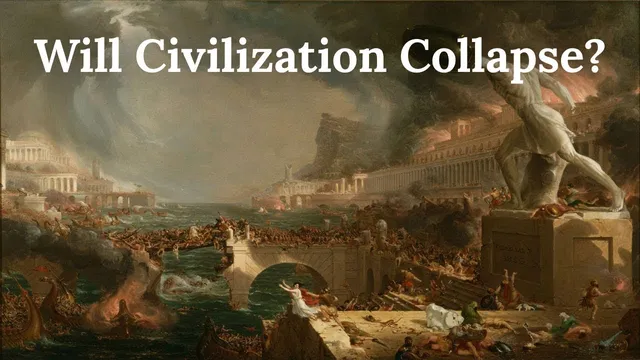
Will Civilization Collapse?
Based on Academy of Ideas's video on YouTube. If you like this content, support the original creators by watching, liking and subscribing to their content.
External shocks are portrayed as survivable; collapse is framed as the result of internal erosion that removes resilience before a crisis hits.
Briefing
Civilizations don’t usually collapse because of a single outside shock; they decline when internal strength and moral cohesion erode until external crises become fatal. The core claim is that great societies can survive invasions, epidemics, and natural disasters—yet fail when they lose resilience and adaptive capacity, effectively “rotting from the inside out.” That framing matters because it shifts the question from “What catastrophe is coming?” to “What long-running internal dynamics are already weakening a society?”
The transcript lays out a pattern-based theory of civilizational lifecycles, drawing on Sir John Bagot Glubb (Glubb Pasha). Civilizations are compared to biological organisms with a natural lifespan: an early burst of energy, followed by growth, then decline, and finally death. Glubb’s recurring pattern—seen across widely different climates, cultures, and religions—begins with an “Age of Pioneers,” when a small, determined group of innovators, warriors, and explorers lays foundations through risk-taking and initiative. Once territory is settled and resources are harnessed, the “Age of Commerce” follows: cities expand, infrastructure is built, wealth accumulates through production and trade, and cultural institutions flourish. This is the “High Noon of prosperity,” a peak of wealth and glory.
But the prosperity that marks the high point also seeds collapse. The transcript argues that the transition into the “Age of Affluence” corrupts civic character: wealth becomes an end in itself, replacing dedication, sacrifice, and duty with selfishness, greed, and vanity. People grow accustomed to comfort and develop low tolerance for hardship—“good times create weak men.” A second accelerant is the rise of welfare and entitlement. With abundant resources, citizens and rulers increasingly rely on the state to redistribute wealth for medical care, education, housing, social insurance, and handouts. The result is described as a welfare state with growing client rosters and subsidy burdens, alongside reduced personal responsibility and independence.
Next comes the “Age of Intellect,” where leisure and security allow more attention to intellectual pursuits. Yet the transcript warns that excessive one-sided rationalism can become tyrannical, treating reason as the only route to truth and discarding symbolic, moral, and often “irrational” truths embedded in myth and religion. As religious and mythic pillars weaken, critical intellectuals multiply and dismantle dominant values, feeding moral relativism and existential nihilism—belief that objective truth and inherent moral value do not exist, and that life and history lack meaning. William Ophuls is used to describe societies becoming “value free,” losing the moral core that once guided them.
The terminal stage is the “Age of Decadence.” Without an overarching guiding ideal, the transcript depicts widespread disorientation and moral decay: masses seek relief through base pleasures, addictions, and escapism; people struggle to distinguish true from false and right from wrong; virtues are inverted into vices. Mental illness becomes normalized, beauty and genius are replaced by banality, and apathy replaces greatness. Citing Rome’s trajectory—especially the shift from early austere virtue to later corruption—the transcript concludes that the process is progressive and difficult to escape. It ends by pointing to another driver of decline: mismanagement and corruption by ruling political classes, which will be examined further in a subsequent segment.
Cornell Notes
The transcript argues that civilizational collapse is driven less by outside shocks than by internal decay that makes societies unable to withstand crises. Using Sir John Bagot Glubb’s “life stages” model, it traces a cycle from the “Age of Pioneers” to the “Age of Commerce,” then to the “High Noon of prosperity,” which seeds the “Age of Affluence.” Affluence is portrayed as moral corrosion through greed, entitlement, and welfare dependence, followed by an “Age of Intellect” where one-sided rationalism and the erosion of religion and myth weaken shared moral foundations. The final “Age of Decadence” is marked by disorientation, pleasure-seeking, moral inversion, and widespread social breakdown. The stakes: if decline is hardwired into internal dynamics, early warning signs matter more than waiting for catastrophe.
Why does the transcript treat external causes (invasions, disasters, epidemics) as insufficient on their own?
What are Glubb Pasha’s main stages of a civilization’s lifespan, and what changes at each step?
How does the transcript connect wealth to moral decline during the “Age of Affluence”?
What role does welfare play in the decline described for Rome?
Why does the transcript say the “Age of Intellect” can be dangerous rather than purely beneficial?
What does the transcript portray as the defining features of the “Age of Decadence”?
Review Questions
- Which internal changes does the transcript claim make civilizations less able to handle external crises?
- How does the transcript link welfare expansion to reduced personal responsibility and long-term decline?
- What mechanisms does the transcript use to connect one-sided rationalism to moral relativism and nihilism?
Key Points
- 1
External shocks are portrayed as survivable; collapse is framed as the result of internal erosion that removes resilience before a crisis hits.
- 2
Glubb Pasha’s lifecycle model describes recurring stages: Pioneers, Commerce, Affluence, Intellect, and Decadence, with prosperity sowing the conditions for decline.
- 3
Affluence is linked to moral corruption through greed and vanity, plus reduced tolerance for hardship as comfort becomes normal.
- 4
Welfare and entitlement are presented as accelerants: state redistribution grows, personal responsibility declines, and civic independence weakens.
- 5
The “Age of Intellect” is treated as a turning point where over-rationalism and the weakening of religion and myth undermine shared moral foundations.
- 6
Decadence is characterized by value inversion, pleasure-seeking escapism, ethical confusion, and social breakdown.
- 7
A further driver of decline is foreshadowed: mismanagement and corruption by ruling political classes.