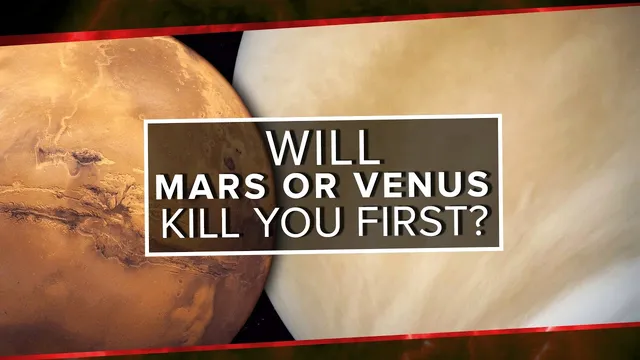
Will Mars or Venus Kill You First?
Based on PBS Space Time's video on YouTube. If you like this content, support the original creators by watching, liking and subscribing to their content.
Mars’ weak gravity and lack of a strong magnetic field allow the solar wind to strip away its atmosphere, leaving surface pressure around 0.5% of Earth.
Briefing
Mars and Venus both pose lethal hazards for human colonists, but they kill in very different ways—Mars through vacuum-like air loss and radiation exposure, Venus through crushing heat/pressure and corrosive cloud chemistry. The core takeaway is that neither planet is “Earth 2.0” in any practical sense: survival depends on engineering workarounds (pressure, shielding, and habitat design) that address multiple, compounding threats at once.
Mars starts with the planet’s inability to hold onto a life-supporting atmosphere. Its small mass—about one-tenth Earth’s—means weaker gravity and a cooled, solidified interior that shut down its once-spinning iron core and magnetic field. Without a strong magnetosphere, the solar wind steadily strips away atmospheric gas. Today the surface pressure is only about 0.5% of Earth’s, effectively a near-vacuum. A casual “walk outside” after a six-month trip would quickly become fatal: even if temperatures occasionally reach survivable highs near 20°C (68°F) at the equator, the low pressure would cause immediate asphyxiation. The danger isn’t explosive decompression so much as ebulism—liquids boil at lower temperatures, leading to bubbling in tissues and, crucially, oxygen-depleted blood that can starve the brain and eventually block blood flow. Recovery is possible only if exposure is brief; a NASA vacuum chamber suit test in 1966 left Jim LeBlanc exposed and he reported saliva boiling off his tongue before blacking out at about 15 seconds, though rapid rescue led to full recovery. Even then, Mars isn’t just a “pressure problem.” Space radiation is a second, long-duration killer: the thin atmosphere and weak magnetic protection allow cosmic rays and solar particles to damage DNA. A round-trip already exceeds recommended radiation lifetime limits, raising cancer risk, and a coronal mass ejection can deliver lethal radiation poisoning. Shielding helps—water or other material about a meter thick can protect against these blasts—but that requires dedicated bunker-like coverage and early warning from solar flares.
Venus flips the script. At the surface, conditions are instantly lethal: roughly 90 atmospheres of pressure and about 450°C would implode and roast an exposed human. The proposed workaround is not ground colonies but floating cloud cities around 50 kilometers up, where pressure and gravity are closer to Earth (about 1 atmosphere and roughly 0.9g). Outside, however, the environment is still hostile. The cloud layer is typically cloudy and often involves scalding fog or rain made of sulfuric acid rather than water, which would blister and dissolve skin. Because the atmosphere is mostly CO2, asphyxiation can occur before acid damage becomes the main failure mode. Protection is comparatively straightforward in concept—acid-proof, heat-resistant suits plus an air supply—while Venus’s thicker atmosphere and induced magnetic sheath (from solar wind interaction) offer better radiation shielding than Mars, though not as good as Earth.
Taken together, Mars and Venus don’t just threaten life; they demand different survival architectures. Mars requires extreme attention to vacuum physiology and radiation shielding against both steady cosmic rays and rare but deadly solar storms. Venus requires chemical and thermal protection in a high-temperature, high-acid cloud environment, even if radiation exposure is less severe than on Mars. The broader message lands on a familiar conclusion: Earth’s combination of pressure, temperature, and magnetic protection is unusually safe, and keeping it that way matters.
Cornell Notes
Mars and Venus are both capable of killing humans, but the lethal mechanisms differ sharply. Mars lacks a strong magnetic field and has a very thin atmosphere (about 0.5% of Earth’s surface pressure), so exposure to near-vacuum conditions leads to asphyxiation and ebulism, while long stays add serious cancer risk from cosmic rays and solar particle events. Venus is far worse at the surface (about 90 atmospheres and ~450°C), but floating cloud cities around 50 km altitude could reduce pressure and gravity to near-Earth levels; the main outdoor threats then become sulfuric-acid fog/rain and CO2 asphyxiation. Radiation protection on Venus is better than on Mars due to atmospheric shielding and an induced magnetic sheath, though it’s not Earth-level. Either way, survival depends on engineered habitats, suits, and shielding.
Why does Mars struggle to keep an atmosphere, and how does that translate into immediate danger for colonists?
What is ebulism on Mars, and why is it more than a “temperature” problem?
How does radiation risk differ between a short Mars trip and a long-term colony?
Why are coronal mass ejections singled out as a special danger for Mars missions?
What makes Venus’ cloud-city concept viable compared with a surface colony, and what still kills people outside?
Review Questions
- If Mars’ atmosphere is stripped by the solar wind, which two planetary features in the transcript explain why that stripping is effective?
- Compare the main “outside the habitat” hazards on Mars versus Venus (physiology vs chemistry vs radiation).
- What role does shielding thickness (around a meter of water or equivalent) play in surviving a coronal mass ejection?
Key Points
- 1
Mars’ weak gravity and lack of a strong magnetic field allow the solar wind to strip away its atmosphere, leaving surface pressure around 0.5% of Earth.
- 2
Near-vacuum exposure on Mars can cause ebulism and oxygen-depleted blood, leading to loss of consciousness within seconds and death shortly after.
- 3
Radiation on Mars is a two-layer problem: steady cosmic rays raise cancer risk, while coronal mass ejections can cause lethal radiation poisoning.
- 4
A long-term Mars colony would need improved shielding and dedicated bunker-like cover because CMEs can be deadly even if steady radiation seems manageable.
- 5
Venus is lethal at the surface (about 90 atmospheres and ~450°C), but floating cloud cities around 50 km altitude reduce pressure and gravity to near-Earth levels.
- 6
On Venus’ cloud layer, sulfuric-acid fog or rain and CO2 asphyxiation dominate the immediate hazards, requiring acid-proof suits and breathable air.
- 7
Venus offers better radiation protection than Mars due to atmospheric shielding and an induced magnetic sheath, though it still isn’t Earth-level safety.