Will Positive Geometry Revolutionize Physics or Destroy It?
Based on Sabine Hossenfelder's video on YouTube. If you like this content, support the original creators by watching, liking and subscribing to their content.
Positive geometry aims to unify physics by encoding which changes are possible using higher-dimensional geometric regions defined by nonnegativity inequalities.
Briefing
Positive geometry is being pitched as a unifying framework for physics—one that could connect particle interactions and even the evolution of the universe—by translating “what a system can do” into geometric objects defined by positivity constraints. The approach generalizes the amplituhedra, higher-dimensional shapes associated with Nima Arkani Hamed and collaborators, and recent work aims to connect those geometric structures to more conventional physics tools such as differential equations and correlation functions. If it delivers, the payoff would be a new bridge between quantum physics and gravity, grounded in a language that already encodes how physical change is allowed.
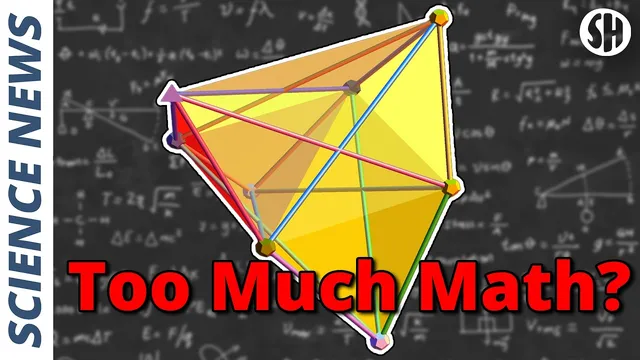
At its core, positive geometry starts from a mathematical recipe: take a complex algebraic variety over the reals and pair it with a closed semi-algebraic region whose interior forms an oriented manifold. In practice, the “dumb YouTuber version” is that it behaves like a polygon (or polytope) in higher dimensions—“positive” because the defining inequalities enforce nonnegativity. On this geometric region, one assigns values to its faces and edges. Those assignments are then interpreted as capturing how a physical system can change, which is why proponents see it as relevant both to particle interactions and to cosmological or gravitational dynamics.
The transcript also places positive geometry in a broader historical pattern: ambitious mathematical programs in physics often begin with promise, then face the question of whether they produce testable physical insight or merely elegant abstraction. Category theory is offered as a cautionary parallel. Category theory was once fashionable among physicists, with diagrams describing relationships between structures, but it never became a revolution in physics—partly because, once mathematics is generalized far enough, it can describe “everything” in a structural sense without yielding a specific theory of the physical world.
The skepticism here is not about mathematical correctness; it’s about the path from formalism to reality. The transcript gives positive geometry a nonzero “bullshit meter” score because the new results are described as mathematically plausible and not yet falsified by failed predictions. Still, it argues that the field has seen abstract frameworks come and go before, and it questions whether positive geometry will ultimately solve concrete problems or just generate a highly mathematical construct that mirrors whatever one already wants to encode.
Finally, the discussion turns philosophical: how much pure mathematics should guide physics. One critique referenced is David Lindley’s “The End of Physics,” which blames physics stagnation on overreliance on mathematics at the expense of experiment. The transcript pushes back, arguing instead that mathematics is a powerful tool whose value depends on how skillfully it’s used—and on whether it leads to understanding rather than a self-referential formal language. The closing message is essentially a challenge: if positive geometry makes “everything look like a polygon,” then the crucial questions are why that should be true and how it connects to the physical world in a way that can be checked.
Cornell Notes
Positive geometry is a mathematical framework aimed at unifying physics by encoding allowed physical “change” into higher-dimensional geometric objects defined by positivity inequalities. It generalizes the amplituhedra associated with Nima Arkani Hamed and collaborators, and recent research tries to connect the geometry to standard physics machinery like differential equations and correlation functions. The promise is a potential bridge between quantum physics and gravity, since the same structures could describe particle interactions and the universe’s evolution. The main caution is historical: highly abstract mathematical programs in physics—category theory is the example—can become structural languages that describe many things without delivering a concrete theory of nature. The key open question is whether positive geometry will produce testable physical insight rather than elegant formalism.
What is positive geometry, in the transcript’s simplified terms, and why is it called “positive”?
How does positive geometry relate to the amplituhedra and to Nima Arkani Hamed’s program?
What kinds of standard physics objects have researchers tried to derive from positive geometry?
Why does category theory function as a cautionary comparison?
What philosophical debate about mathematics in physics is raised, and where does the transcript land?
Review Questions
- What role do positivity inequalities play in defining positive geometry, and how does that connect to interpreting “allowed change” in physics?
- What are the transcript’s two main reasons positive geometry is intriguing despite skepticism (mathematical plausibility and familiarity of derived physics objects)?
- Why does the transcript treat category theory as an instructive historical parallel, and what lesson does it draw for positive geometry?
Key Points
- 1
Positive geometry aims to unify physics by encoding which changes are possible using higher-dimensional geometric regions defined by nonnegativity inequalities.
- 2
The framework generalizes the amplituhedra, higher-dimensional shapes associated with Nima Arkani Hamed and collaborators.
- 3
Recent work attempts to connect positive geometry to conventional physics by deriving differential equations and correlation functions.
- 4
Skepticism centers on whether the approach yields testable physical insight or mainly produces elegant abstraction, echoing concerns raised by category theory’s history in physics.
- 5
The transcript frames the central philosophical question as how much pure mathematics should guide physics, arguing that mathematics is valuable when used skillfully and tied to understanding and evidence.
- 6
The key open challenge is explaining why “everything looks like a polygon” under this framework and whether that correspondence can be validated against reality.