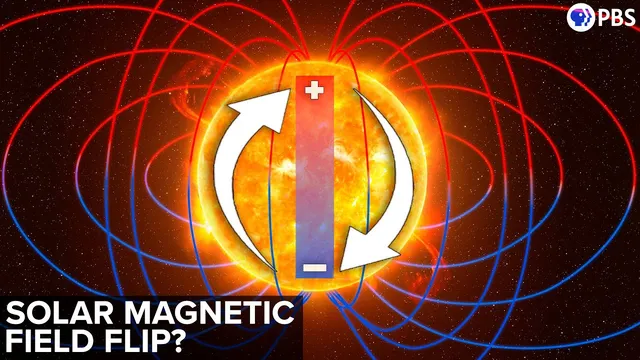
Will The Sun’s Magnetic Field Flip This Year?
Based on PBS Space Time's video on YouTube. If you like this content, support the original creators by watching, liking and subscribing to their content.
A May 2024 CME linked to rapidly growing sunspots produced auroras and marked the strongest geomagnetic storm Earth had seen since 1989.
Briefing
A major solar storm in May 2024—described as the strongest Earth has experienced since 1989—arrived after a cluster of sunspots grew on the Sun’s surface, signaling an unusually intense stretch of activity. The key concern now is timing and scale: solar activity is still climbing toward the peak of the current 11-year cycle, and the Sun’s magnetic field appears to be heading toward a polarity reversal sooner and more powerfully than many forecasts expected. That matters because these magnetic changes drive space weather, including coronal mass ejections (CMEs) that can trigger auroras and disrupt Earth’s space environment.
The storm traced back to the Sun’s magnetic machinery. Sunspots are dark because strong magnetic fields emerging from the solar interior suppress convection, letting those regions cool and dim. But the magnetic field itself is built and reshaped by a dynamo process. In broad strokes, the Sun generates magnetism through interactions between its radiative zone and convection zone, where turbulent plasma flows and the Coriolis force help kick-start the dynamo. The field begins in a dipole-like, north–south “poloidal” configuration, then differential rotation—faster equatorial rotation than polar rotation—twists it into a toroidal, ring-like field. Two named steps help describe the transformation: the “omega process” coils poloidal field into toroidal field, while the “alpha process” involves kinks and protrusions that allow magnetic flux tubes to rise.
As toroidal magnetic fields intensify, buoyancy helps them push upward through the Sun’s plasma. Once they reach the surface, Coriolis-driven twisting can create paired sunspots of opposite polarity, and the emergence pattern migrates from higher latitudes toward the equator as the cycle progresses—captured in “butterfly diagrams.” The magnetic field doesn’t just build; it also tangles. Energy stored in twisted flux tubes can be released when field lines reconnect into a more orderly configuration, often producing CMEs. When such eruptions slam into Earth’s magnetosphere, they can produce auroras even at low latitudes.
The cycle’s reset hinges on how the Sun reverses its magnetic field. As the toroidal field reaches maximum strength, Coriolis effects rotate it back toward poloidal geometry, forming many smaller north–south loops. Over time, these loops grow strong enough to flip the global magnetic polarity, while the old toroidal field fragments and decays—starting the process anew with a cleaner dipole.
Why the cycle averages about 11 years comes down to the time required to wind the dipole into an unstable toroidal configuration. Yet intensity is far less predictable. A major forecasting clue is the strength of the Sun’s poloidal (dipole) field during solar minimum, since it seeds the toroidal field that later powers sunspots. Still, predicting the rebuilt poloidal field after a maximum is difficult because it depends on the messy details of how toroidal-field kinks reconnect. That uncertainty helps explain why expectations for cycle 25 shifted: earlier projections anticipated a relatively weak continuation, but the cycle has ramped up more steeply, pushing forecasts for the peak and magnetic-field flip later than previously estimated. The takeaway is practical—space weather forecasts matter now, because the Sun’s magnetic evolution is both active and still changing faster than models anticipated.
Cornell Notes
The Sun’s magnetic field is generated by a dynamo that turns an initial dipole-like (poloidal) field into a stronger, twisted toroidal field through differential rotation. Buoyancy and Coriolis-driven twisting help magnetic flux rise, producing sunspots and paired opposite polarities; reconnection of tangled field lines can then trigger coronal mass ejections that drive auroras and other space-weather effects. The global magnetic polarity flips when smaller loops formed during the winding/unwinding process become strong enough to replace the old dipole, resetting the cycle. Solar cycles average about 11 years because that’s the typical winding time, but cycle strength is harder to predict since it depends on chaotic reconnection details. Recent observations show cycle 25 is ramping up more strongly than expected, implying heightened space-weather risk ahead of the peak and polarity reversal.
How do sunspots form, and why are they dark?
What turns the Sun’s magnetic field from a dipole into a ring-like structure?
Why do coronal mass ejections happen during active periods?
What triggers the Sun’s magnetic polarity reversal?
Why is predicting solar-cycle strength so difficult even when the cycle length is fairly stable?
What changed about expectations for solar cycle 25?
Review Questions
- Which physical processes link differential rotation to the formation of toroidal magnetic fields, and how does that connect to sunspot emergence patterns?
- Explain the sequence from toroidal-field buildup to reconnection-driven CMEs and then to auroras on Earth.
- Why does the poloidal field strength during solar minimum serve as a better predictor of the next maximum than the strength of the previous cycle overall?
Key Points
- 1
A May 2024 CME linked to rapidly growing sunspots produced auroras and marked the strongest geomagnetic storm Earth had seen since 1989.
- 2
Sunspots are dark because strong magnetic fields suppress convection, cooling the surface region where flux emerges.
- 3
The solar dynamo starts with a poloidal (dipole-like) field, then differential rotation twists it into a toroidal (ring-like) field via the omega process.
- 4
Magnetic flux tubes rise through buoyancy, and Coriolis-driven twisting (alpha process) helps create sunspot pairs of opposite polarity.
- 5
Solar-cycle polarity reversal occurs when Coriolis effects rotate toroidal fields back toward poloidal geometry, letting new loops build a flipped global dipole.
- 6
Cycle length averages about 11 years because that’s the typical winding time, but cycle intensity is harder to forecast due to chaotic reconnection that rebuilds the next poloidal field.
- 7
Forecasts for cycle 25 have shifted upward because observed activity ramped faster and stronger than expected, implying a peak and polarity flip later than earlier estimates.