Will This Go Faster Than Light?
Based on Veritasium's video on YouTube. If you like this content, support the original creators by watching, liking and subscribing to their content.
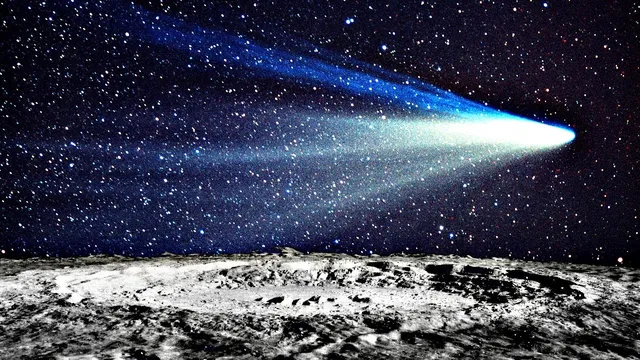
A laser spot can appear to move faster than light while the photons themselves still travel at light speed, so no information is transmitted superluminally.
Briefing
Einstein’s speed limit holds up: even wildly imaginative “faster-than-light” setups don’t let anything carry information or matter beyond light speed. The apparent trick is usually an illusion—like a laser spot that sweeps across the Moon faster than light—where the photons still travel at light speed, just arriving in such rapid succession that the *location* of the spot seems to outrun light. That kind of effect can’t transmit usable signals, because the underlying particles never exceed the universal speed limit.
A second idea—flicking a long rigid stick so its tip “moves” across the Moon faster than light—also fails for a more basic reason: forces don’t propagate instantly through matter. In a solid, the fastest a disturbance can travel is limited by the speed of sound, since each atom must pass the push along to its neighbors. Even if the geometry suggests the tip should move quickly, the energy and mechanical influence can’t reach the tip fast enough, leaving the motion either extremely weak or nonexistent.
The transcript then tackles a more sophisticated proposal: a space-age engine spinning two carbon nanotube tethers to extreme lengths, with the tether tip approaching light speed. The centripetal-force requirement is the first showstopper. Objects moving in circles need an inward force that scales with the square of speed; at 99% of light speed, the required pull becomes enormous—illustrated as hundreds of meganewtons for a gram at that speed. Carbon nanotubes can be strong, but the tether can’t be a uniform thin strand: as the tether tapers toward the tip, each additional gram at the end demands more inward force, forcing the material to thicken progressively all the way back to the motor. When the numbers are pushed, the required thickness grows so extreme that about 30 meters from the tip the tether would need to be as wide as the observable universe.
Even if materials were magically stronger, inertia adds another wall. As speed increases, the effective inertia rises, demanding more force to accelerate the tether tip. The transcript claims that pushing a gram to 99% of light speed requires several times more force than the earlier centripetal estimate, and trying to add the final 1% to reach light speed runs into a theoretical energy divergence—an “infinite energy” requirement in the idealized setup.
Finally, there’s a deeper, insurmountable constraint: the tether’s integrity depends on electromagnetic interactions between charges in the material. Those interactions are mediated by photons, and the photons themselves travel at light speed. So even with infinite energy and arbitrarily strong materials, the internal forces that hold the tether together can’t propagate faster than light, preventing the tip from crossing the limit.
The only “faster than light” effects left are apparent and don’t violate relativity: distant galaxies can appear to recede faster than light because space itself expands between them and us. Their motion through space remains subluminal; the changing geometry makes their light effectively unreachable, not because anything outruns light locally, but because the distance grows too quickly for the photons to ever arrive.
Cornell Notes
The transcript argues that apparent faster-than-light motion usually comes from geometry or expanding space, not from anything physically exceeding light speed. A laser spot can sweep across the Moon faster than light because photons still travel at light speed; only the *landing pattern* moves quickly, so no information travels faster. A rigid-stick idea fails because forces propagate through matter no faster than the speed of sound. A proposed spinning carbon nanotube tether collapses under centripetal-force requirements, increasing inertia at relativistic speeds, and the fact that electromagnetic forces holding the tether together are mediated by photons that move at light speed. The only genuine “superluminal” observations involve galaxies receding due to cosmic expansion, not objects moving through space faster than light.
Why does a laser spot moving across the Moon faster than light not mean photons exceed light speed?
What breaks the “flick a rigid stick” faster-than-light idea?
What is the core physics problem with spinning a long tether so its tip approaches light speed?
Why does increasing speed make the tether problem even worse beyond centripetal force?
Why can’t electromagnetic cohesion let the tether tip exceed light speed?
How can galaxies appear to recede faster than light without violating relativity?
Review Questions
- What distinction between “spot motion” and “photon motion” prevents the laser-spot idea from enabling faster-than-light communication?
- In the spinning-tether scenario, which constraint dominates first: centripetal-force scaling, relativistic inertia, or the photon-mediated nature of electromagnetic forces—and why?
- How does cosmic expansion produce an apparent faster-than-light recession without any object locally exceeding light speed?
Key Points
- 1
A laser spot can appear to move faster than light while the photons themselves still travel at light speed, so no information is transmitted superluminally.
- 2
Mechanical effects in solids propagate no faster than the speed of sound, undermining rigid-stick “tip outruns light” proposals.
- 3
Circular motion demands centripetal force that scales with speed squared, making ultra-relativistic tether designs structurally impossible.
- 4
Relativistic inertia increases as speeds approach light speed, raising the required force and leading to an idealized infinite-energy barrier at the limit.
- 5
Even with perfect materials and unlimited energy, electromagnetic cohesion can’t propagate faster than light because it relies on photon-mediated interactions.
- 6
Apparent superluminal recession of galaxies can occur due to expansion of space, not because matter moves through space faster than light.