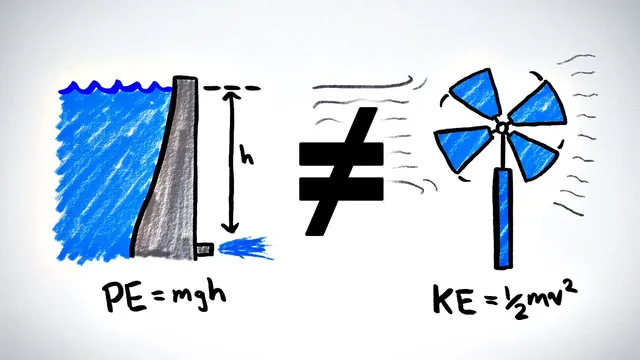
Windmills Are NOT Like Dams
Based on minutephysics's video on YouTube. If you like this content, support the original creators by watching, liking and subscribing to their content.
Windmills extract power by reducing the kinetic energy of moving air, so slowing the wind is unavoidable.
Briefing
Windmills can’t behave like dams because wind energy comes from motion: slowing the air to extract power inevitably reduces how much wind continues downstream. The key constraint is that the maximum extractable energy equals the drop in the wind’s kinetic energy, which scales with the square of speed. If a windmill reduces wind speed from v to v/2, then the outgoing kinetic energy is (v/2)² = v²/4, meaning the wind loses 3/4 of its kinetic energy—an energy-extraction “efficiency” of 75% for the wind that passes the turbine.
But that’s only half the story. The amount of wind passing through the turbine per second also changes, because the wind speed at the turbine itself sits between the incoming and outgoing speeds. Under the standard idealized model, the wind speed at the windmill is halfway between the two: for an incoming speed v and outgoing speed v/2, the speed at the rotor becomes (v + v/2)/2 = 3v/4. That means only 3/4 as much wind volume (and thus mass flow) passes through each second compared with the undisturbed flow. Combining these effects—extracting 3/4 of the kinetic energy from each parcel of wind, while only 3/4 as many parcels pass per second—yields an overall efficiency of (3/4)×(3/4) = 9/16 = 56.25%.
Repeating the same tradeoff for other speed reductions reveals a non-obvious optimum. If the windmill slows the wind to one-third of its incoming speed (outgoing speed v/3), the kinetic-energy drop is v² − (v/3)² = v² − v²/9 = 8v²/9, so 88.88% of the kinetic energy of the wind passing the turbine is extracted. Yet the wind speed at the rotor becomes halfway between v and v/3, which is (v + v/3)/2 = 2v/3. That reduces the mass flow rate to 2/3 of the original. The overall efficiency becomes 0.8888… × 2/3 ≈ 0.59259, or 59.259%.
Pushing the slowdown further (below one-third speed) increases the fraction of energy extracted from each parcel, but it starves the turbine of wind—too little mass flow passes per second—so total efficiency falls. Slowing the wind less than one-third does the opposite: more wind passes, but each parcel retains more kinetic energy, again lowering total efficiency. The result is a best-case ideal windmill that reduces wind speed to 2/3 of the incoming speed after the turbine (equivalently, outgoing speed v/3), achieving about 59% overall efficiency in extracting wind power.
Real turbines involve additional engineering constraints—wake losses, blade aerodynamics, and mechanical limits—so the 59% figure is an idealized upper bound rather than a guaranteed real-world performance number. Still, the central lesson holds: windmills face a fundamental physics tradeoff between extracting energy and keeping enough wind moving through the system.
Cornell Notes
Windmills extract power by slowing moving air, unlike dams that can lower water height without necessarily reducing flow. Because kinetic energy depends on speed squared, the maximum energy a turbine can take from wind equals the drop in kinetic energy between incoming speed v and outgoing speed. However, slowing the wind also reduces how much air passes through each second, since the wind speed at the rotor lies halfway between incoming and outgoing speeds. Optimizing both effects shows the best ideal case occurs when the outgoing wind speed is v/3 (so the wind at the turbine is 2v/3), producing an overall efficiency of about 59.259%. Slowing more or less than this lowers total efficiency even if the per-parcel energy extraction fraction improves or worsens.
Why can’t a windmill be treated like a dam when comparing energy extraction?
How does kinetic energy set the maximum fraction of energy extractable from wind?
Why does the amount of wind passing through per second depend on the rotor speed?
How do the two effects combine to produce 56.25% efficiency for a v→v/2 windmill?
What speed reduction maximizes overall efficiency, and what does it yield?
What happens to efficiency if the turbine slows wind more than to v/3 or less than to v/3?
Review Questions
- In the ideal model, how is the wind speed at the turbine related to the incoming and outgoing wind speeds?
- Compute the overall efficiency if a turbine reduces wind speed from v to v/4 using the same two-step logic (energy fraction and mass-flow fraction).
- Why does maximizing per-parcel energy extraction not automatically maximize total power output for a windmill?
Key Points
- 1
Windmills extract power by reducing the kinetic energy of moving air, so slowing the wind is unavoidable.
- 2
Maximum extractable energy fraction depends on speed squared: outgoing kinetic energy scales as (v_out/v_in)².
- 3
Total efficiency depends on both energy extracted per unit of wind and the mass flow rate through the turbine.
- 4
In the idealized model, the wind speed at the rotor is halfway between incoming and outgoing speeds, which sets the mass flow reduction.
- 5
For a v→v/2 slowdown, overall efficiency is (3/4)×(3/4)=56.25%.
- 6
The ideal efficiency maximum occurs when outgoing wind speed is v/3, giving overall efficiency 16/27 ≈ 59.259%.
- 7
Real wind turbines can’t reach the ideal bound exactly because of additional aerodynamic and engineering losses.