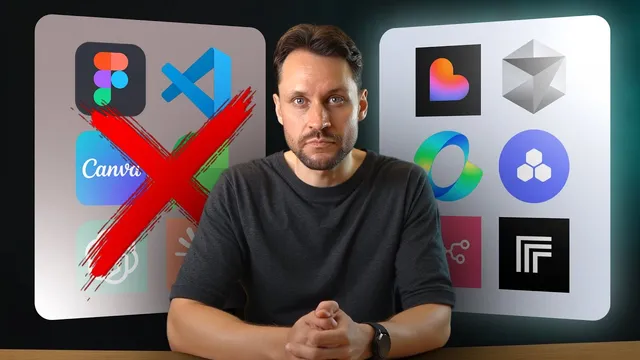
Winning Startups Are Changing To These Tools (here's why)
Based on Simon Høiberg's video on YouTube. If you like this content, support the original creators by watching, liking and subscribing to their content.
Bootstrapped SaaS execution still centers on build, sell, and systems that accelerate both, but AI changes how those tasks are performed.
Briefing
Bootstrapped SaaS success still boils down to three moves—build stuff, sell stuff, and set up systems so building and selling happen faster—but AI has shifted what “building” and “marketing” look like in 2025. The core change: technical founders no longer hold the same near-monopoly on speed and output because AI can compress many software and design tasks into natural-language instructions. The upside is a lower barrier to launching profitable businesses; the downside is that the old advantage of being the in-house engineer is weaker, so founders must adapt by mastering the right AI tooling.
For product creation, the transcript frames a middle path between traditional coding and no-code platforms, calling it “vibe coding.” Instead of writing everything from scratch or being limited by drag-and-drop constraints, founders can describe what an app should do and let AI and LLMs generate the implementation. Lovable is presented as a flagship tool in this category: users write prompts, iterate with feedback, and can switch to a developer mode to inspect the generated codebase. It also supports customization through component libraries—for example, replacing UI components with Chakra UI—and can publish directly or sync the code to a GitHub repository for self-hosting and continued development. The workflow described on the team is to start with Lovable for rapid iteration, then move to a more advanced editor for deeper engineering work.
That next step is Cursor, an AI-first code editor built on VS Code principles. Cursor is positioned as repository-aware: it can analyze an entire codebase, answer questions about it, and perform complex changes consistent with existing patterns. It can also use web search inside the editor when needed, and it leverages TypeScript’s semantic and logical error signals to correct and improve code. For web development, it can be given access to the browser so it can read console errors and iterate without constant manual intervention. The transcript emphasizes a practical pairing—Lovable for early product generation, Cursor for large-scale refactors and engineering tasks.
Selling, in this framework, is treated as marketing—specifically content marketing for bootstrapped SaaS. Rather than focusing on a broad tool stack for every marketing channel, the approach is to master content creation end-to-end, including visuals and distribution. Cling AI is highlighted for image and video generation, including style-matched visuals via reference images and high-quality video clips for social posts. FeedHive is then presented as an AI social media operations layer: it helps write posts with a fine-tuned assistant, assigns performance prediction scores that account for relevance and trending topics, and recommends recycled content from past posting history to improve productivity. The transcript also notes FeedHive’s basic image editing, while recommending specialized creative tools like Cling AI for best results.
Finally, systems and automation are where speed compounds. The automation tool named is n8n (spelled “NAN” in the transcript), which supports both deterministic workflows and autonomous AI agent workflows using combinations of AI models. Self-hosting is pitched as a way to remove workflow-run costs, leaving only compute costs for the AI used. To expand beyond mainstream models, the transcript points to Replicate for running models via simple API calls and to Hugging Face for access to a vast library of specialized open-source models (described as nearly 2 million). Together, Replicate and Hugging Face are framed as the infrastructure that lets founders plug niche AI capabilities into n8n workflows, enabling highly customized automation for building, marketing, and operations.
Cornell Notes
Bootstrapped SaaS success still rests on three essentials: build, sell, and create systems that make both faster. AI weakens the old edge of being a technical founder by enabling “vibe coding,” where natural-language prompts drive app creation. Lovable supports rapid website/app generation with iterative prompts, code inspection, and GitHub syncing, while Cursor provides repository-aware, TypeScript- and browser-error-guided engineering for deeper refactors. For selling, the transcript recommends focusing on content marketing and mastering tools for visuals and distribution: Cling AI for images/video and FeedHive for AI-assisted writing, performance scoring, and recycling. For operations, n8n enables both traditional automations and AI agent workflows, especially when paired with Replicate (API-hosted models) and Hugging Face (large open-source model library).
What does “vibe coding” change for founders building SaaS products?
How do Lovable and Cursor fit together in a build workflow?
Why does the transcript recommend focusing marketing on content for bootstrapped SaaS?
What specific capabilities does FeedHive add beyond basic scheduling?
How does n8n support both traditional automation and AI agent workflows?
Why are Replicate and Hugging Face presented as key infrastructure for scaling AI beyond mainstream models?
Review Questions
- Which tool in the build stack is best suited for rapid prompt-to-app iteration, and what feature lets users inspect the generated codebase?
- How does Cursor use repository context and error signals (like TypeScript or browser console errors) to improve code without constant manual intervention?
- What three AI functions does FeedHive provide for content operations, and how does “recycling” differ from simply reposting old content?
Key Points
- 1
Bootstrapped SaaS execution still centers on build, sell, and systems that accelerate both, but AI changes how those tasks are performed.
- 2
“Vibe coding” enables faster product creation by letting founders describe desired behavior in natural language while AI generates implementation details.
- 3
Lovable supports iterative app generation, code inspection, direct publishing, and GitHub syncing for self-hosting and continued development.
- 4
Cursor complements Lovable by operating as a repository-aware, AI-assisted code editor that can use web search and fix issues guided by TypeScript and browser console errors.
- 5
For bootstrapped SaaS marketing, content creation is treated as the highest-leverage focus, with Cling AI for visuals and FeedHive for writing, performance prediction, and recycling.
- 6
n8n supports both deterministic automations and autonomous AI agent workflows, and self-hosting shifts cost emphasis toward AI compute rather than workflow-run limits.
- 7
Replicate and Hugging Face expand AI capability by making it practical to run and integrate a wide range of specialized open-source models via APIs.