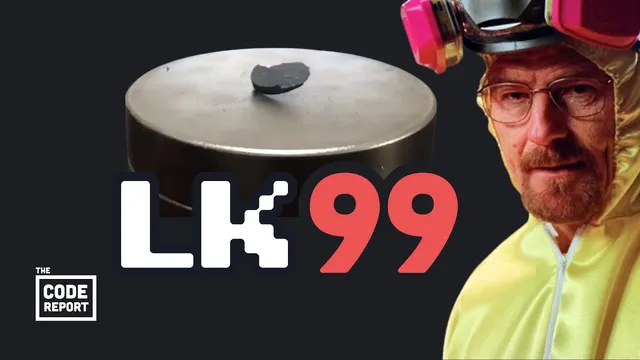
"World-changing" LK-99 Superconductor explained quickly
Based on Fireship's video on YouTube. If you like this content, support the original creators by watching, liking and subscribing to their content.
LK-99 is claimed to be a room-temperature, ambient-pressure superconductor, which would remove the extreme cooling and pressure barriers that limit most superconductors.
Briefing
South Korean researchers’ claim that LK-99 is a room-temperature, ambient-pressure superconductor has ignited a global sprint to reproduce the results—because a material that conducts electricity with zero resistance at ordinary conditions would upend energy systems, electronics, and medical technology. If the claim holds, it would represent the biggest scientific breakthrough of the 21st century, eliminating the need for the extreme cooling and specialized conditions that make today’s superconductors largely impractical.
Superconductors differ from ordinary conductors because they allow electrons to move without electrical resistance, avoiding the heat losses that force computers to use fans and power lines to operate at high voltages. In practice, however, most superconductors only work at super-cold temperatures near absolute zero or under extreme pressures, with notable exceptions such as specialized MRI systems. Superconductors also exhibit distinctive magnetic behavior: type 1 materials expel magnetic fields via the Meissner effect, while type 2 superconductors don’t fully expel magnetic fields and can function at comparatively higher temperatures.
LK-99’s potential advantage is that it allegedly works at room temperature and ambient air pressure—conditions that would make superconductivity usable outside lab settings. The transcript describes a relatively straightforward synthesis route: heat lead oxide and lead sulfate at 725°C for 24 hours to form a lanarkite phase, then mix with copper phosphide under vacuum and heat again to produce LK-99. That “cook it up” simplicity is part of what makes the claim so explosive: it suggests other labs might be able to test it quickly rather than waiting years for complex infrastructure.
Still, skepticism is strong. The current benchmark for high-temperature superconductors is far from room temperature—around negative 20°C—and they require enormous pressures on the order of 25 million PSI. The LK-99 papers are also described as non-peer-reviewed, and the surrounding process has raised red flags, including claims that the work may have been uploaded before full consensus and that at least one related paper was taken down after another room-temperature superconductor claim. In other words, the scientific stakes are high, but so is the risk of error, cherry-picked data, or outright mistakes.
For now, the next 48 hours are framed as especially critical, with researchers worldwide racing to replicate the recipe and verify whether LK-99 truly shows superconducting behavior under ordinary conditions. If it does, the payoff could be enormous: faster, more efficient electronics; cheaper medical imaging; and transformative possibilities in quantum computing, frictionless transport, and dramatic energy-efficiency gains. If it doesn’t, the episode will likely join the long history of superconductivity “rabbit holes” where extraordinary claims collide with experimental reality.
Cornell Notes
LK-99 is a claimed room-temperature, ambient-pressure superconductor that—if verified—would eliminate the extreme cooling and pressure requirements that limit today’s superconductors. Ordinary conductors lose energy as heat due to resistance, while superconductors transmit electricity with zero resistance and show characteristic magnetic behavior (Meissner effect for type 1; partial field behavior for type 2). The transcript notes a relatively simple synthesis: heat lead oxide and lead sulfate at 725°C for 24 hours to form lanarkite, then combine with copper phosphide under vacuum and heat again. Major caveats remain: the papers are non-peer-reviewed, replication is underway, and current high-temperature superconductors still require very low temperatures and massive pressures. Verification will determine whether LK-99 becomes a foundational materials breakthrough or another failed claim.
What makes superconductors fundamentally different from ordinary conductors, and why does that matter for real-world power and electronics?
Why are today’s superconductors mostly impractical, even though they work?
How do type 1 and type 2 superconductors differ in magnetic behavior?
What synthesis route for LK-99 is described, and what does it imply about how quickly labs can test the claim?
What benchmarks and red flags are used to justify skepticism about LK-99?
If LK-99 works as claimed, what downstream technologies could change first?
Review Questions
- What physical property distinguishes superconductors from ordinary conductors, and how does that connect to heat generation in current-carrying materials?
- Why does the Meissner effect matter for understanding superconductors, and how does it differ between type 1 and type 2 materials?
- What specific experimental conditions do current high-temperature superconductors require, and how does that contrast with the LK-99 claim?
Key Points
- 1
LK-99 is claimed to be a room-temperature, ambient-pressure superconductor, which would remove the extreme cooling and pressure barriers that limit most superconductors.
- 2
Superconductors conduct electricity with zero resistance, preventing the resistive heating that drives cooling needs in electronics and energy losses in power systems.
- 3
Magnetic behavior distinguishes superconductors: type 1 expels magnetic fields via the Meissner effect, while type 2 allows partial magnetic field penetration and can work at higher temperatures.
- 4
The transcript describes an LK-99 synthesis involving heating lead oxide and lead sulfate at 725°C for 24 hours to form lanarkite, then combining with copper phosphide under vacuum and reheating.
- 5
Current high-temperature superconductors still require far colder temperatures (around negative 20°C) and extreme pressures (about 25 million PSI), making the LK-99 claim a major outlier.
- 6
The LK-99 papers are non-peer-reviewed and surrounded by process concerns, so replication by independent labs is the decisive next step.