World's Heaviest Weight
Based on Veritasium's video on YouTube. If you like this content, support the original creators by watching, liking and subscribing to their content.
A dead weight machine calibrates force transducers by suspending precisely known masses and using their net gravitational force as the reference.
Briefing
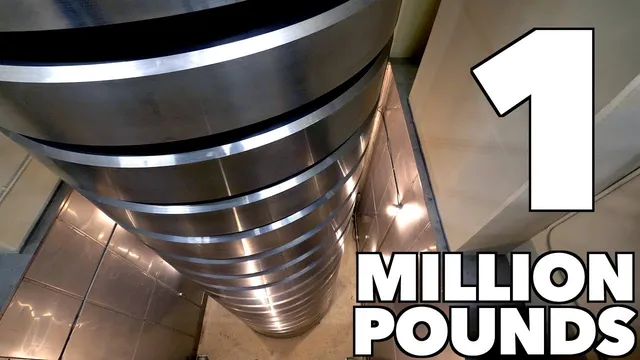
Measuring forces in the tens of millions of newtons isn’t done by guessing or extrapolating from smaller instruments—it’s done by calibrating force sensors against enormous, precisely defined “dead weights.” At the center of that effort is a dead weight machine that can apply 4,448,222 newtons, engineered to match exactly 1,000,000 pounds of force (about 4.45 mega newtons). The machine’s odd-looking capacity comes from its construction: twenty 50,000-pound increments stacked together (20 × 50,000 pounds = 1,000,000 pounds), with each individual mass carefully calibrated so the total force is known with extremely small uncertainty.
The calibration chain starts underground, where the weight stack sits on a system of carefully measured masses. Those masses then calibrate force sensors—called force transducers—in a lab above. In operation, a hydraulic ram raises a lifting frame until the force transducer contacts the loading frame; as the frame rises, more of the 50,000-pound blocks become suspended by the transducer. Because the force from the suspended weights is known, the transducer’s readings can be tuned to match reality.
The payoff is that these calibrated transducers can be embedded in real test stands used to monitor forces during demanding events like rocket engine firings. When a rocket is ramped up or down, the “percent of power” isn’t just a control setting—it’s tied to measurements made by sensors whose accuracy traces back to the calibrated weight stack. That’s why uncertainty matters: aerospace testing can’t tolerate loose error bars. The standard target described here is an uncertainty of 0.0005% (five parts per million). At the machine’s full 1,000,000 pounds of applied force, that translates to accuracy within about five pounds.
Achieving that level of precision requires more than calibrating the masses themselves. The local gravitational acceleration at the test site must be accounted for, since it’s slightly less than Earth’s standard gravity—meaning extra force is needed to reach the same “million pounds” target. Buoyancy also enters the calculation: the massive weights displace air, so an additional 125 pounds must be added to counteract the buoyant force and ensure the net force matches the intended value.
The transcript frames this as a lesson in why “one physical test is worth a thousand expert opinions.” Instead of assuming a device can be calibrated up to some limit and then generalized, the approach is to build the calibration capability itself—because in safety-critical contexts like aircraft and rocket testing, the difference between a 10% uncertainty and a few parts per million isn’t academic. It determines whether engineers can trust the numbers when the stakes are highest.
Cornell Notes
A dead weight machine provides a traceable way to calibrate force transducers for extremely large forces. Its 1,000,000-pound capacity is built from twenty 50,000-pound calibrated masses, producing 4.45 mega newtons (4,448,222 newtons). Force sensors are calibrated by suspending these known masses from the transducer as a hydraulic system raises a loading frame. The resulting uncertainty target is 0.0005% (five parts per million), meaning about ±5 pounds at full scale. Precision depends not only on mass calibration against the U.S. fundamental mass standard (K20) but also on local gravity and buoyancy corrections, since both affect the net force delivered by the weights.
Why does the dead weight machine use a capacity tied to exactly 1,000,000 pounds of force rather than a round number in newtons?
How does suspending calibrated masses translate into calibrating a force transducer?
What does “five parts per million” mean in practical terms for a million pounds of force?
Why must local gravity and buoyancy be corrected when calibrating force from weights?
How are the huge masses themselves calibrated to such fine uncertainty?
What’s the operational reason these calibrated transducers matter for rockets and aircraft?
Review Questions
- What specific design feature of the dead weight machine makes its total force traceable to 1,000,000 pounds-force?
- List the three major contributors to error that must be handled to achieve five parts per million uncertainty.
- Explain how the calibration process uses a hydraulic lift and a suspended weight stack to tune a force transducer’s readings.
Key Points
- 1
A dead weight machine calibrates force transducers by suspending precisely known masses and using their net gravitational force as the reference.
- 2
The 4,448,222-newton (4.45 mega newton) capability corresponds to exactly 1,000,000 pounds of force built from twenty 50,000-pound increments.
- 3
The target measurement uncertainty is 0.0005% (five parts per million), translating to about ±5 pounds at full 1,000,000 pounds of applied force.
- 4
Mass calibration traces back to K20 through stepwise comparisons of known masses, scaling from kilograms to large pound-based combinations.
- 5
Achieving the force accuracy requires correcting for local gravitational acceleration, described as slightly less than standard gravity, which adds roughly 600 pounds to the force budget.
- 6
Buoyancy corrections matter because the weights displace air; the transcript cites about 125 pounds to counteract buoyant force.
- 7
Calibrated transducers are embedded in rocket and aircraft test stands so thrust and “percent power” settings are tied to measured force, not assumptions.