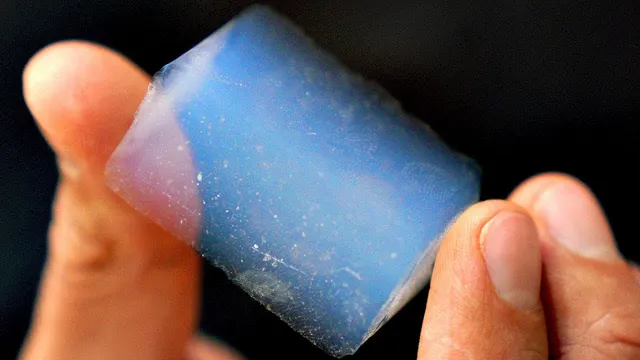
World's Lightest Solid!
Based on Veritasium's video on YouTube. If you like this content, support the original creators by watching, liking and subscribing to their content.
Aerogel is an ultra-low-density solid built from a nanoporous skeleton that can be about 99.8% air by volume.
Briefing
Aerogel’s defining trick is simple: it keeps a solid, nanoporous skeleton while removing almost all of the material’s liquid—leaving a material that is about 99.8% air by volume and so light it can be less dense than air in some cases. That structure isn’t just a curiosity; it drives aerogel’s performance as an unusually effective thermal insulator, its optical look, and even its ability to capture fast-moving particles.
The practical case for aerogel’s insulation shows up in a chocolate test. Two silica samples with very different internal structures sit over a flame: a conventional glass petri dish and an aerogel layer. The glass heats rapidly, smokes, and cracks from thermal expansion as the chocolate bunnies melt within about a minute. Under the aerogel, the bunny stays largely intact for several minutes. A thermocouple check focuses on the temperature beneath the aerogel, revealing that heat spreads around the sample rather than through it efficiently—parts of the bunny warm and soften, but the bottom remains protected longer than with glass. The result is a clear demonstration that aerogel blocks heat flow far better than you’d expect from something that is mostly air.
That insulation traces back to how aerogel is made. In 1931, Professor Samuel Kistler tackled a bet about jellies—materials that are mostly liquid trapped inside a solid network. If the liquid is simply evaporated, the solid skeleton collapses because liquid molecules pull on the structure as they leave. Kistler’s solution replaced the liquid with another solvent (like alcohol) and then used an autoclave to push the solvent to a supercritical fluid state, where liquid and gas distinctions vanish. When the pressure is released, the nanoporous solid skeleton remains, with gas occupying the pores: aerogel.
The transcript also links aerogel’s appearance to its nanoscale structure. Aerogel can look nearly invisible on light backgrounds and slightly bluish on darker ones. The explanation is Rayleigh scattering: tiny pores scatter shorter wavelengths (blue) much more strongly than longer ones, making aerogel opaque in ultraviolet and transparent in infrared. Against a blue sky, the scattered blue light is removed before reaching the eye, producing a “portable sunset” effect.
Finally, aerogel’s pore scale affects heat transfer through the Knudsen effect. Because the pores are narrower than the mean free path of air molecules, hot molecules struggle to diffuse through the material and carry energy upward. That’s why NASA has used aerogel insulation on rovers such as Sojourner, Spirit, Opportunity, and Curiosity, and plans further use for Mars missions. Beyond insulation, aerogel has been used in the Stardust mission to slow and capture comet dust traveling at roughly six kilometers per second by letting particles penetrate the porous network, break it apart, and lose energy until they stop. The remaining challenge is making aerogel cheaper and more durable—efforts include improving elasticity and developing hydrophobic, waterproof versions.
Cornell Notes
Aerogel is an ultra-light solid made by preserving a nanoporous skeleton while removing nearly all liquid from a gel. The key manufacturing step, developed by Samuel Kistler in 1931, uses solvent exchange and supercritical drying in an autoclave so the solid structure doesn’t collapse when pressure is released. Its pore network makes it an exceptional thermal insulator: heat diffusion through air is suppressed by the Knudsen effect because pore widths are smaller than air molecules’ mean free path. Aerogel’s nanoscale structure also shapes its color through Rayleigh scattering, explaining why it can look bluish and why it behaves differently across ultraviolet and infrared. NASA has used aerogel for rover insulation and Stardust for capturing fast comet particles.
Why can aerogel be less dense than air, and what does “99.8% air” mean physically?
What is the core problem with making aerogel by simply evaporating the liquid out of a gel?
How does the supercritical fluid step prevent the gel skeleton from collapsing?
Why does aerogel insulate better than air, even though it contains mostly air?
How does aerogel’s structure determine its color and transparency?
How does aerogel capture comet dust in the Stardust mission?
Review Questions
- Describe the sequence of steps used to turn a liquid-filled gel into aerogel without collapsing the solid skeleton.
- Explain the Knudsen effect and how pore size changes heat transfer compared with ordinary air.
- Use Rayleigh scattering to predict why aerogel looks different against a light background versus a dark background.
Key Points
- 1
Aerogel is an ultra-low-density solid built from a nanoporous skeleton that can be about 99.8% air by volume.
- 2
Kistler’s 1931 approach prevents gel collapse by using solvent exchange plus supercritical drying in an autoclave.
- 3
Aerogel insulates better than air because pore widths are smaller than the mean free path of air molecules, limiting diffusion via the Knudsen effect.
- 4
Aerogel’s bluish look comes from Rayleigh scattering, which strongly scatters shorter wavelengths while allowing infrared to pass.
- 5
NASA has used aerogel insulation on rovers including Sojourner, Spirit, Opportunity, and Curiosity, with planned Mars applications.
- 6
Aerogel’s porosity also enables particle capture in missions like Stardust by letting fast dust penetrate and lose energy inside the network.