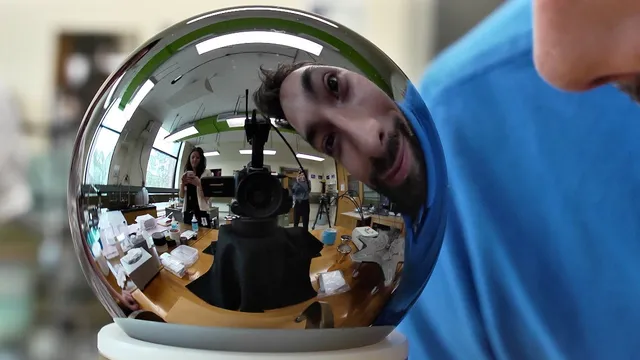
World's Roundest Object!
Based on Veritasium's video on YouTube. If you like this content, support the original creators by watching, liking and subscribing to their content.
The kilogram’s current definition depends on a single platinum-iridium cylinder (“Le Grand K”) stored under bell jars near Paris, and its mass has drifted relative to other reference cylinders.
Briefing
A 1-kilogram silicon-28 sphere—so precisely sculpted it’s effectively “countable” at the atomic level—is being positioned as a way to end the kilogram’s dependence on a single physical artifact. That matters because the current kilogram definition relies on a platinum-iridium cylinder stored under bell jars near Paris, and its mass has drifted measurably over decades. Even tiny changes—on the order of tens of micrograms—ripple through science and engineering, since many other measurements ultimately depend on the kilogram.
The kilogram’s fragility traces back to the metric system’s early attempts to anchor units to something reproducible. In 1793, a “grave” was defined as the mass of a cubic decimeter of water at the melting point of ice, essentially a liter of water. Political and linguistic pressures soon forced a change: the term “grave” sounded too close to “graf,” and the French Revolution’s push for equality made nobility-flavored names unacceptable. The unit shrank to the gram, then grew again when scientists found the gram too small, leading to the kilogram.
By 1799, the kilogram definition was refined to match the mass of a liter of water at 4°C, the temperature where water is densest. But water proved too variable for a stable standard, so a platinum cylinder was created to match that mass—later replaced in 1889 by a platinum-iridium alloy cylinder known as the International Prototype Kilogram, nicknamed “Le Grand K” or “Big K.” Big K remains the only SI base unit still defined by a physical object. It sits in a climate-controlled vault at the International Bureau of Weights and Measures, guarded by multiple independently controlled keys.
The problem emerged when comparison replicas—made at the time Big K was created—were periodically re-weighed. Despite careful storage and cleaning, their masses diverged over time, and even Big K no longer matched its “sister” cylinders. The drift reached roughly 50 micrograms, comparable to the weight of a fingerprint. Since the cylinders are washed before weigh-ins, the cause is believed to be a slow physical process affecting the metal itself. A unit that changes undermines the reliability of mass-based measurements.
To break that link, metrology is moving toward definitions grounded in constants of nature rather than objects. The silicon sphere approach uses a nearly perfect crystal of pure silicon-28 with no relevant defects, allowing scientists to determine the sphere’s mass by calculating how many atoms it contains. The sphere’s roundness is crucial: knowing its diameter precisely lets researchers compute its volume, and with the silicon’s known atomic spacing, the number of atoms follows. That count can then redefine Avogadro’s constant, shifting the kilogram definition away from Big K and toward a concept.
A parallel strategy uses a Watt Balance to redefine the kilogram by fixing Planck’s constant. Together, the two methods act as cross-checks, aiming to reduce uncertainties to around twenty micrograms. If agreement holds, the kilogram could be redefined so it no longer depends on a single cylinder in a Paris vault—turning a historically “grave” problem into a stable, constant-based standard.
Cornell Notes
The kilogram’s current definition depends on a single platinum-iridium cylinder (“Le Grand K”) stored near Paris, and its mass has drifted relative to other reference cylinders by up to about 50 micrograms over decades. That instability matters because four SI base units—and many derived units like newtons, joules, volts, and watts—ultimately rely on the kilogram. To remove the dependence on a physical object, scientists are building a highly polished silicon-28 sphere and redefining the kilogram through atomic counting: measure the sphere’s diameter with lasers, compute its volume, and use the known silicon crystal structure to determine the number of atoms. This would let Avogadro’s constant (and thus the kilogram) be defined by constants rather than by a metal artifact. A second route uses a Watt Balance to fix Planck’s constant, providing an independent check.
Why is the kilogram’s drift such a big deal for science and industry?
What exactly is “Big K,” and how is it protected?
How did scientists discover that the prototype’s mass was not perfectly stable?
How does the silicon-28 sphere replace a physical artifact with an atomic calculation?
Why does the sphere need to be “the roundest object,” and how is roundness achieved?
What is the alternative method besides the silicon sphere, and how do the two approaches relate?
Review Questions
- What evidence shows that the platinum-iridium prototype kilogram is not perfectly stable over time?
- Describe the chain of reasoning from measuring a silicon sphere’s diameter to redefining the kilogram via Avogadro’s constant.
- How do the silicon sphere approach and the Watt Balance approach differ, and why is agreement between them important?
Key Points
- 1
The kilogram’s current definition depends on a single platinum-iridium cylinder (“Le Grand K”) stored under bell jars near Paris, and its mass has drifted relative to other reference cylinders.
- 2
Replica cylinders diverged by up to about 50 micrograms over decades, implying a slow physical change in the metal rather than measurement contamination.
- 3
Because four SI base units and many derived units depend on the kilogram, even microgram-level drift can propagate through scientific measurements.
- 4
The silicon-28 sphere approach aims to redefine the kilogram by calculating the number of atoms in a nearly perfect silicon crystal rather than comparing to a metal artifact.
- 5
Laser-based diameter measurements and the known atomic spacing in silicon allow researchers to compute the sphere’s volume and atom count, enabling a new definition of Avogadro’s constant.
- 6
A parallel strategy uses a Watt Balance to fix Planck’s constant, and the two methods serve as mutual cross-checks to reduce uncertainty.
- 7
If uncertainties fall to around twenty micrograms with consistent results, the kilogram can be redefined so it no longer relies on a physical object in a vault.