World's Strongest Magnet!
Based on Veritasium's video on YouTube. If you like this content, support the original creators by watching, liking and subscribing to their content.
The 45-tesla record field is produced by a hybrid magnet: 11.5 tesla from an outer superconducting outsert plus 33.5 tesla from an inner resistive magnet.
Briefing
A 45-tesla hybrid magnet—nearly a million times Earth’s magnetic field—has become a real-world laboratory tool for probing matter, generating electricity, and even levitating objects that aren’t normally magnetic. The National High Magnetic Field Laboratory in Tallahassee, Florida, has maintained a Guinness World Record for the strongest continuous magnetic field since 2000, and the magnet’s extreme strength comes with practical consequences: filming inside or near it is notoriously difficult because the field can interfere with electronics and even damage camera equipment.
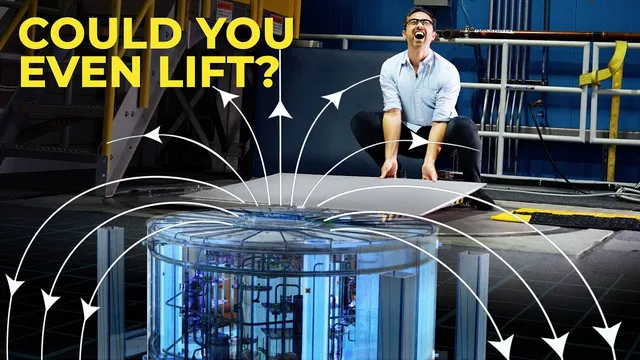
The magnet’s peak field isn’t spread evenly across the apparatus. It reaches its maximum in a narrow, centimeter-tall region at the center of a bore running through the middle, while the field drops off rapidly outside that core. Still, the surrounding “fringe field” remains dangerous. A key safety threshold is the 100 gauss line: objects with the right shapes can start pivoting and then accelerate toward the magnet before anyone can react. The lab therefore treats ferromagnetic items—like metal implants—as off-limits within that zone.
Engineering the record requires more than superconductors alone. Superconducting wire can only sustain magnetic fields up to roughly 20 tesla before it stops being superconducting. To push higher, the system combines an outer superconducting magnet with an inner resistive magnet. The superconducting outsert produces 11.5 tesla, while the resistive inner magnet adds 33.5 tesla; field addition yields the 45-tesla peak. Ramping to full power takes about an hour and a half because the resistive section demands enormous current—47,000 amps—along with substantial cooling. The resistive coils are built from stacked, thin conductor plates (a Bitter-style design) so cooling water can be driven through the structure and remove heat from the innermost windings.
Once running, the magnet turns basic physics into visible effects. Ferromagnetic materials are pulled in, but the more surprising demonstrations involve non-ferromagnetic matter. A Nerf football stuffed with steel washers becomes easy to identify because the washers dominate the response. Ferrofluid—tiny magnetite particles suspended in liquid—forms ridges and spikes as particles align with the field, and it can climb the container walls. Conductive metals also behave differently when moving: as a metal plate falls through the field, changing magnetic flux induces eddy currents that generate their own magnetic field to oppose the motion, slowing the plate via Lenz’s Law. The induced currents dissipate energy as heat, and the lab notes that in some setups the heating can be intense enough to boil water.
The magnet also enables levitation in multiple ways. With superconductors below their critical temperature, induced currents can persist and expel magnetic flux, allowing stable “human levitator” demonstrations above a ring of superconductors. Separately, diamagnetism and paramagnetism let strong fields repel or attract materials like water and liquid oxygen, enabling levitation of items that aren’t ferromagnetic—though the lab uses a weaker 31-tesla system for optical viewing.
Beyond spectacle, the lab’s goal is material discovery. Extreme magnetic fields help researchers test how electrons scatter in ultra-clean materials and how matter behaves under harsh conditions—alongside high electric fields, high pressure, and ultra-low temperatures. The record magnet’s power draw is significant—about 8% of the lab’s local generating capacity, costing roughly $250,000 to $300,000 per month—but the payoff is a new experimental frontier that scientists expect to reshape research over the next decades.
Cornell Notes
A hybrid magnet producing a continuous 45-tesla field enables experiments that go far beyond pulling on iron. Its peak field is confined to a small region, but the surrounding fringe field can still cause objects to pivot or accelerate toward the magnet, making ferromagnetic items and implants a safety concern. The 45-tesla result requires combining an outer superconducting magnet (11.5 tesla) with an inner resistive magnet (33.5 tesla), because superconductors alone top out near 20 tesla. Moving conductors slow down in the field due to eddy currents and Lenz’s Law, while superconductors can support stable levitation by expelling magnetic flux. These capabilities matter because extreme fields help reveal how materials behave and improve properties by reducing electron scattering in ultra-clean samples.
Why can’t superconducting magnets alone reach 45 tesla, and how does the hybrid design solve that limit?
What makes the fringe field dangerous even when the 45-tesla core is hard to access?
How does Lenz’s Law slow a falling metal plate through a magnetic field?
Why do non-ferromagnetic materials sometimes levitate in strong magnets?
What enables stable levitation with superconductors in the “human levitator” setup?
Review Questions
- What specific engineering constraints limit superconducting magnets, and how does the hybrid superconducting-plus-resistive design overcome them to reach 45 tesla?
- Explain how eddy currents arise when a conductor moves through a magnetic field and how Lenz’s Law determines the direction of the induced force.
- Compare diamagnetism and ferromagnetism: what kinds of materials respond to strong magnets through each mechanism, and what observable effects follow?
Key Points
- 1
The 45-tesla record field is produced by a hybrid magnet: 11.5 tesla from an outer superconducting outsert plus 33.5 tesla from an inner resistive magnet.
- 2
The strongest field is confined to a narrow region in the bore; outside it, the fringe field still poses hazards, with the 100 gauss line used as a practical danger threshold.
- 3
Ramping to full power takes about 1.5 hours because the system must drive extremely large currents (47,000 amps) into the superconducting and resistive components.
- 4
Moving conductors slow down in strong magnetic fields because changing flux induces eddy currents that oppose the motion via Lenz’s Law, with energy dissipated as heat.
- 5
Ferrofluid demonstrates how nanoscale magnetite particles align with magnetic fields, forming ridges, spikes, and climbing behavior near the magnet.
- 6
Stable levitation can occur through superconducting flux expulsion (with persistent induced currents) and through diamagnetism/paramagnetism in non-ferromagnetic materials like water and liquid oxygen.
- 7
Ultra-strong magnetic fields support material discovery by enabling experiments under extreme conditions and by improving measurements in ultra-clean materials where electron scattering is reduced.