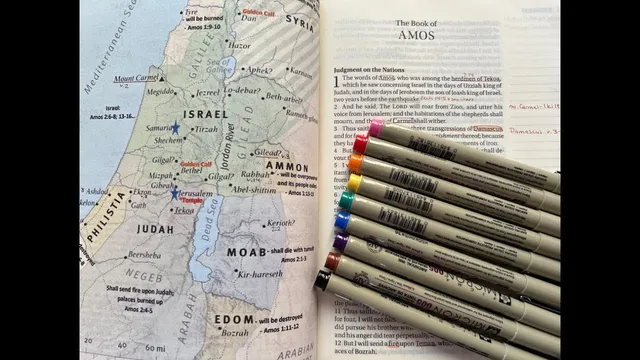
Wormwood explained; Book of Amos
Based on Bible Notetaking with Katie 's video on YouTube. If you like this content, support the original creators by watching, liking and subscribing to their content.
Amos is dated to the reigns of Jeroboam II (Israel) and Uzziah (Judah), with the study situating the prophecies within the lead-up to major events like the Assyrian conquest.
Briefing
Amos is framed as a tightly structured prophetic book whose messages about Israel’s and Judah’s moral collapse can be tracked through a web of cross-references—especially to Revelation’s symbolic language. The core takeaway is that Amos’s warnings (including repeated “woes,” judgments, and calls to righteousness) are treated as part of a larger biblical pattern: when people abandon God’s ways, the result is spiritual “darkness,” bitterness, and a famine of God’s true word.
The notes begin by placing Amos in historical sequence: Amos prophesied during the reigns of Jeroboam II in Israel and Uzziah in Judah, with the broader timeline running alongside other prophets (Hosea, Micah, Isaiah) and culminating in major events like the Assyrian conquest of Israel. From there, the book’s internal architecture is emphasized—eight “dooms” in chapters 1–2, followed by five sermons, five visions, and three promises. Key identity markers for Amos are highlighted in Amos 1:1 and Amos 7:14, and the surrounding historical context is reinforced with material tied to the prophetic setting.
A standout historical detail is an earthquake mentioned in Amos 1:1 and also referenced in Zechariah 14:5, with the notes pointing to a proposed date around 760 BC. The study approach then becomes highly visual: maps are used to track Assyria’s approach, major cities and regions (Damascus, Samaria, Bethl, Gaza, Tyre, Edom, Ammon, Moab), and the geographic flow of judgment. The study also links specific Amos locations to recurring biblical themes—such as idolatry (e.g., golden calf traditions connected to Dan and Bethel), and the proximity of Megiddo to Mount Carmel, where Elijah’s confrontation with false worship is treated as a thematic precursor.
As the notes move through Amos’s text, recurring motifs are color-coded and cross-referenced. “Fire,” “sword,” “trumpet,” and “wormwood” are treated as symbolic threads that reappear elsewhere in Scripture, particularly in Revelation. The “trumpet” motif is connected to Revelation’s sequence of judgments against God’s enemies, while “wormwood” becomes a central interpretive bridge: Amos 5:7’s warning about leaving off righteousness is linked to Revelation 8:11, where a star named Wormwood makes waters bitter and causes many to die.
The study then expands beyond Amos into a broader theology of righteousness and covenant faithfulness. Amos’s rebuke of Israel for interfering with Nazarites (Amos 2:11) is tied to the Nazarite vow in Numbers 6 and examples like Samson in Judges 13. The notes also stress that God’s people are marked by prophecy and commandments—connecting Amos’s prophetic identity to Revelation 12:17 and Revelation 19:10.
Finally, the “bitter waters” theme is traced through Exodus 15:22–26 (Mara’s bitterness cured by a tree) and into Luke 23:31 (green tree vs. dry tree), culminating in Psalm 1’s “green tree” imagery for believers. The practical conclusion is moral and spiritual: righteousness is not self-generated, but attributed to Christ; abandoning God’s commandments produces bitterness, deception, and a future famine of hearing God’s word (Amos 8:11–12, paired with Daniel 12:4 and Revelation 6). The overall effect is a study method that treats Amos as a map—geographically, symbolically, and doctrinally—leading into the Bible’s later prophetic imagery.
Cornell Notes
Amos is organized as a set of prophetic “dooms,” sermons, visions, and promises, anchored in a historical timeline during Jeroboam II (Israel) and Uzziah (Judah). The study emphasizes cross-references that connect Amos’s themes—judgment, righteousness, and spiritual decline—to later biblical symbolism, especially Revelation. A key interpretive thread is “wormwood”: Amos 5:7 (leaving off righteousness) is linked to Revelation 8:11 (waters made bitter). The notes also build a theology of God’s righteousness and covenant faithfulness by tracing “bitter waters” from Exodus 15:22–26 to Christ imagery (green tree) and “green tree” believer language in Psalm 1.
How do the notes place Amos in time, and why does that matter for interpreting the prophecies?
What is the earthquake connection between Amos 1:1 and Zechariah 14:5, and what date is suggested?
Why does “wormwood” become a central theme, and how is it linked across Scripture?
How do the notes interpret the Nazarite references in Amos 2:11?
What do the notes do with the “trumpet” and “fire/sword” motifs in Amos 1–2?
How do Exodus 15:22–26 and Psalm 1’s “green tree” imagery connect to Amos’s themes?
Review Questions
- Which historical reigns are used to date Amos, and how does that dating affect the way the “dooms” are understood?
- How do the notes connect Amos 5:7 to Revelation 8:11, and what does that imply about the meaning of “wormwood”?
- What is the study’s logic for linking Mara’s bitter waters (Exodus 15) to Christ imagery and to the “green tree” believer theme in Psalm 1?
Key Points
- 1
Amos is dated to the reigns of Jeroboam II (Israel) and Uzziah (Judah), with the study situating the prophecies within the lead-up to major events like the Assyrian conquest.
- 2
The book’s structure is treated as eight “dooms” in Amos 1–2, followed by sermons, visions, and promises, providing a roadmap for reading.
- 3
An earthquake is linked between Amos 1:1 and Zechariah 14:5, with the notes suggesting a timeframe around 760 BC.
- 4
Geography is used as an interpretive tool: maps track regions and cities named in Amos alongside themes like idolatry and judgment.
- 5
Symbolic words—especially “wormwood,” “trumpet,” “fire,” and “sword”—are cross-referenced to later Scripture, particularly Revelation.
- 6
Amos’s references to Nazarites (Amos 2:11) are tied to the Numbers 6 vow and examples like Samson, framing Israel’s actions as spiritual interference.
- 7
Righteousness is presented as Christ-centered rather than self-generated, with “bitter waters” (Exodus 15) and “green tree” imagery (Psalm 1) used to contrast covenant faithfulness with spiritual decline.