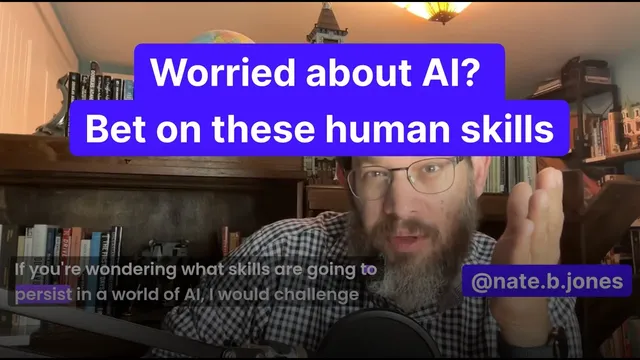
Worried about AI? Bet on these human skills
Based on AI News & Strategy Daily | Nate B Jones's video on YouTube. If you like this content, support the original creators by watching, liking and subscribing to their content.
AI’s biggest limitation is missing real-world feedback loops that humans run continuously—tasting, iterating, and adjusting based on what people actually like.
Briefing
AI is getting better at tasks that look like pattern recognition—especially in medicine and many diagnostic-style questions—but the most durable advantage for humans will come from skills that rely on lived feedback, taste, empathy, and context. The core claim is that AI’s limits aren’t just about “knowledge” or “speed.” They’re about missing feedback loops that humans naturally run in real time—tasting, iterating, and adjusting until something feels right to other people.
A concrete example is cooking. AI can generate recipes, yet blind taste tests tend to favor human-made versions. The gap isn’t simply creativity; it’s iteration. Humans can taste, notice dryness or imbalance, and modify the recipe immediately. Top chefs keep cycling through that sensory feedback with customers’ preferences until the result matches what people actually want. Without an effective “taste-and-correct” loop, AI often overemphasizes a narrow flavor profile and misses the nuance that comes from repeated human evaluation.
Medicine is framed as a second battleground where AI is steadily closing the gap. Every medical-diagnosis model released in 2024 is described as incrementally better, building on a major jump earlier (referred to as “01”). Even if AI isn’t yet used for diagnosis at scale, the direction matters: over the next 10–15 years, registered nurses and nursing-type roles may become especially valuable because the human presence shapes care. The diagnosis itself could eventually become something AI handles better than doctors, shifting power away from credentialed expertise and toward the human side of healthcare.
That shift would elevate bedside manner—kindness, caring, and the overall patient experience—because AI and robots delivering care are unlikely to match the concern and responsiveness that people provide. In other words, clinical authority may move from “who knows the most” to “who can deliver the most human experience,” even as AI improves the technical diagnostic layer.
The same logic extends to careers. Technical skills won’t disappear, but the value of routine code production may decline as AI accelerates drafting and training. The long-term premium may move toward applying AI to business problems that have a human component—especially where “what people want” is the deciding factor. A marketing example illustrates this: an ad concept using a large language model to depict a child writing to an Olympic track star sounded topical and accurate, but it “fell flat” because it didn’t match how people expect that kind of letter-writing to look and feel. Eventually, Google pulled the ad.
Finally, the transcript argues that humans will remain crucial for architecting large software systems and solving novel problems efficiently, particularly when systems must reflect human behavioral needs at scale. Whether in healthcare, engineering, or marketing, the durable edge comes from feedback loops and human context—areas where AI can assist but not fully replace the human role.
Cornell Notes
The transcript argues that AI’s strongest progress will not eliminate human value; it will shift it. AI can increasingly handle diagnosis-like tasks and generate outputs (like recipes or marketing copy), but it struggles with nuance because it lacks effective feedback loops—tasting, iterating, and adjusting based on human preferences. In healthcare, rising AI diagnostic ability could increase the importance of nursing roles and bedside manner, since empathy and patient experience remain hard for robots to replicate. In careers, routine technical output may face pressure, while human skills that interpret what people want, design systems around human behavior, and solve novel problems efficiently should retain long-term payoff.
Why do human-made recipes tend to beat AI-generated ones in blind taste tests?
How does the transcript connect improving AI medical diagnosis to the future value of nursing?
What happens to the “power” of doctors if AI becomes better at diagnosis?
What marketing example is used to show where human perspective still matters?
Which engineering skills are suggested to remain valuable even as AI improves code generation?
Review Questions
- What specific kind of feedback loop does the transcript claim AI lacks in cooking, and how does that affect outcomes?
- According to the transcript, how might AI’s improving diagnostic accuracy change the relative value of doctors versus nurses?
- Which parts of software engineering are predicted to lose value with AI, and which parts are predicted to gain or remain valuable?
Key Points
- 1
AI’s biggest limitation is missing real-world feedback loops that humans run continuously—tasting, iterating, and adjusting based on what people actually like.
- 2
Blind taste tests tend to favor human recipes because humans can detect nuance (like dryness or imbalance) and refine repeatedly, while AI lacks sensory correction.
- 3
As AI diagnostic models improve, nursing roles may become more valuable because human presence and patient experience remain difficult to automate.
- 4
Bedside manner—kindness, caring, and the overall health care experience—could become a differentiator even if AI handles more diagnosis.
- 5
Routine code production may face reduced value as AI drafts common solutions, but solving novel problems efficiently is expected to remain a human strength.
- 6
Human perspective is critical when outputs must match what people expect emotionally and behaviorally, not just what is technically correct (illustrated by the pulled Google ad).
- 7
Long-term durable skills cluster around understanding human behavior and designing systems around it, not just generating text or code faster.