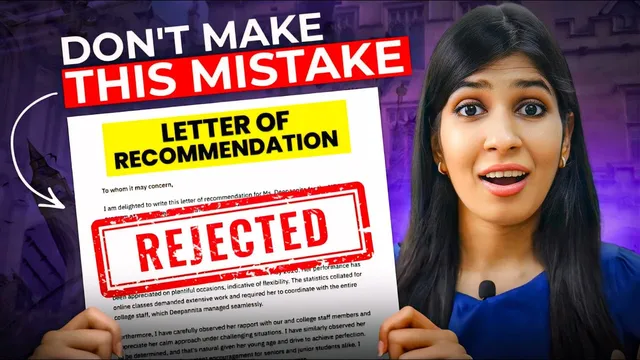
Worst LOR Mistakes - BEWARE! 🤯🔥 | Letter of Recommendation | Study Abroad
Based on WiseUp Communications's video on YouTube. If you like this content, support the original creators by watching, liking and subscribing to their content.
Choose recommenders who know the applicant personally, not just those with higher titles, because firsthand observation produces stronger, specific details.
Briefing
Study abroad applications often hinge on letters of recommendation, but many students sabotage their chances by treating the process like a formality instead of a credibility test. The biggest takeaway is that strong LORs come from recommenders who know the applicant well, include specific evidence for a limited set of qualities, and follow professional formatting norms—especially around length and opening lines.
A common first mistake is choosing the wrong recommenders and then trying to force every letter to say the same thing. When multiple LORs overlap, admissions readers see redundancy rather than a full picture of the applicant. A better approach is to assign each recommender a distinct angle based on real experience: one letter can focus on research skills from a professor who supervised a project; another can highlight classroom seriousness and punctuality alongside extracurricular leadership, communication, and teamwork from a professor who observed the student in and out of class; a third can draw on internship performance to show competence in a corporate environment. Together, these letters should collectively cover the applicant’s range without repeating the same claims.
Another frequent error is chasing “more reputed” names—like a head of department, dean, or senior manager—under the belief that status automatically makes the letter stronger. The problem is that high-ranking recommenders often write generic endorsements because they haven’t worked closely with the student. Admissions committees typically value depth over title. Letters gain power when the recommender can provide concrete examples of the applicant’s work, character, and impact.
Quality also collapses when letters are stuffed with adjectives. Overly enthusiastic praise—“very passionate,” “zest for knowledge,” “excellent leadership,” “amiable and friendly”—without proof reads like student-written copy. Instead of listing dozens of traits, the letter should demonstrate a few qualities through specific stories, outcomes, or reasons the recommender observed the student behaving that way. The goal is to let evidence carry the message rather than relying on sweeping claims.
Length and structure matter too. Two short letters (around 200–300 words) can signal that the recommender has little to contribute, while two very long letters (over 600 words) can dilute quality and look like a student-crafted SOP. An “ideal” target suggested here is roughly 375–475 words, fitting comfortably on one page while still allowing enough detail to stand out.
Finally, even the opening line can undermine professionalism. Starting with “To whomsoever it may concern” signals a lack of care about who will read the letter. A stronger first line addresses the admissions committee, admissions office, or admissions officer directly, setting a more credible tone from the start.
Cornell Notes
Strong letters of recommendation for study abroad succeed when they’re credible, specific, and professionally formatted. The most damaging mistakes include picking recommenders who don’t know the applicant well, repeating the same themes across multiple letters, and filling the text with praise that lacks evidence. Admissions readers also react to length: very short letters can imply limited knowledge, while very long letters can look like student-written content. A practical target is about 375–475 words per letter, with a direct, professional opening (e.g., addressing the admissions committee) instead of “To whomsoever it may concern.”
How should students choose recommenders so their letters don’t overlap or feel generic?
Why is “more reputed” not automatically better for a LOR?
What’s wrong with writing a LOR full of adjectives like “passionate,” “amiable,” and “excellent”?
How do letter length extremes affect how admissions committees perceive the recommender?
What opening lines make a LOR look more professional?
Review Questions
- What combination of recommender choice and letter content prevents overlap across multiple LORs?
- How can a student replace adjective-heavy praise with evidence while keeping the letter concise?
- Why might both very short and very long letters reduce credibility, and what word range is recommended instead?
Key Points
- 1
Choose recommenders who know the applicant personally, not just those with higher titles, because firsthand observation produces stronger, specific details.
- 2
Assign each letter a distinct focus tied to real experiences (research, classroom + extracurricular performance, internship work) to avoid repetitive overlap.
- 3
Avoid adjective-only praise; demonstrate qualities with concrete examples, outcomes, or stories the recommender witnessed.
- 4
Keep letters within an effective length range (about 375–475 words) to maintain credibility and readability.
- 5
Don’t write multiple letters that are too short (200–300 words) or too long (over 600 words), since both extremes can harm perceived quality.
- 6
Use a professional, targeted opening that addresses the admissions committee/office rather than “To whomsoever it may concern.”