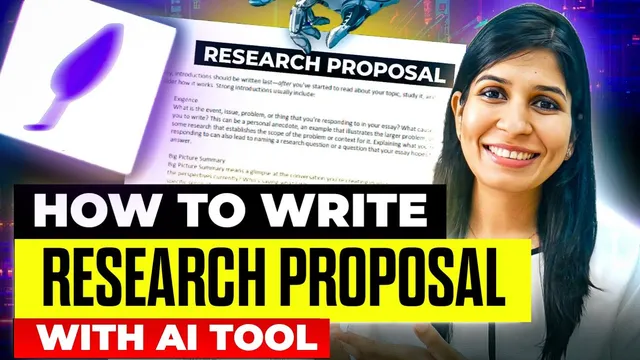
Write a Research Proposal with AI Tool!🔥 All sections explained in detail 🤯 Jenni AI
Based on WiseUp Communications's video on YouTube. If you like this content, support the original creators by watching, liking and subscribing to their content.
A research proposal must convince an academic committee that the research problem is important and that the applicant has a workable plan to investigate it.
Briefing
A research proposal is essentially a persuasion document: it must convince an academic committee that a chosen research problem matters and that the applicant has a credible, step-by-step plan to investigate it and reach a solution. The biggest hurdle for many students is not writing—it’s selecting a topic that is both authentic and researchable. To speed up that early stage, the transcript highlights Jenny, an AI writing assistant built for academics, with a chat feature that can generate topic ideas tailored to a field of study.
Jenny’s topic-generation workflow starts with prompting. Broad prompts (for example, “nanotechnology or Material Science”) are described as producing weaker results than more targeted prompts. The suggested approach is to narrow the research area first, then ask Jenny for topic ideas within that narrower scope. A concrete example given is generating research topic ideas for “super hydrophobic antibacterial fabrics,” where multiple plausible topics appear quickly—something the creator claims would otherwise take weeks of manually scanning hundreds of papers.
Once a topic is selected, the proposal’s structure largely mirrors a research paper, with one major difference: proposals don’t include results and discussion sections because the work hasn’t been conducted yet. Depending on the committee, proposals may also require extra components such as a work plan or budget. Typical length is around 2,500 to 3,000 words, but applicants are urged to check specific submission requirements.
The transcript lays out the core sections in order. First comes the proposed title, which should be concise yet informative enough to signal what the research will cover. Next is the abstract, similar to a research paper’s abstract, summarizing the proposal’s introduction, literature review, research design, and conclusion. The introduction then builds the case: it introduces the topic, explains the rationale, reviews prior work briefly, identifies a research gap (what existing studies haven’t solved), and states the research objective aimed at closing that gap.
A central section follows: the detailed literature review. Here, applicants are expected to compare and contrast theories, methods, and prior findings, while weighing strengths and weaknesses. The transcript emphasizes correct paraphrasing, proper citations, and avoiding accidental plagiarism.
From there, the methodology section outlines how the project will be executed. It should include the theoretical basis, a framework for tackling the problem, the chosen approach, and the plan for data collection and analysis—whether through experiments, surveys, or simulations. For experiments, it should specify materials, a step-by-step procedure, and analysis tools. The scope must also be explicit about what will be investigated and what will not.
Additional sections include a tentative timeline (with realistic scheduling, such as mapping goals across a 4–5 year PhD window) and, when required, a budget. The budget should list costs such as materials, equipment, travel, and contingency for uncertainty like experiment failures, while also justifying each expense to improve funding odds. The conclusion then reiterates objectives, significance, broader implications, and potential applications, followed by a references list of all cited sources.
Throughout, Jenny is positioned as a writing and research-support tool: uploading literature to keep sources organized, using prompts to critically evaluate papers, summarizing work, generating paragraph starters or autocomplete suggestions, producing citations and references from uploaded or web sources, and polishing language to sound more academic. The transcript also mentions a free trial and a premium discount coupon code: wise 20.
Cornell Notes
A strong research proposal persuades an academic committee that a research problem is important and that the applicant has a workable plan to study it. Topic selection is treated as the hardest step, and Jenny is presented as a way to generate topic ideas quickly—especially when prompts are specific rather than broad. The proposal structure closely follows a research paper but omits results and discussion, typically adding elements like a work plan or budget. Key sections include a concise title, an abstract summarizing introduction/literature/research design/conclusion, an introduction that identifies a research gap and objective, a detailed literature review that compares approaches, and a methodology that specifies theory, data collection/analysis, and scope. A realistic timeline, optional budget with justified costs, a conclusion on significance and implications, and a complete references list close the document.
What makes a research proposal persuasive to an academic committee?
How should a student use Jenny to generate better research topic ideas?
Which sections belong in a research proposal, and what’s different from a research paper?
What must the methodology section specify to be considered complete?
How should a budget be handled when a grant or funding proposal requires one?
How can Jenny support academic writing beyond topic generation?
Review Questions
- If an academic committee asks for a research proposal but not results, how should the abstract and overall structure be adjusted to match a proposal stage?
- What specific elements must be present in the methodology section to show the project is feasible from start to finish?
- How would you narrow a broad research area into a prompt that is likely to produce stronger topic ideas from an AI tool?
Key Points
- 1
A research proposal must convince an academic committee that the research problem is important and that the applicant has a workable plan to investigate it.
- 2
Topic selection is the main challenge; using Jenny for topic ideation is most effective when prompts are specific rather than broad.
- 3
Proposals typically omit results and discussion sections, but may add work plan and budget components depending on committee requirements.
- 4
The introduction should move from rationale and brief prior work to a clearly defined research gap and a focused research objective.
- 5
The literature review should compare and contrast theories, methods, and prior findings while assessing strengths and weaknesses with correct paraphrasing and citations.
- 6
The methodology must specify theory, framework, data collection and analysis approach, experimental procedure (if applicable), and the study scope.
- 7
When budgets are required, include justified costs plus contingency for uncertainty, and provide a realistic timeline to match project demands.