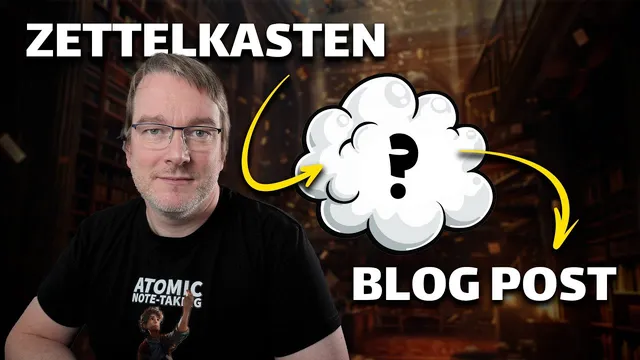
Writing blog posts from your Zettelkasten
Based on Martin Adams's video on YouTube. If you like this content, support the original creators by watching, liking and subscribing to their content.
Use a readiness check: if a full draft can be written entirely from existing Zettelkasten notes, the piece is likely ready; otherwise, identify outline gaps and keep researching to fill them.
Briefing
Zettelkasten notes can become publishable work—blog posts, articles, or even YouTube scripts—when the writing is grounded in what’s already in the system. The key test for readiness is whether a full draft can be produced entirely from existing notes, without needing fresh research; if gaps show up during outlining, the process becomes iterative: keep reading, keep note-taking, and fill those holes until the draft can stand on its own.
The approach matters because publishing isn’t just output—it’s a way to clarify thinking, explain ideas more sharply, and invite feedback that exposes blind spots. Writing also serves a practical entrepreneurial purpose: people who care deeply about a topic can build a body of work around it, attract others with similar interests, and potentially turn that shared focus into a business. In that framing, publishing becomes both intellectual discipline and a route to community and monetization.
Determining what kind of publication to make depends on the scope of the piece. An introductory post may only require definitions, benefits, and drawbacks. A deep dive—where readers learn “everything they’ll probably need”—demands more exhaustive notes. A third option is a narrow perspective that targets a specific question and lets the author’s synthesis and lived experience do the heavy lifting. For example, instead of covering all of content creation or all of entrepreneurship, a writer might focus on one monetization question: how a “solo entrepreneur” makes money from content creation. That kind of tight angle supports a unique point of view rather than a broad survey.
The transcript also emphasizes how to avoid plagiarism and shallow rehashing: relying on a single source and then writing from it risks copying or merely restating someone else’s ideas. Better results come from synthesizing multiple perspectives—or from combining learning with personal experience and application. As the author’s own career activities accumulate (launching a YouTube channel, publishing a book, building a course, creating a community), those experiences add authority and texture that wouldn’t exist without practice.
A practical method for generating publishable drafts is question-driven writing. Start with a problem you genuinely want to answer, then pull relevant note clusters from the Zettelkasten—mindset, habits, and psychology notes like anxiety or motivation—and assemble them into an article outline. The example given is an article on avoiding burnout as a content creator, built from mindset and habit notes plus supporting psychological material.
Finally, the transcript draws a line between bottom-up and top-down workflows. A top-down approach begins with a desired conclusion and then searches for supporting research, which encourages cherry-picking and bias. A bottom-up approach starts from the notes already captured, letting the writing emerge from the accumulated evidence and reasoning, which is presented as a more reliable path to truth and coherence.
Cornell Notes
Publishing from a Zettelkasten hinges on readiness and method. A strong readiness signal is the ability to draft a full piece using only existing notes, with research added only to close specific gaps found during outlining. Publication scope can vary: introductory posts need less, deep dives require more exhaustive notes, and narrow questions can highlight a unique synthesis (e.g., monetization strategies for solo content creators). Question-driven writing works well by pulling together relevant note clusters (mindset, habits, psychology) to answer a specific problem like avoiding burnout. Bottom-up drafting from notes helps reduce bias compared with top-down writing that searches for evidence to support a preselected claim.
What practical test indicates someone is ready to publish from a Zettelkasten?
How should a writer choose between an introductory post, a deep dive, or a narrow-angle article?
Why does the transcript treat publishing as more than output?
What’s the recommended way to avoid plagiarism or “rehashing” when writing?
How does question-driven writing turn Zettelkasten notes into an article?
What’s the difference between bottom-up and top-down writing, and why does it matter?
Review Questions
- When outlining a potential blog post, what specific signal tells you whether additional research is necessary?
- Give one example of how a narrow-angle question could be derived from broader note topics in a Zettelkasten.
- How would a top-down workflow change the kinds of sources a writer tends to select compared with a bottom-up workflow?
Key Points
- 1
Use a readiness check: if a full draft can be written entirely from existing Zettelkasten notes, the piece is likely ready; otherwise, identify outline gaps and keep researching to fill them.
- 2
Treat publishing as a thinking tool—writing clarifies ideas, and feedback helps correct blind spots.
- 3
Match the publication type to note depth: introductory posts need less, deep dives require exhaustive notes, and narrow questions can leverage targeted synthesis.
- 4
Build originality by synthesizing multiple sources or by applying learning through personal experience, rather than restating a single book.
- 5
Generate drafts by starting with a question and assembling related note clusters (mindset, habits, psychology) into an outline.
- 6
Avoid bias by using bottom-up drafting from notes; don’t begin with a conclusion and then cherry-pick research to justify it.