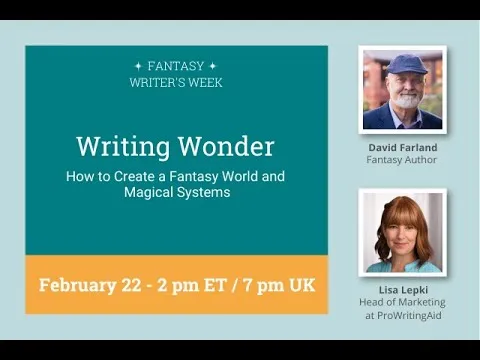
Writing Wonder: How to Create a Fantasy World and Magical Systems with David Farland
Based on ProWritingAid's video on YouTube. If you like this content, support the original creators by watching, liking and subscribing to their content.
Treat wonder as an engineered emotional payoff: surprise plus admiration delivered often enough to prevent it from becoming mundane.
Briefing
Fantasy writing advice centers on one core lever: repeatedly manufacturing “wonder”—a feeling of surprise mixed with admiration—so readers stay engaged instead of sliding into familiarity. David Farland frames wonder as a dominant emotional draw across popular culture, arguing that the strongest fantasy and science-fiction stories keep delivering fresh, unexpected marvels every few pages. The practical problem is that wonder can wear off when it’s repeated too predictably; the writer’s job is to keep the experience original and “fresh,” even inside a consistent world.
Farland ties wonder to audience psychology and genre design. He notes that nostalgia can also pull readers in, but it can become mundane when overused. For younger readers, wonder is especially potent: around age 12, wonder can function as a near-universal draw, while adventure tends to be weaker for some groups. That helps explain why blockbuster fantasy for middle grade and young adult audiences often blends wonder with other engines—romance, humor, horror, and mystery—rather than relying on action beats alone. He uses examples like Harry Potter’s Hogwarts, where nearly every room contains a new twist: classes can be “wondrous” in their subject matter, while the building itself keeps surprising students with shifting staircases and hidden supernatural details.
Worldbuilding is presented as the foundation that makes wonder possible. Farland emphasizes building the world first—then letting characters and plot grow out of it—so the setting’s environment, culture, and history shape behavior. He recommends the “iceberg principle” (show only selected details so readers feel the depth beneath the surface), and he stresses realism where it matters: maps should look like plausible planets, societies should reflect constraints, and world elements shouldn’t be “sloppy” just because the genre is fantasy. He also promotes a “cool rule” for life and creatures: even if hard-science explanations aren’t required, the world should be fun, internally consistent, and imaginative in its consequences.
Magic systems get special scrutiny because they can either amplify wonder or replace it with something less compelling. Farland warns against “stock” magic systems that borrow familiar tropes without adding new logic, and against magic that lacks rules, costs, or a source. He argues that magic works best when it has internal logic and consequences—so the protagonist pays a price, becomes constrained, or faces moral tradeoffs. He also discourages magic that functions like an alternate science where spells are simply instructions that remove tension; when magic becomes too easy to master, wonder can get traded away for straightforward problem-solving.
He rounds out the craft with sensory immersion: fantasy isn’t an excuse for vague description. To “bring a story to life,” writers should use all senses—smell, taste, sound, touch, sight—along with character emotion and internal thought, aiming to slow the reader into a more receptive, trance-like state. Across worldbuilding, magic, and prose, the throughline is consistent: wonder must be engineered, grounded enough to feel credible, and delivered in a way that keeps the reader actively discovering what’s next.
Cornell Notes
Wonder is the emotional engine that keeps fantasy and science fiction compelling: it’s surprise mixed with admiration, and it can dominate reader attention when it stays fresh. Farland argues that wonder must be delivered repeatedly in service of story, often by building a world full of “cool” permutations—places, creatures, and rules that surprise characters and readers alike. Worldbuilding should come before characters and plot, using techniques like the iceberg principle and realistic constraints (maps, ecology, physics where relevant). Magic systems should avoid stock tropes and must include rules, a source, and costs/consequences; otherwise magic becomes mundane or turns into mere alternate science. Sensory prose—smell, sound, touch, taste, sight—helps immerse readers so wonder lands as lived experience.
Why does “wonder” matter more than nostalgia or pure adventure for many fantasy audiences?
How can a writer keep wonder from turning into something predictable?
What’s the recommended order of operations in worldbuilding—world first or character first?
What makes a magic system compelling rather than generic or boring?
How should wonder be integrated into story rather than treated as set dressing?
What does “sensory immersion” look like in practice for fantasy prose?
Review Questions
- What specific techniques does Farland recommend to keep wonder fresh across multiple scenes (and why does repetition risk making it mundane)?
- How do rules, sources, and costs function together to prevent magic systems from becoming either generic or consequence-free?
- In Farland’s framework, how does worldbuilding constrain character behavior, and what does the iceberg principle add to reader experience?
Key Points
- 1
Treat wonder as an engineered emotional payoff: surprise plus admiration delivered often enough to prevent it from becoming mundane.
- 2
Build the world first so characters and plot emerge from environmental, cultural, and historical constraints rather than feeling anachronistic.
- 3
Use the iceberg principle to imply depth—show only selected details so readers sense a larger, unexplored reality beneath the surface.
- 4
Design magic with internal logic: include rules, a clear source of power, and meaningful consequences so wonder doesn’t collapse into convenience.
- 5
Avoid stock magic systems and prophecy-driven clichés; replace them with systems that feel distinct and consequential.
- 6
Ground fantasy prose in sensory detail (smell, taste, sound, touch, sight) and tie it to character emotion to sustain immersion.
- 7
Deliver wonder in service of story by linking each marvel to character struggle and plot momentum rather than letting worldbuilding become static display.