You Don’t Deserve What You Want | Stoic Philosophy
Based on Einzelgänger's video on YouTube. If you like this content, support the original creators by watching, liking and subscribing to their content.
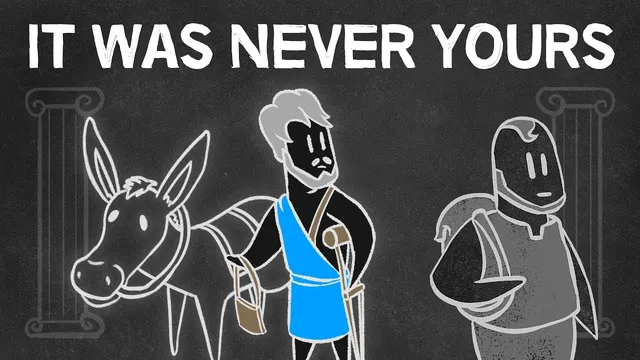
Epictetus draws a boundary between what’s truly “yours” (choices, attitudes, actions) and what’s borrowed and impermanent (wealth, relationships, even the body).
Briefing
Entitlement is portrayed as a double failure: it rests on a mistaken belief that life owes someone specific outcomes, and it then manufactures chronic emotional pain when reality refuses to comply. Epictetus is used to draw a hard line between what people truly “own” and what they merely possess temporarily. Homes, possessions, loved ones, and even the body are described as borrowed goods—temporary gifts that can be reassigned at any moment—so the only legitimate “entitlements” are internal: opinions, attitudes, pursuits, and the choices that follow from them. That distinction matters because it reframes disappointment: the world not delivering desired extras isn’t the core injustice; the real problem is the mental claim that those extras were owed.
The transcript also links entitlement to modern social patterns—self-focused demands, outrage when expectations aren’t met, and blame directed outward—then categorizes entitlement into material, social, and legal forms. Across these versions, the same mechanism repeats: a person believes they have a right to something, feels wronged when they don’t get it, and becomes trapped in dissatisfaction. Stoic logic is presented as a corrective. By training attention on impermanence, people can stop treating transient things as guaranteed. A favorite ceramic cup, for instance, should be seen as one object among many, vulnerable to breakage, theft, confiscation, and eventual decay. The same logic is extended to relationships: love is directed toward impermanent human beings who can leave, so the “entitled” fantasy—if it were real—would prevent separation.
Even when others behave badly, Stoicism shifts the target from external events to internal interpretation. Epictetus’ guidance is quoted to underline that insults and blows don’t automatically injure; the injury comes from one’s own conclusion that those events are insulting. The practical takeaway is to “buy time” after provocation—pause long enough to realign attitudes—rather than being hypnotized by the event’s apparent importance.
To reduce entitlement, the transcript recommends detachment and reconditioning desire. A story attributed to Seneca is used as a model: a wealthy senator temporarily lives on lentil soup, simple clothing, and weak wine and vinegar water to test whether fear of poverty is justified. The experiment reportedly dulls attachment and makes the loss of wealth less terrifying, which directly addresses the emotional engine behind entitlement.
From there, the focus turns to contentment through simplicity. Seneca’s “highest pleasure” is described as enjoying life with minimal needs—so Fortune has fewer levers to pull. Instead of demanding perfect partners or universal respect, people can learn to appreciate what they already have and take pleasure in not requiring more. The transcript closes by tying entitlement to a lack of perspective: Stoicism emphasizes interconnectedness, where individuals are “limbs” of one body. When entitlement treats life as a personal entitlement machine, it disrupts harmony in the larger community—“what injures the hive injures the bee.” The proposed alternative is peace: align one’s will with how events unfold, accept impermanence, and seek a steadier kind of happiness that doesn’t depend on being granted everything demanded.
Cornell Notes
Entitlement is framed as a Stoic error of judgment: people treat temporary things—wealth, status, relationships, even their bodies—as if they were owed to them. Epictetus draws the boundary between what’s truly “yours” (your choices, attitudes, and actions) and what’s borrowed and impermanent. When expectations are built on entitlement, disappointment turns into anger and ongoing dissatisfaction because happiness becomes dependent on external outcomes. The remedy is practical: detach from what can be taken away, train attention on impermanence, pause to correct interpretations after provocation, and cultivate enjoyment of simpler living. Stoicism adds a social dimension too—entitlement conflicts with the idea that humans are interconnected parts of one community.
Why does Stoicism treat entitlement as logically flawed rather than just emotionally frustrating?
How does the ceramic cup example work as a training exercise against entitlement?
What’s the Stoic response when someone feels insulted or mistreated?
How does the senator’s lentil-soup experiment reduce entitlement?
What does “enjoying the minimum” add to detachment?
How does Stoicism connect entitlement to harm in the wider community?
Review Questions
- Which category of things does Stoicism say people are actually entitled to, and why?
- How does the “cup” analogy change the way someone should interpret losing a valued possession?
- What internal step does Epictetus recommend after provocation, and how does it prevent entitlement-driven anger?
Key Points
- 1
Epictetus draws a boundary between what’s truly “yours” (choices, attitudes, actions) and what’s borrowed and impermanent (wealth, relationships, even the body).
- 2
Entitlement is treated as a mistaken belief that external outcomes are owed, which then produces emotional turmoil when reality doesn’t comply.
- 3
Stoic practice shifts attention from external events to internal interpretation—insults and harms become injurious through one’s own conclusions.
- 4
Detachment can be trained through deliberate exposure to loss or simplicity, illustrated by the senator’s temporary life on lentil soup and basic clothing.
- 5
Contentment is strengthened by learning to enjoy minimal needs, making privileges and special treatment nonessential.
- 6
Entitlement conflicts with Stoic interconnectedness: personal demands can disrupt the well-being of the larger community.