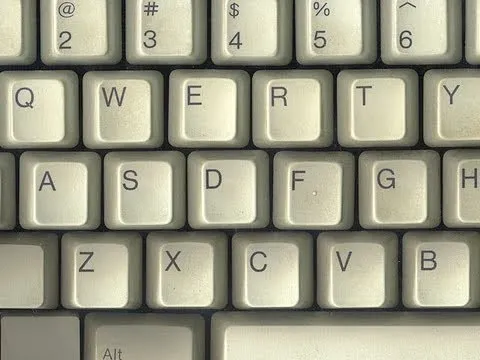
You Don't Type Alone.
Based on Vsauce's video on YouTube. If you like this content, support the original creators by watching, liking and subscribing to their content.
Heavy computer users average about 5,000 to 10,000 keystrokes per day and roughly 1,500 to 3,000 mouse clicks per day.
Briefing
Typing and mouse-clicking are constant, measurable parts of modern life—and the numbers are big enough to make “alone at the keyboard” feel like a myth. On average, heavy computer users such as office workers rack up roughly 5,000 to 10,000 keystrokes per day and click a mouse about 1,500 to 3,000 times daily. Tools like WhatPulse can track those actions in real time, including keystrokes, mouse clicks, and even how far the cursor moves, turning everyday habits into daily totals.
Beyond productivity, keyboard use also has a small physical cost. Sitting and using a computer burns about 20 more calories per hour than doing nothing, though the baseline energy burn is already substantial. The transcript gives a simple way to estimate “existing” calories: multiply body weight in pounds by 11 (or kilograms by 0.02) to get calories per minute required just to keep the body running. Computer work adds only a modest increment, but it’s still measurable.
The most striking thread is how communication habits scale globally. The transcript notes that 6 billion text messages are sent each day, with Earth’s population estimated at about 7 billion—so texting alone already involves nearly everyone. Keyboard typing is then folded into the picture. Using an estimate of about 350 million people typing 5,000 to 10,000 characters a day, and combining that with daily texting volume, the math lands on a global rate: at any given second, the space bar is pressed about 6 million times.
That figure becomes more personal through timing. A space-bar press takes roughly 1/10th of a second. During that brief window, statistical overlap suggests as many as 600,000 other people press their space bars at the same time. The takeaway isn’t just that typing is common—it’s that the act of pausing between words is synchronized across the planet, making the feeling of isolation during typing hard to justify.
The transcript also zooms in on letter and key frequency. Not all characters are used equally: “E” is the most common letter in many languages that include it, and a “keyboard sculpture” visualizes letter popularity by raising each character to a height proportional to its frequency. For self-measured letter frequencies, Patrick Wied’s heat map lets users paste text and see character usage patterns. In everyday typing, the space bar emerges as the most pressed key—nearly twice as popular as the letter “E.” Together, these details connect individual behavior (what gets typed) to global behavior (how often it happens), turning a mundane habit into a shared, quantifiable rhythm.
Cornell Notes
The transcript quantifies everyday typing and shows how it connects people worldwide. It cites typical daily totals for computer users—about 5,000 to 10,000 keystrokes and 1,500 to 3,000 mouse clicks—and notes that computer use burns roughly 20 extra calories per hour compared with doing nothing. It then shifts to communication scale: with 6 billion texts sent daily and an estimate of 350 million people typing thousands of characters per day, the space bar is pressed about 6 million times every second. Because a space-bar tap takes about 0.1 seconds, that implies up to around 600,000 other people press space at the same moment. The transcript also highlights character frequency, with “E” often most common among letters, while the space bar is the most pressed key overall.
How can someone measure their own typing and clicking habits, and what does that measurement include?
What are the typical daily interaction counts for heavy computer users, and how are they framed?
How does the transcript estimate calories burned from “just existing” versus using a computer?
Why does the space bar become the centerpiece of the global math?
How does the transcript turn “millions per second” into a feeling of not being alone?
What tools or visuals are used to discuss which letters and characters are most frequent?
Review Questions
- What assumptions and numbers are needed to estimate how many times the space bar is pressed per second worldwide?
- How does the transcript connect letter frequency (like the prominence of “E”) to key frequency (like the space bar being most pressed)?
- WhatPulse is used for more than just keystrokes—what other measurements does it track, and why does that matter for interpreting daily totals?
Key Points
- 1
Heavy computer users average about 5,000 to 10,000 keystrokes per day and roughly 1,500 to 3,000 mouse clicks per day.
- 2
WhatPulse can track keystrokes, mouse clicks, and cursor movement distance to quantify daily computer activity.
- 3
Using a computer burns only modestly more energy than doing nothing—about 20 extra calories per hour—on top of a baseline energy cost of “existing.”
- 4
Texting is already massive at global scale: about 6 billion text messages are sent each day.
- 5
Combining texting with keyboard typing estimates yields an estimated global space-bar rate of about 6 million presses per second.
- 6
Because a space-bar tap takes about 0.1 seconds, the transcript estimates up to around 600,000 people press space at the same time.
- 7
Character frequency is uneven: “E” is often the most common letter, but the space bar is the most pressed key overall.