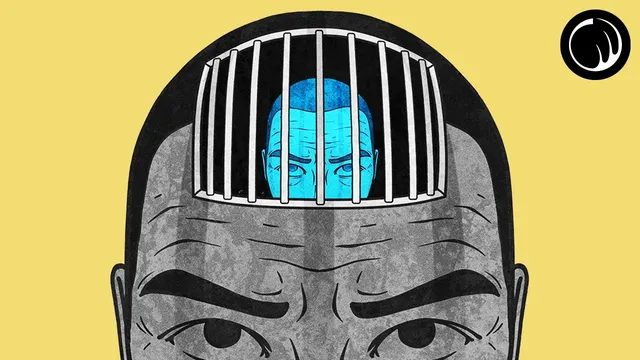
You’re too self-aware. And that’s why things feel weird.
Based on Pursuit of Wonder's video on YouTube. If you like this content, support the original creators by watching, liking and subscribing to their content.
Self-awareness intensifies suffering by making human limits—ignorance, futility, and death—hard to ignore.
Briefing
Self-awareness is a double-edged gift: it sharpens human suffering by making limits, ignorance, and death feel unavoidable—but it also provides the only route to transmute that suffering into meaning. The core claim is that humans are driven to understand, control, and “matter,” yet they can’t fully control themselves or reality. That mismatch creates a persistent existential unease: people can see their own ignorance and futility clearly, while still lacking the ability to resolve what they most want to resolve.
The transcript frames this as a paradox built into human consciousness. Humans are “symbolic selves,” able to name themselves, imagine beyond the present, and reason about atoms and infinity. At the same time, they remain biological creatures—part of nature, subject to decay and death. That tension produces a kind of existential vertigo: intense lucidity without directorial power. Instead of steering the show of existence, people end up watching it go wrong repeatedly, with a clear view of failures and absurdities but no clear direction.
Historically, the problems of self-awareness are portrayed as worsening as societies gain more knowledge. Cognitive, agricultural, scientific, industrial, and technological revolutions are cited as successive inflations of awareness—especially in modern, Westernized contexts where reason, order, control, and certainty become tools in a “war against the universe.” Yet the universe itself is described as indifferent; the pain is human. As old myths and traditions lose authority under new knowledge, the transcript suggests that progress in safety and longevity has not been matched by progress in meaning, purpose, connection, and clarity.
A key anchor comes from Ernest Becker’s “denial of death,” which is used to capture the symbolic identity humans build to rise above nature while still being trapped inside it. The transcript also invokes H. P. Lovecraft’s warning that the mind’s inability to correlate everything is merciful—because fully connecting dissociated knowledge could be psychologically overwhelming. That “someday” is treated as effectively here: science and technology have opened terrifying vistas of reality and humanity’s position in it, and those vistas can’t be escaped.
Still, the message is not nihilistic. Self-awareness is presented as the lifeline for managing and enduring suffering. Because humans can interpret experience, they can weave meaning from bodies, minds, nature, history, and the future—turning pain into something livable through art, curiosity, and aesthetic experience. The transcript’s final move is to treat the paradox as something to embrace rather than solve: awareness causes suffering, but suffering can become worthwhile through awareness. The closing segment promotes the author’s book, The Terrible Paradox of Self-awareness, as a set of reflections on self, meaning, truth, desire, suffering, futility, time, death, and hope—aimed at people who find existence absurd yet still want to live well inside that condition.
Cornell Notes
The transcript argues that self-awareness creates existential suffering because it reveals human limits—ignorance, futility, and mortality—while humans are driven to control and understand everything. Modern science and Western culture intensify this problem by replacing older myths with knowledge, leaving people more exposed to paradoxes and “terrifying vistas” about reality. Ernest Becker’s “denial of death” and H. P. Lovecraft’s idea that correlation of knowledge can be psychologically dangerous are used to frame why humans feel trapped between symbolic meaning-making and biological reality. The central counterpoint is that self-awareness is also the mechanism for transforming suffering into meaning through interpretation, art, curiosity, and love. The goal isn’t to eliminate the paradox, but to use it to live well.
Why does self-awareness make life feel “weird” or unbearable, even though it’s often treated as a good thing?
How do the transcript’s “symbolic self” and “worm in nature” ideas explain the paradox of consciousness?
What role do modern revolutions and Westernization play in intensifying the problem?
How do Ernest Becker and H. P. Lovecraft support the transcript’s view of existential distress?
If self-awareness causes suffering, what’s the proposed way to make that suffering worthwhile?
What does “embrace the paradox” mean in practical terms here?
Review Questions
- What specific gap between human drives and human capabilities does the transcript identify as the source of existential unease?
- How do the transcript’s references to “denial of death” and Lovecraft’s “correlating knowledge” connect to the idea that modern science intensifies psychological burden?
- What mechanisms does the transcript propose for turning suffering into meaning without claiming the paradox can be solved?
Key Points
- 1
Self-awareness intensifies suffering by making human limits—ignorance, futility, and death—hard to ignore.
- 2
Humans are portrayed as symbolic meaning-makers who are still trapped in biological reality, creating a built-in paradox.
- 3
Modern knowledge and Western emphasis on control replace older myths, leaving people more exposed to existential contradictions.
- 4
The “war against the universe” can’t be won because the universe is indifferent; the pain is human.
- 5
Ernest Becker’s “denial of death” and H. P. Lovecraft’s warning about correlating knowledge frame why heightened awareness can feel psychologically dangerous.
- 6
The transcript’s solution isn’t to eliminate the paradox but to use awareness to transmute suffering into meaning through art, curiosity, and love.
- 7
Meaning-making—interpreting bodies, minds, nature, history, and the future—is presented as the lifeline that makes life livable despite uncertainty.