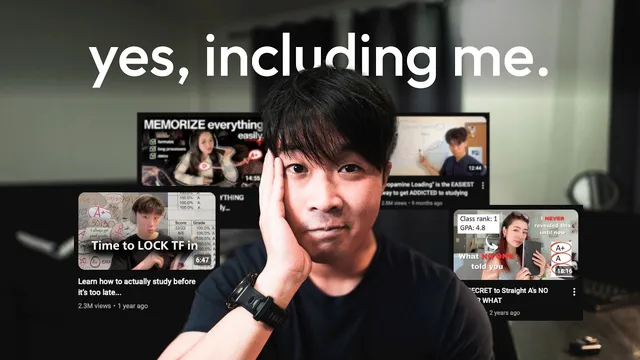
you should stop watching study youtubers. (yes, even me.)
Based on Kai Notebook's video on YouTube. If you like this content, support the original creators by watching, liking and subscribing to their content.
Self-help can trigger dopamine from learning (“aha” moments) even when viewers don’t do the recommended actions.
Briefing
Self-help YouTube can become a dopamine trap: it delivers the “reward” of learning without the effort of doing, which can make viewers feel productive while bingeing content instead of taking action. The core claim ties human motivation to biology—actions lead to rewards, and rewards (especially dopamine) reinforce the behaviors that produced them. Effort matters in this loop: harder tasks generate bigger dopamine responses. But watching self-help content is unusually effortless. The brain gets a quick “aha” hit from absorbing ideas, so dopamine rises even though the viewer hasn’t put in the work the advice is meant to trigger.
That mismatch—reward without effort—helps explain why self-help can turn addictive. The transcript compares the mechanism to drugs: both can deliver dopamine with minimal friction, bypassing the hard part of behavior change. In this framing, binge-watching becomes a habit loop in which the viewer repeatedly consumes information, receives a learning-related reward, and interprets that internal feeling as progress. The result is a false sense of productivity: the brain is trained to seek the next rewarding input rather than to execute the behaviors the content recommends.
The argument also lands in a broader cultural moment. With constant distractions and the rise of AI, people may increasingly offload thinking—letting tools write, decide, or explain instead of practicing critical thought. The transcript urges viewers to “start using your brains” and not surrender effort to automation, positioning deliberate learning and problem-solving as a counterweight to “brain rot.”
Still, the message isn’t anti-self-help. The utility of self-help content is described as a starting point—a catalyst that guides people toward specific actions, especially those who don’t know what to do yet. The fix is behavioral, not moral: viewers should use the dopamine from watching as motivation to act, rather than treating the dopamine itself as the outcome.
To operationalize that, the transcript introduces a “1:1 ratio” for consuming self-help: the effort spent watching should match the effort spent applying what was learned. The idea is to reinforce the action the advice points to, replacing the reward of passive consumption with the reward that comes from doing. A practical example is given using the current video: after finishing, the viewer should pause, reflect, and spend time processing the lesson in silence rather than immediately queuing the next video. The transcript also repeats a guiding principle—knowledge without action is ignorance—and concludes that meaningful results depend on output, not just information intake.
Cornell Notes
The transcript argues that self-help YouTube can be harmful when it becomes a dopamine loop: viewers get the “reward” of learning (an aha moment) without the effort of taking the recommended actions. Because dopamine reinforces the behavior that produced it, binge-watching can feel productive while replacing real change with passive consumption. The proposed remedy keeps self-help but changes how it’s used: apply a “1:1 ratio,” where the effort spent watching matches the effort spent doing. Dopamine should be treated as a starting motivator to begin action, not as the end goal. The approach aims to shift reinforcement from watching to execution, aligning learning with output.
Why does the transcript claim self-help videos can become addictive or counterproductive?
How does “effort” change the dopamine reward, and why does that matter for behavior change?
What is the “1:1 ratio,” and how is it supposed to prevent passive bingeing?
What practical step does the transcript recommend after finishing a self-help video?
How does the transcript connect self-help consumption to broader issues like AI and distraction?
What role does self-help content still play in the transcript’s view?
Review Questions
- How does the transcript’s reward/effort model explain the difference between feeling productive and actually changing behavior?
- What would “1:1 ratio” look like for a specific self-help video you’ve watched recently (name the action and estimate the effort)?
- Why does the transcript argue that pausing for reflection after a video is part of breaking the binge loop?
Key Points
- 1
Self-help can trigger dopamine from learning (“aha” moments) even when viewers don’t do the recommended actions.
- 2
Dopamine reinforcement can make binge-watching feel rewarding, training the brain to seek consumption over effortful change.
- 3
Effort is central to how rewards scale; low-effort watching creates a mismatch with high-effort behavior change.
- 4
The transcript compares the dopamine mechanism of passive consumption to drug-like reward loops to highlight the risk of addiction-like habits.
- 5
Self-help remains valuable when used as a guide toward action rather than a substitute for action.
- 6
The “1:1 ratio” recommends matching the effort of watching with the effort of applying what was learned.
- 7
Pausing to reflect after finishing a self-help video is offered as a concrete way to convert learning into action.