You're Technically HOTTER Than The Sun (with XKCD!)
Based on minutephysics's video on YouTube. If you like this content, support the original creators by watching, liking and subscribing to their content.
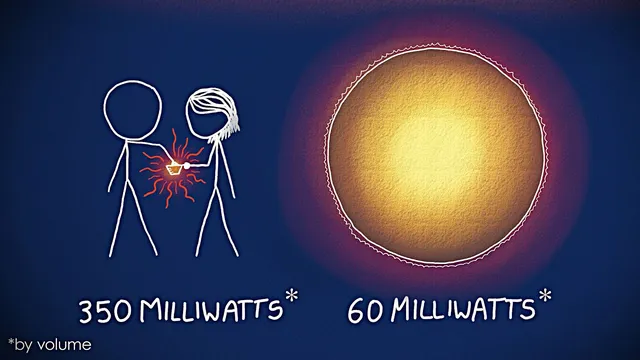
A planet-scale radioactive mass can become extremely hot because heat is generated by volume while heat loss depends on surface area, forcing higher temperatures to radiate enough energy.
Briefing
If Mercury, Uranus, and Neptune—and the dwarf planets Ceres and Pluto—suddenly became made of the chemical elements that share their names, the biggest shock wouldn’t be visual. It would be heat: planet-scale radioactive material would turn “cool in small amounts” into “hot enough to glow,” and the most dangerous case would end with a catastrophic chain reaction that obliterates Earth.
Start with the non-radioactive worlds. Mercury and Ceres would become metals (cerium for Ceres, corresponding to the element name), so they’d mostly just look heavier and shinier. Their brightness would increase enough that Ceres could become visible to the naked eye. But that improvement in visibility would be offset by a different problem: the night sky would be harder to navigate because the other altered planets would change the overall sky background.
The real temperature story begins with radioactive elements. Uranus, if composed of uranium, and Pluto, if composed of plutonium, would generate heat through slow radioactive decay. Even uranium’s most common and stable isotope wouldn’t feel hot in a small lump, but scaling up to a planet-sized mass changes everything. Heat production happens throughout the volume, while heat loss depends on surface area. Because volume grows faster than surface area as objects get larger, the interior of a large heat-producing body accumulates heat faster than it can radiate it away. Thermodynamics then forces the object to rise in temperature until it can radiate enough energy to balance production. The result: a planet made from uranium could glow like an ordinary star, bright enough to be seen without a telescope.
Pluto made from plutonium would also heat and glow—barely visible from Earth—though the viewing experience would be ruined by the next planet over. Neptune, if made from neptunium, is the nightmare scenario. Even the most stable neptunium isotope is fissile, meaning it can trigger a runaway fission chain reaction. In the transcript’s scenario, “237Neptune” would rapidly convert the planet into an expanding cloud of high-energy particles and X-rays. Roughly four hours later, the resulting shock wave would reach Earth, stripping away the surface and everything on it and leaving behind a molten remnant.
The same general outcome would occur for Uranus and Pluto if their compositions used fissile isotopes, but the timing would differ: uranium’s shock wave would arrive about an hour sooner than Neptune’s. The practical takeaway is blunt. When choosing between isotopes, stability matters—if you’re unsure, pick the most stable one—and neptunium should be avoided entirely.
The discussion then pivots to broader “what if” hypotheticals—spinning Earth faster, filling the solar system with something like soup out to Jupiter, or trying to read every law that applies—before pointing to Randall Munroe’s “What If 2” as the source of the style of these thought experiments and a place to find many more scenarios.
Cornell Notes
Making planets out of their element-name counterparts turns “small-sample coolness” into planet-scale heat. Uranus-as-uranium and Pluto-as-plutonium would heat up enough to glow, because heat is generated throughout a body’s volume while radiation scales with surface area; large objects must become extremely hot to radiate away the accumulated energy. Ceres and Mercury, as metals, would mainly look heavier and brighter, with Ceres potentially visible to the naked eye. The most dangerous case is Neptune-as-neptunium: even the most stable neptunium isotope is fissile, so 237Neptune would trigger runaway fission, producing an expanding burst of high-energy particles and X-rays and a shock wave that reaches Earth about four hours later, leaving a molten blob. The lesson: choose the most stable isotopes and avoid neptunium.
Why would a planet made of uranium become extremely hot even if a small lump wouldn’t feel hot?
What changes in visibility would happen for Mercury and Ceres if they became made of their element-name metals?
How does the transcript connect the Sun’s core heat to the idea of being “hotter than the Sun”?
What makes neptunium the worst option in the scenario?
How do the outcomes differ if uranium or plutonium use fissile isotopes instead of just “radioactive” ones?
Review Questions
- In the transcript’s heat-scaling argument, which geometric factor (volume vs. surface area) drives the temperature rise for large radioactive objects?
- Why does “most stable isotope” become the recommended choice when comparing isotopes in these thought experiments?
- What role does fissility play in turning Neptune-as-neptunium into an immediate catastrophe rather than a slow-glow scenario?
Key Points
- 1
A planet-scale radioactive mass can become extremely hot because heat is generated by volume while heat loss depends on surface area, forcing higher temperatures to radiate enough energy.
- 2
Uranus made of uranium would glow like an ordinary star because accumulated decay heat would raise its temperature until radiation balances production.
- 3
Pluto made of plutonium would also glow, but only barely visible from Earth in the scenario.
- 4
Mercury and Ceres made of their element-name metals would mainly look heavier and shinier, with Ceres potentially visible to the naked eye.
- 5
Neptune made of neptunium is the most dangerous case because neptunium is fissile even in its most stable isotope (237Neptune), enabling runaway fission.
- 6
Runaway fission would produce an expanding burst of high-energy particles and X-rays and a shock wave that reaches Earth roughly four hours later in the transcript’s setup.
- 7
When choosing between isotopes, stability is the safer default—and neptunium should be avoided altogether.