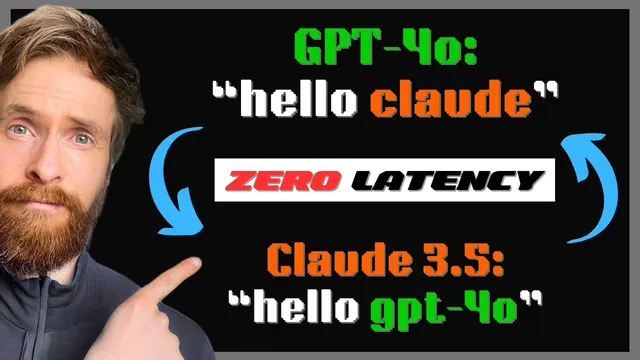
ZERO LATENCY Claude 3.5 + GPT-4o Voice Conversation | Python Threading
Based on All About AI's video on YouTube. If you like this content, support the original creators by watching, liking and subscribing to their content.
Near-zero perceived latency comes from overlapping model generation and text-to-speech playback using threading rather than waiting for each turn to finish sequentially.
Briefing
A practical way to make AI-to-AI voice conversations feel “zero latency” is to run two model calls in parallel and keep a tight audio handoff loop between them. Instead of waiting for one agent to finish generating text and then waiting again for speech playback, the setup starts the next agent’s response while the current agent’s audio is still playing. The result is a back-and-forth conversation where the next audio is ready right as the previous one ends—removing the dead air that usually makes voice chat feel laggy.
The core mechanism is threading: one thread handles the first model’s response (and its text-to-speech audio), while a second thread simultaneously sends that response text into a second model to generate the next reply. As soon as the first model’s audio begins playing, the second model is already working on its answer and producing its own audio stream. When the second audio finishes, the system immediately loops back—feeding the second model’s output as the next prompt to the first model—so the conversation continues without pauses. The approach explicitly uses the time spent generating and playing audio as compute time for the next turn, turning latency into overlap.
Implementation details focus on prompt control and context. The system keeps conversation continuity by passing historical dialogue into each model call, so each agent responds with context rather than starting fresh. It also uses system prompts to shape “characters” for each side of the discussion. In the demo, the topic is loaded from a text file (a “common topic” variable), then the system prompt is swapped to create a “Hardcore Democratic AI” versus “Hardcore Republican AI” contrast for an American politics scenario involving Kamala Harris and a potential VP pick. Voice selection matters too: the demo assigns different voices to Claude 3.5 and GPT-4o, and the creator notes that a faster-speaking voice can improve perceived responsiveness and engagement.
The transcript includes a sample exchange where the Democratic-leaning persona argues Harris should pick a moderate running mate to appeal to centrists and battleground states, while the Republican-leaning persona pushes back—claiming Harris is abandoning her base and arguing Trump should focus on Harris’s record rather than identity. The conversation continues with both sides trading campaign strategy and debate timing opinions, demonstrating that the threading loop can sustain multi-turn dialogue.
Cost is the main constraint. Text generation is described as effectively negligible cost, but voice output is expensive—citing a Creator plan at $22/month for limited audio and character volume, with the demo consuming roughly $20 worth of voice usage (about 83,000 characters). The builder suggests that cheaper voice pricing—or swapping in open-source models for speech—would be necessary before this kind of “smooth, website-ready” experience becomes broadly practical. There’s also optimism that if GPT-4o voice becomes available via API at reasonable cost, the system could reach another level.
Overall, the takeaway is less about a new model and more about orchestration: threading plus prompt/context management and streaming text-to-speech can make AI voice debates feel continuous, engaging, and interactive enough for real applications—if the voice cost hurdle is addressed.
Cornell Notes
The transcript describes a method for creating near “zero latency” voice conversations between two AI models by using threading and streaming audio. One model generates a response and its text-to-speech audio, while the other model is simultaneously prompted with that response to prepare the next turn. When the first audio finishes, the second audio is already ready, and the system loops by feeding each agent’s output into the other. Prompting provides continuity through conversation history and shapes personas via system prompts (e.g., “Hardcore Republican AI” vs “Hardcore Democratic AI”). The approach is compelling for user experience, but voice generation costs are high, making pricing the main barrier to scaling it into websites or apps.
How does threading eliminate the usual pause between spoken AI turns?
What role do conversation history and prompts play in keeping the dialogue coherent?
Why does voice choice affect the perceived quality of the conversation?
What was demonstrated in the politics example, and how did the personas differ?
What limits scaling this approach, and what solutions are suggested?
Review Questions
- In a threaded two-model voice loop, what exactly gets passed from one model to the other, and at what time relative to audio playback?
- How do system prompts and conversation history work together to produce a consistent debate persona across multiple turns?
- Why might the same threading logic still feel “slow” to users, even if latency is overlapped—and how does voice speed factor into that?
Key Points
- 1
Near-zero perceived latency comes from overlapping model generation and text-to-speech playback using threading rather than waiting for each turn to finish sequentially.
- 2
The system loops by feeding the second model’s output back into the first model while the second model’s audio is still playing.
- 3
Conversation history is included in each prompt to maintain continuity across turns, not just topic-level context.
- 4
System prompts can be swapped to create distinct debate personas (e.g., “Hardcore Democratic AI” vs “Hardcore Republican AI”) while keeping the topic constant via a shared topic file.
- 5
Different text-to-speech voices for each model affect engagement and perceived responsiveness, with faster voices generally improving flow.
- 6
Voice generation costs dominate overall expense; text generation is comparatively cheap, so pricing is the main barrier to deploying this widely.
- 7
Lower-cost voice options—open-source speech or cheaper API voice—are positioned as the next step for scaling the experience.